

We recognize the immense pressure facing project managers and structural engineers to maintain tight schedules while ensuring absolute safety. In the world of high-rise construction, bridge building, and industrial infrastructure, the integrity of a connection often rests on the performance of a single fastener. The ASTM A325 Tension Control (TC) bolt is a marvel of engineering, designed to provide consistent, verifiable tension with minimal human error. However, even the most sophisticated hardware is susceptible to installation failures if industry standards are disregarded.
At LRKD Industries, we specialize in supplying high-quality TC bolts that meet the most rigorous structural requirements. Through our experience in the New York construction market, we have identified recurring field errors that compromise structural integrity.
Here are the seven most common mistakes made with A325 TC bolts and the professional protocols required to correct them.
1. Skipping Pre-Installation Verification (PIV) Testing
The most critical error occurs before a single bolt is permanently installed in the steel. Many crews assume that because TC bolts are "pre-set" to shear at a specific tension, they do not require field testing. This is a violation of RCSC (Research Council on Structural Connections) specifications.
The Fix: We mandate that every lot of TC bolts must undergo Pre-Installation Verification (PIV) using a tension calibrator, such as a Skidmore-Wilhelm device. This test must be performed daily, or whenever the installation environment or tool changes. Verification ensures that the specific bolt, nut, and washer assembly: along with the electric shear wrench: is functioning correctly under current jobsite conditions.

2. Improper Lubrication Management
A325 TC bolts are manufactured with a specific lubricant that is essential for the "torque-to-tension" relationship. When these fasteners are left exposed to the elements or stored in open buckets, the lubricant can dry out, wash away, or become contaminated with grit. Without proper lubrication, the friction between the nut and the bolt increases, causing the spline to shear prematurely before the required tension is reached.
The Fix: Maintain fasteners in their original, sealed containers until the moment of installation. If fasteners become dry or dirty, they should not be lubricated in the field unless specifically authorized by the manufacturer, as this can lead to over-tensioning. At LRKD, we provide expertly packaged fasteners to ensure they arrive and remain in optimal condition.

3. Misidentifying Connection Types
Confusion between "Snug-Tight" and "Slip-Critical" connections often leads to incorrect installation procedures. For A325 bolts, a snug-tight condition is achieved when all plies in a joint are in firm contact. However, many projects require pretensioned or slip-critical connections where the TC bolt must be fully tensioned (spline sheared) to prevent any movement between the steel members.
The Fix: Review the contract drawings and detailing early in the project. Our in-house detailing and engineering services assist in identifying exactly where TC bolts are required and ensuring the correct grade and length are specified for the specific connection type. Never assume a connection only requires snug-tightness if it involves high-strength A325 fasteners in a structural capacity.
4. Incorrect Spline Interpretation
A common misconception is that a sheared spline is the only indicator of a successful installation. If a joint is not properly "snugged" in a systematic pattern before the final tensioning, the shearing of the spline may only be pulling the plates together rather than generating the required internal clamping force.
The Fix: Follow a two-step installation process. First, bring all bolts in the joint to a snug-tight condition starting from the most rigid part of the connection (the center) and moving outward. Only once the plates are in firm contact should the electric shear wrench be used for final tensioning. If the spline shears before the plates are tight, the bolt has not achieved its design tension.

5. Storage and Environmental Degradation
Fasteners stored in the mud or left on open decks in the Bronx or Long Island winters will inevitably fail. Moisture leads to oxidation, and cold temperatures can affect the performance of the lubricant. This degradation is not just aesthetic; it fundamentally changes the mechanical behavior of the fastener during installation.
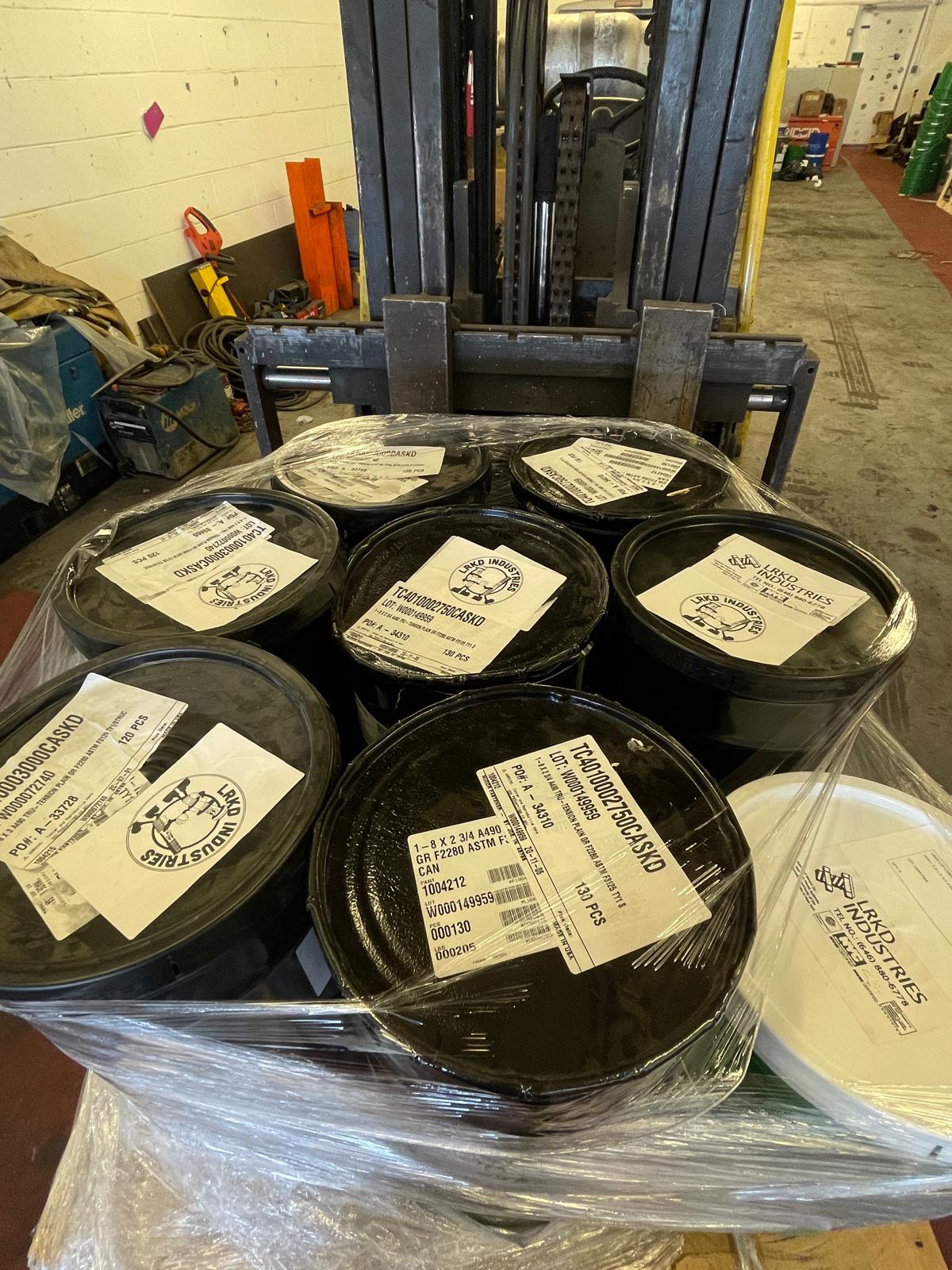
The Fix: Implement a centralized, climate-controlled storage solution on-site. We recommend staging only the amount of fasteners needed for a single day's work. Our bulk supply solutions come in heavy-duty, sealed buckets designed to withstand jobsite handling while keeping the components clean and dry.
6. Galvanizing Compatibility Issues
Mixing "plain" A325 bolts with galvanized nuts, or vice versa, is a recipe for disaster. Galvanized coatings add thickness to the threads, which requires nuts to be overtapped to accommodate the coating. Using a standard nut on a galvanized bolt: or a galvanized nut on a plain bolt: can lead to thread stripping or a total inability to reach tension.
The Fix: Always source TC bolts as matched assemblies. This means the bolt, nut, and washer are tested and shipped together from the same manufacturer. We provide mechanically galvanized options that are specifically engineered for compatibility, ensuring that the friction coefficients remain consistent across the entire lot.
7. The "Torque Equals Tension" Fallacy
Perhaps the most dangerous mistake is the belief that torque is a reliable substitute for tension. Torque is the measure of twisting force, while tension is the measure of clamping force. Factors such as thread condition, lubrication, and washer placement can cause a bolt to reach a high torque value without ever reaching the required tension.
The Fix: Use the TC bolt for exactly what it was designed for: calibrated tensioning. The spline is engineered to shear when the internal tension reaches the specified minimum, regardless of the torque applied. If you find yourself reaching for a torque wrench to "check" a TC bolt, you are likely using the wrong metric. For foundation work requiring specific grades like F1554 anchor bolts, ensure you are following the separate tensioning guidelines specific to those anchors.
Partnering for Structural Success
We believe that providing the world’s best fasteners is only half of the equation. The other half is ensuring our partners have the knowledge and support to install them correctly. As a proud Women-Minority Business Enterprise (WMBE), LRKD Industries is dedicated to breaking barriers in the construction industry through accuracy, dependability, and unwavering support.
Whether you are working on a high-rise in Manhattan or a bridge in Long Island, our team is ready to provide the technical expertise and high-quality steel supply your project demands. We recognize the complexities of modern structural engineering, and we aspire to be the collaborative partner that helps you build with confidence.
Author: MEDIA_LRKD