

We recognize that for structural engineers and contractors, the integrity of a high-rise building or a transcontinental bridge rests on the reliability of its smallest components. In 2026, the landscape of structural fastening has evolved with the introduction of the ASTM F3125-26a revision. This update brings critical changes to how we specify and utilize A490 bolts, particularly concerning hydrogen-induced cracking (HIC) resistance.
Structural integrity is not a variable; it is a baseline requirement. At LRKD Industries, we provide the high-strength fasteners that serve as the backbone of modern infrastructure. This guide details the technical specifications, compliance updates, and strategic applications of A490 bolts to ensure your next project meets the most rigorous standards of the current year.
Engineering Strength: The A490 Specification
The A490 bolt, now officially designated under the unified ASTM F3125 standard as Grade A490, represents the pinnacle of heavy-duty structural fastening. These are not general-purpose hardware; they are alloy steel fasteners engineered for heavy-load environments where standard bolts would fail.
Mechanical Properties of A490 Bolts
- Tensile Strength: 150 ksi minimum to 173 ksi maximum.
- Yield Strength: 130 ksi minimum.
- Material: Heat-treated alloy steel.
- Hardness: 33 to 39 HRC.
The narrow window of tensile strength (150–173 ksi) is a deliberate engineering choice. By capping the maximum strength at 173 ksi, the industry limits the risk of brittle fracture, a common failure mode in overly hardened steels. We understand that in massive industrial facilities and high-rise structures, ductility is as vital as raw strength. A490 bolts provide the necessary clamping force to secure friction-type connections while maintaining the predictable performance required for seismic and wind-load calculations.
ASTM F3125-26a: New Standards for HIC Resistance
The most significant shift in 2026 is the implementation of mandatory hydrogen-induced cracking (HIC) validation for Grade 150+ bolts. Under the ASTM F3125-26a update, A490 bolts specified for acidic or "sour" service environments must now undergo specific validation testing.
Understanding the 26a Update
We recognize that environmental stressors can lead to delayed fracture in high-strength steels. The 2026 revision explicitly references ISO 15156-2 as the technical basis for this validation. This testing is required before full-scale production for any project where the bolts will be exposed to defined hydrogen sulfide (H₂S) levels, specific pH ranges, or extreme temperatures.
This is not a suggestion; it is a compliance requirement for any new submittal in 2026. Generic hydrogen embrittlement data is no longer accepted for sour service applications. We ensure that every batch of A490 fasteners we supply for such specialized environments has undergone the necessary ISO-compliant testing to guarantee safety and longevity.
A490 vs. A325: A Strategic Comparison
Selecting the correct fastener is a matter of both engineering necessity and economic efficiency. While A490 bolts offer superior strength, they are not always the optimal choice for every connection.
Grade A325 (F3125 Grade A325)
These are the industry standard for most structural steel connections. With a tensile strength of 120 ksi, they are highly ductile and can be hot-dip galvanized. We recommend A325 bolts for the majority of building frames where the extra capacity of an A490 is not numerically required.
Grade A490 (F3125 Grade A490)
We specify A490 bolts when connection geometry is constrained or when load demands are exceptional. Using A490 bolts can often reduce the total number of fasteners required in a joint, which simplifies detailing and speeds up field erection. However, they require more stringent inspection, including mandatory magnetic particle testing (MT) to detect subsurface flaws: a requirement that does not apply to A325 bolts.
Tension Control (TC) Variants
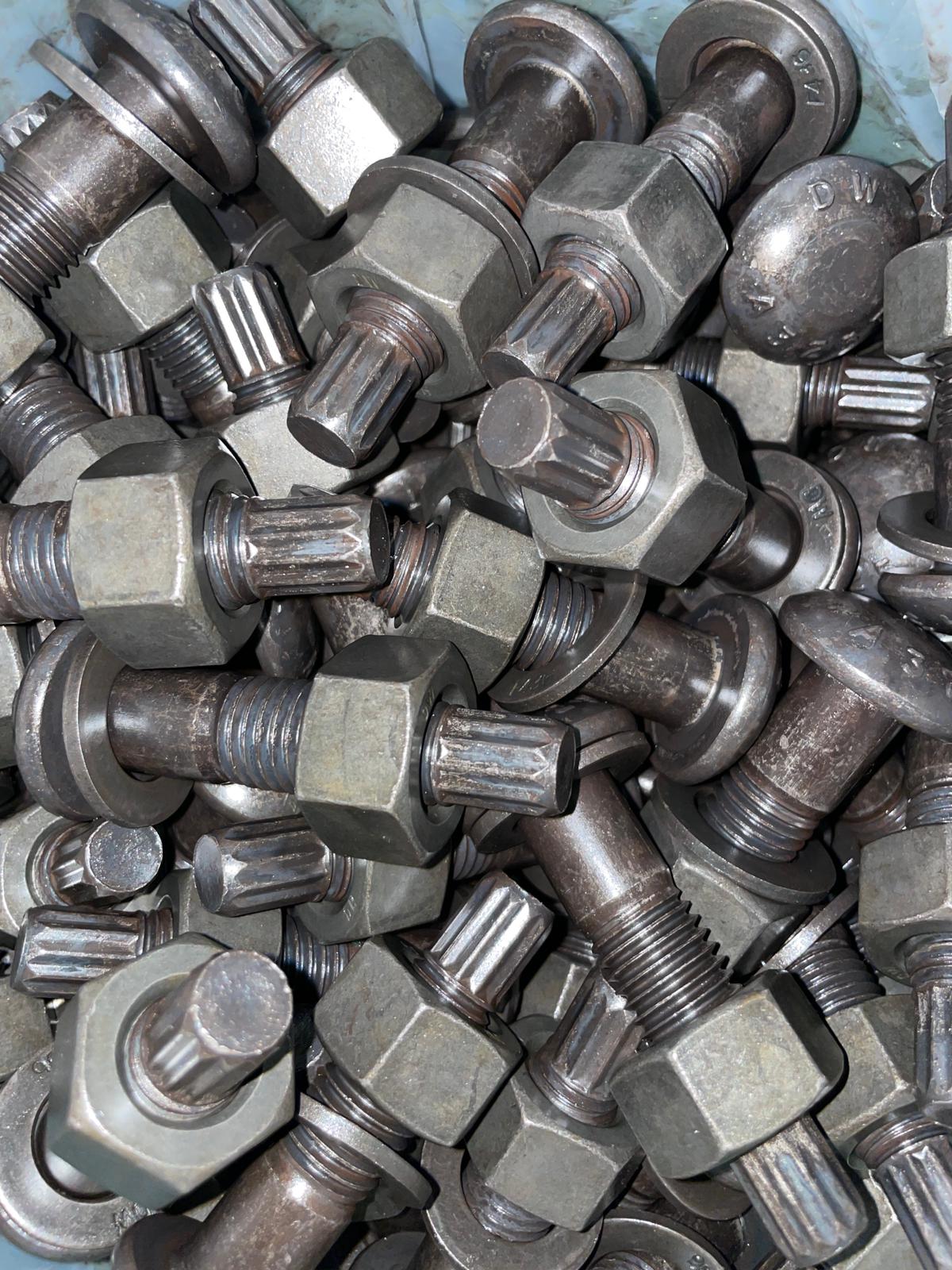
For projects requiring high-volume installation with guaranteed tension, we provide Tension Control (TC) bolts. The A490 equivalent in the TC world is known as F2280. These fasteners feature a spline that shears off when the correct tension is reached, eliminating the need for manual torque checks and ensuring uniform clamping across the entire structure.
Critical Coating and Protection Requirements
Corrosion protection for A490 bolts is a complex area of compliance. Due to their high hardness and strength, A490 bolts are exceptionally susceptible to hydrogen embrittlement. This susceptibility dictates very strict rules regarding surface treatments.
Prohibition of Galvanizing
We must state clearly: Grade A490 bolts cannot be hot-dip galvanized or electroplated. The acid pickling and molten zinc exposure involved in traditional galvanizing present a high risk of introducing hydrogen into the steel, leading to catastrophic failure under load.
Approved Zinc-Flake Systems
For projects requiring corrosion resistance, we offer A490 bolts with specialized zinc-flake coatings, such as those compliant with ASTM F1136 Grade 3 or ASTM F2833 Grade 1. These coatings provide excellent salt-spray resistance without the risks associated with galvanizing. They are the preferred solution for bridges and exposed industrial structures where A490 strength is essential.

Foundation and Anchor Bolt Clarification
While we focus here on structural steel-to-steel connections, it is vital to distinguish these from foundation anchors. We do not use ASTM A325 or A490 for anchor bolt applications. Instead, we utilize the ASTM F1554 specification for foundation cages, embed hardware, and heavy-duty anchors.
F1554 Grades 36, 55, and 105 are specifically engineered for embedment in concrete. When your project moves from the steel frame to the foundation, we transition to these appropriate grades to ensure the structural load path is maintained with the correct material properties for the application.
Precision Installation and Quality Control
Installation of A490 fasteners requires a disciplined approach. We advocate for the use of the "turn-of-nut" method or calibrated wrenches when using standard heavy hex bolts. For maximum efficiency, we recommend A490 TC bolts (F2280), which offer a visual confirmation of proper installation.
Traceability and Certification
We maintain rigorous records for every lot of fasteners we distribute. Every A490 bolt assembly from LRKD Industries comes with full Mill Test Reports (MTRs), ensuring that chemistry, heat treatment, and mechanical testing results are transparent and verifiable. In 2026, where liability and safety are paramount, this level of documentation is not an option: it is a requirement.
LRKD Industries: Your Partner in Structural Integrity
We firmly believe that a supplier should be more than a vendor; we are a collaborative partner in your project's success. Based in the New York area and serving contractors across the Bronx, Long Island, and beyond, LRKD Industries brings an insider's understanding of the challenges of urban and industrial construction.
Why Professionals Choose LRKD:
- WMBE Representation: We are proud members of the Women-Minority Business Enterprise community, helping our partners meet diversity goals while providing premium steel supplies.
- In-House Expertise: We provide detailing and engineering services to minimize errors before fabrication begins.
- Prompt Distribution: Our logistics are tailored to the fast-paced needs of high-rise and infrastructure projects.
- Unwavering Quality: Every bolt we supply meets the specific ASTM standards required for 2026 compliance.
Building for the future requires materials that are tested for the challenges of today. Whether you are erecting a new landmark in Manhattan or a critical bridge on Long Island, we provide the strength and accuracy your project demands.
Author: MEDIA_LRKD