

We recognize that in the fast-paced environment of structural steel erection, efficiency is not just a preference: it is a requirement. For contractors, engineers, and fabricators, the transition to Tension Control (TC) bolts has redefined how high-strength joints are secured. These "twist-off" fasteners eliminate the ambiguity of traditional torquing methods, replacing them with a mechanical guarantee of proper pretension.
At LRKD Industries, we specialize in providing the high-quality structural bolts necessary for the most demanding projects. Whether you are working on a high-rise in New York City or an industrial facility in Long Island, understanding the technical nuances of TC bolts is essential for maintaining safety, meeting RCSC specifications, and ensuring jobsite productivity.
THE ANATOMY OF A TENSION CONTROL BOLT
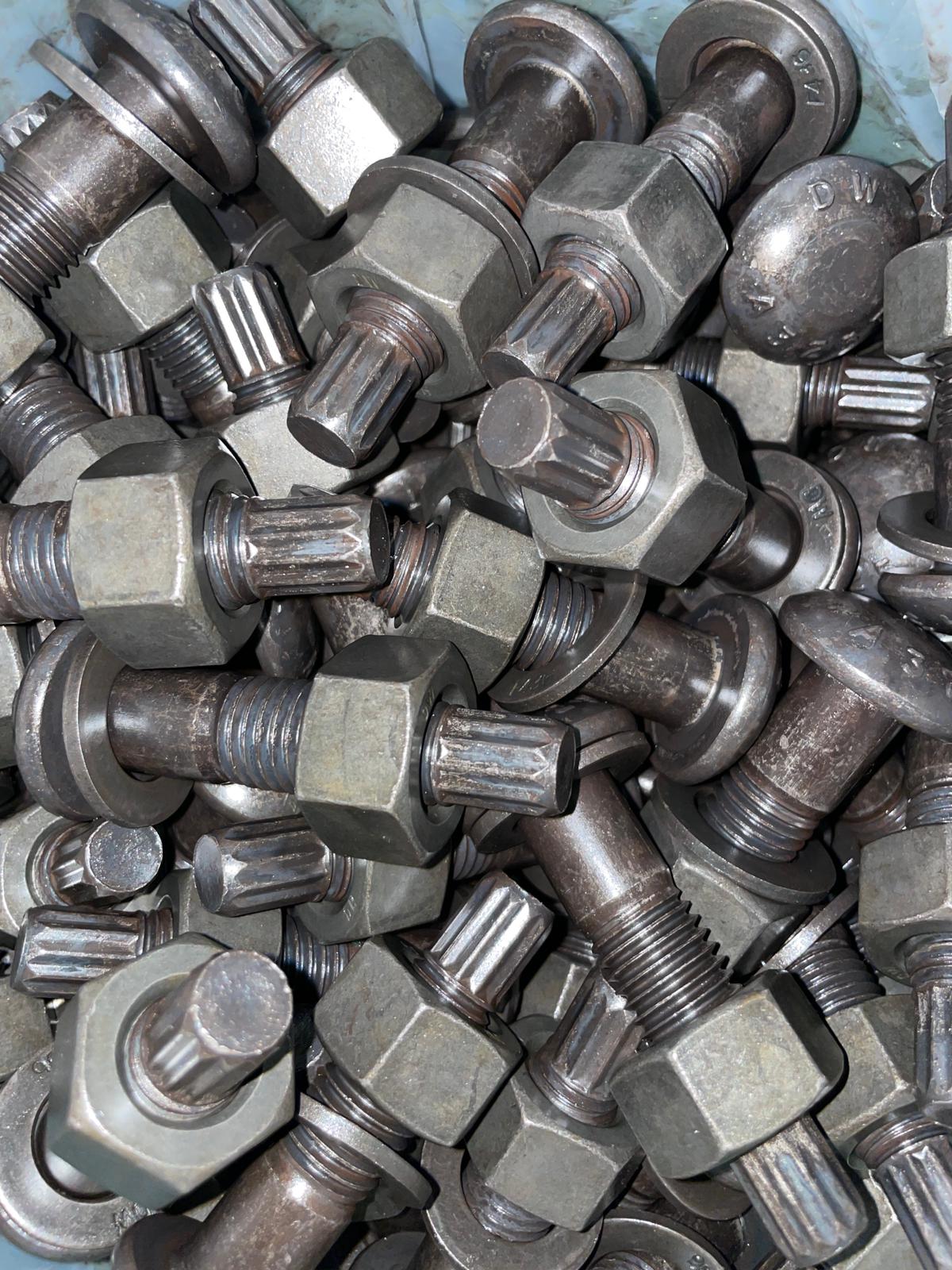
A tension control bolt is more than just a fastener; it is a precisely engineered assembly. Unlike a standard hex bolt, a TC bolt features a splined end that extends beyond the threaded portion. This spline is the critical component that dictates when the bolt has reached its required tension.
Each assembly consists of three primary parts:
- The Bolt: Typically featuring a round, dome-shaped head (though heavy hex heads are available for specific applications).
- The Nut: A heavy hex nut designed to withstand high-clamping forces.
- The Washer: An ASTM F436 hardened flat washer, which is essential for distributing the load and protecting the base metal.
We provide these components as pre-assembled sets. This ensures that the lubrication on the threads: a factor often overlooked but vital for accurate tensioning: is consistent across the entire lot.
UNDERSTANDING ASTM SPECIFICATIONS: F3125, A325, AND A490
The industry standards for high-strength structural bolts were recently consolidated under the ASTM F3125 umbrella. It is important to distinguish between the two primary grades used in TC assemblies:
ASTM F1852 (Formerly A325)
These are the most common TC bolts used in structural steelwork. They provide a minimum tensile strength of 120 ksi. We recommend F1852 bolts for general structural applications where standard high-strength requirements are met.
ASTM F2280 (Formerly A490)
For projects requiring higher load-bearing capacities, F2280 bolts are the standard. With a minimum tensile strength of 150 ksi, these bolts are used in heavy industrial joints and large-scale infrastructure.
It is critical to note that A490/F2280 bolts require more stringent handling. Because of their higher hardness, they are more susceptible to hydrogen embrittlement if not properly coated. We ensure all our high-strength fasteners meet these rigorous standards, providing the reliability your project demands.
Note on Anchor Bolts: While we discuss structural steel-to-steel connections here, it is important not to confuse TC bolts with foundation fasteners. For foundation cages and embed hardware, we supply ASTM F1554 anchor bolts in Grades 36, 55, and 105. TC bolts (A325/A490) are not intended for use as anchor bolts in concrete foundations.
THE CRITICAL SNUG-TIGHT PHASE
Before the final "twist-off" occurs, every joint must reach a "snug-tight" condition. The RCSC Specification defines snug-tight as the point where the plies of a joint are in firm contact.
We emphasize that final tensioning should never be attempted until the entire joint is snug. Failure to do so can lead to uneven loading and potential structural failure. During the snugging process, workers use a standard impact wrench or a spud wrench to bring the steel plates together.
It is a common mistake to allow the spline to twist off during the snugging phase. If a spline shears before the final tensioning sequence, the bolt must be replaced. We advocate for a systematic tightening pattern: starting from the most rigid part of the joint and moving outward: to ensure uniform contact across the connection.
JOBSITE INSTALLATION: THE SHEAR WRENCH METHOD
The primary advantage of the TC bolt system is the use of the electric shear wrench, often called a "TC Gun." This tool features a dual-socket design that simplifies the installation process into a few decisive steps.
THE INSTALLATION SEQUENCE
- Insertion: The bolt is placed through the hole with the washer located under the nut.
- Engagement: The inner socket of the shear wrench is placed over the bolt spline, while the outer socket engages the nut.
- Tensioning: When the trigger is pulled, the two sockets rotate in opposite directions. The outer socket turns the nut, while the inner socket holds the spline.
- Twist-Off: As the resistance increases, the torque eventually reaches the bolt’s calibrated break point. The spline shears off at the torque-control groove.
- Verification: The presence of a sheared spline serves as visual evidence that the bolt has reached its minimum required pretension.

PRE-INSTALLATION VERIFICATION AND CALIBRATION
Reliability in construction is built on verification. The RCSC requires pre-installation verification for all pretensioned joints. This means that before production bolting begins, a sample of bolts from each lot must be tested in a tension calibrator (such as a Skidmore-Wilhelm device).
We recommend testing at least three assemblies per lot, diameter, and length. Each assembly must achieve at least 1.05 times the specified minimum pretension. This process verifies that the bolts, the lubrication, and the tools are all functioning correctly. If a bolt fails to reach the required tension before the spline twists off, the lot is considered non-compliant.
BEST PRACTICES FOR FASTENER STORAGE AND HANDLING
The performance of a TC bolt is highly dependent on its lubrication. If bolts are left exposed to the elements, the lubrication can dry out or become contaminated with dirt and grit. This changes the friction between the nut and the threads, leading to inaccurate tensioning.
We advise the following jobsite practices:
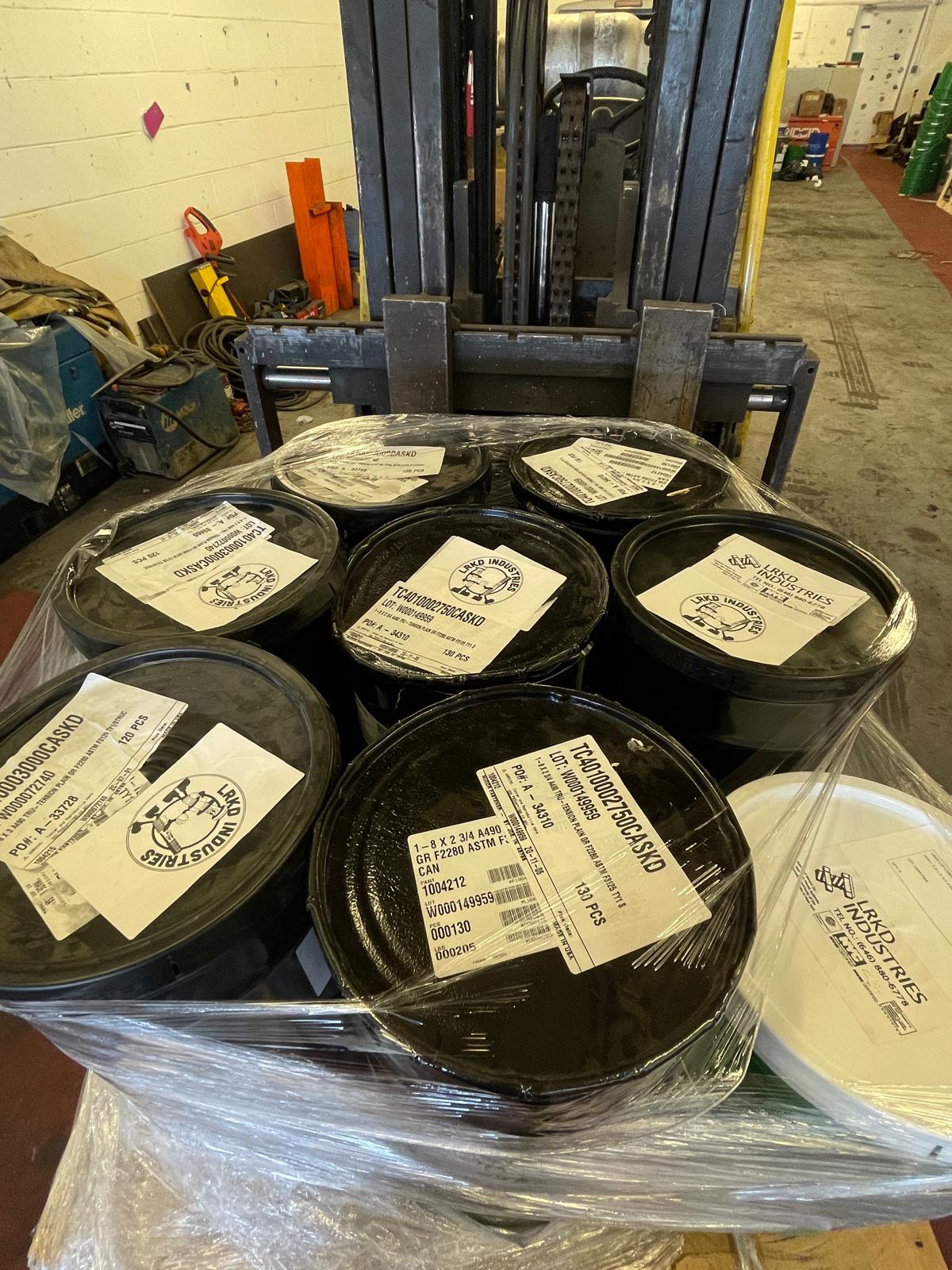
- Keep Bolts Sealed: Store fasteners in their original, sealed buckets until the moment of installation.
- Protect from Moisture: Store containers in a dry, covered area to prevent rust and lubrication degradation.
- Do Not Re-Lubricate: In the field, do not add oil or grease to TC bolts. If a lot has lost its lubrication, it should be returned to us for professional re-lubrication and re-testing.
- One-Time Use: Once a TC bolt has been fully tensioned and the spline has twisted off, it cannot be reused.
WHY PARTNER WITH LRKD INDUSTRIES?
Selecting a fastener supplier is a strategic decision that impacts the safety and timeline of your project. We position ourselves as a collaborative partner, providing the technical expertise and logistics support necessary for success in the New York construction market and beyond.
LRKD Industries is proud to be a certified Women-Minority Business Enterprise (WMBE). We understand the importance of diversity in the global community and are committed to breaking barriers in the steel industry. Our in-house detailing and engineering services allow us to build virtual projects before fabrication, minimizing errors and ensuring that every fastener we supply: from hex lag screws to A490 TC bolts: fits perfectly the first time.
We guarantee dependability, accuracy, and prompt service. When you source from us, you are not just buying steel; you are investing in a commitment to excellence that extends from our warehouse to your jobsite.
CONCLUSION: THE STANDARD FOR STRUCTURAL INTEGRITY
Tension control bolts represent the pinnacle of fastening technology for structural steel. By combining the bolt, nut, and washer into a calibrated assembly, the industry has simplified a complex engineering challenge. We remain steadfast in our advocacy for proper installation methods and high-quality materials.
By following the guidelines for ASTM specifications, ensuring a proper snug-tight condition, and maintaining rigorous storage standards, contractors can ensure that every connection is secure. We are here to support that mission with a comprehensive inventory of structural solutions tailored to your specific needs.
Author: MEDIA_LRKD