


Field rework represents one of the most significant cost overruns in foundation construction. When anchor bolt cages arrive on site with improper tolerances or assembly errors, contractors face delays, concrete pour cancellations, and expensive corrective measures that cascade through project schedules. The solution begins long before the cage reaches the jobsite: it starts with precision fabrication.
Understanding Anchor Bolt Cage Assemblies
Anchor bolt cages serve as the critical connection between concrete foundations and the structures they support. These prefabricated assemblies consist of anchor bolts secured between template plates, with precise spacing that must align with the base plates of columns, equipment, or other structural elements. The cage holds bolts in exact position during the concrete pour, eliminating the uncertainty of field-set installations.
We fabricate anchor bolt cages for applications ranging from bridge piers and building columns to offshore wind foundations and marine structures. Each application demands exacting tolerances, but the consequences of misalignment multiply exponentially in large-scale infrastructure projects where foundation work occurs early in the construction sequence.

The Critical Distinction: F1554 Anchor Bolts vs. Structural Bolts
A fundamental misunderstanding in foundation work involves confusing anchor bolt specifications with structural bolt specifications. ASTM F1554 governs anchor bolts: the threaded rods that embed in concrete to create connections between foundations and structural elements. This specification includes three grades: Grade 36 for standard applications, Grade 55 for moderate strength requirements, and Grade 105 for high-strength connections.
ASTM A325 and A490 bolts serve entirely different purposes. These structural bolts connect steel to steel in above-grade construction, functioning in bearing or friction-type connections between beams, columns, and plates. Using structural bolt specifications for foundation anchors represents a specification error that can compromise both performance and cost efficiency.
When we fabricate anchor bolt cages, we select F1554 material based on the design loads, environmental conditions, and project requirements. Marine applications often require Grade 55 with hot-dip galvanizing for corrosion resistance, while wind turbine foundations may specify Grade 105 to handle extreme tension loads during storm events.
Fabrication Tolerances That Prevent Field Rework
Precision begins with understanding the tolerance requirements specified in project drawings. Standard tolerance for anchor bolt spacing typically falls within ±1/8 inch, though critical applications may require tighter tolerances. This seemingly small dimension becomes crucial when base plates with pre-drilled holes must align with anchor bolts protruding from cured concrete.
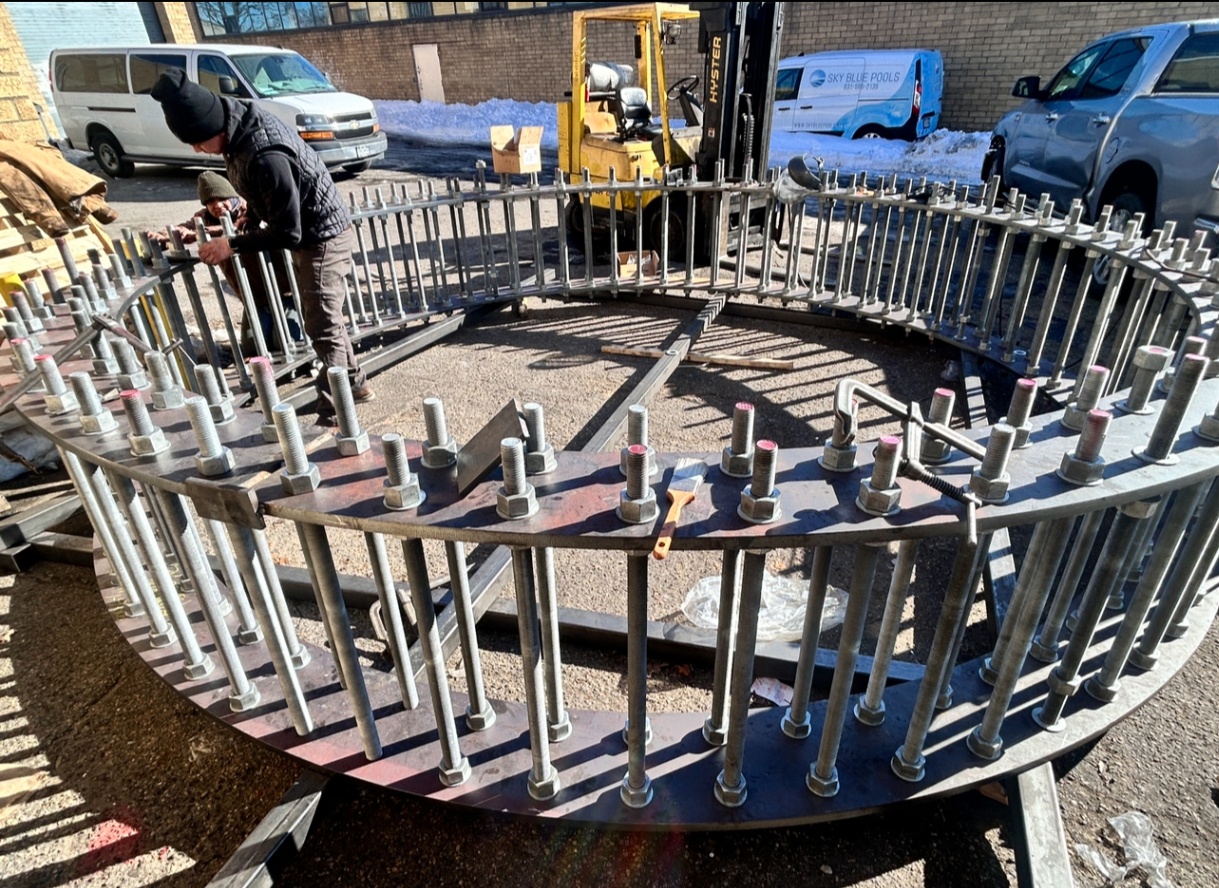
Template plate fabrication demands rigorous quality control. We verify hole locations using coordinate measuring equipment, ensuring each bolt position matches the shop drawings before assembly begins. The template plates themselves must maintain flatness within specified limits: warped plates introduce alignment errors that compound during installation.
Bolt verticality represents another critical dimension. Anchor bolts must project perpendicular to the foundation surface, which requires the template plates to remain level during the concrete pour. We incorporate leveling feet and adjustment mechanisms into cage designs, allowing field crews to achieve precise horizontality before concrete placement begins.
Assembly Sequencing for Installation Success
Proper assembly sequencing protects precision from the shop through jobsite installation. The process begins with positioning the lower template plate in the excavated foundation hole, centered and supported so it does not contact the bottom or sides. The cage rests on adjustable feet that allow for fine-tuning of horizontal alignment.
Verticality verification follows horizontal positioning. The most reliable method involves leveling the top template plate, which automatically ensures vertical bolt orientation if the cage was fabricated square. This check must occur before concrete placement and should be reverified as the concrete level rises.

Concrete containment requires careful attention to detail. PVC protective sleeves between the lower and upper template plates serve dual purposes: they prevent concrete intrusion around the anchor bolt threads and create a corrosion barrier that extends service life. The sleeves must be sealed at both ends to prevent concrete infiltration during the pour.
The cage should be suspended or supported with its top surface below the final concrete elevation. Complete concrete coverage protects the entire assembly from weathering and provides the design-specified embedment depth. Exposed cage components represent both a corrosion risk and a potential alignment compromise if the concrete surface requires chipping or grinding.
Marine Construction Applications
Marine structures impose severe demands on anchor bolt cage assemblies. Salt water exposure, tidal action, and wave loads create an aggressive environment where corrosion and fatigue failures threaten structural integrity. We address these challenges through material selection, protective coatings, and design details that enhance durability.
Hot-dip galvanizing provides proven corrosion protection for marine anchor bolts. The zinc coating sacrificially corrodes before the base metal, extending service life in salt water environments. For exceptional corrosion resistance, stainless steel anchor bolts offer superior performance despite higher material costs.
Foundation cages for marine structures often incorporate larger diameter bolts with extended embedment depths to resist uplift forces from storm surges and wave action. The template plates may include additional bracing and temporary support features to maintain alignment during installation in challenging offshore conditions.
Wind Turbine Foundation Requirements
Wind turbine foundations represent some of the most demanding applications for anchor bolt cage fabrication. A single turbine tower base may require forty to sixty anchor bolts arranged in a circular pattern, each positioned within tight tolerances to align with the tower's base flange.
The loads imposed by wind turbines create unique challenges. During operation, the rotating blades generate dynamic forces that cycle continuously, subjecting anchor bolts to fatigue loading. Storm events introduce extreme bending moments at the base, placing outer ring bolts in high tension while inner bolts may experience compression.
We fabricate wind turbine foundation cages using F1554 Grade 105 material for its superior strength and ductility. The circular template plates receive additional attention during hole layout, as angular position errors multiply across large diameter bolt circles. Computer-controlled drilling and water jet cutting ensure precision that manual methods cannot achieve.
How Precision Fabrication Eliminates Rework
The cost of field rework extends beyond the immediate correction expenses. Consider a scenario where anchor bolts misalign with a structural steel base plate by just 1/4 inch: within the nominal hole clearance but unacceptable for proper bolt tensioning. The contractor faces several expensive options: chipping concrete to relocate bolts, drilling new holes in the base plate, or fabricating a custom adapter plate.
Each solution delays the project schedule, consumes labor hours, and potentially weakens the connection. The concrete chipping option risks damaging the anchor bolt embedment. Drilling new base plate holes may compromise the structural capacity. Custom adapter plates add material costs and fabrication time.
Precision fabrication prevents these scenarios by delivering cage assemblies that meet specified tolerances without modification. Our fabrication process includes multiple verification steps: template plate inspection, bolt positioning checks during assembly, and final dimensional verification before shipment. This investment in quality control costs less than a single field rework incident.
The Path Forward
Avoiding costly field rework begins with recognizing that anchor bolt cage fabrication demands specialized expertise and quality control systems. The distinction between foundation anchors and structural connections, the selection of appropriate F1554 grades, and the maintenance of tight tolerances throughout fabrication and installation all contribute to successful outcomes.
For contractors working on marine structures, wind farms, bridges, or commercial construction, the decision to source precision-fabricated anchor bolt cages represents a strategic investment in schedule adherence and cost control. The foundation work establishes the accuracy for everything that follows: an investment in precision at this stage prevents compounding errors throughout the project.
We recognize that foundation contractors face intense schedule pressure and budget constraints. This is why we maintain fabrication capabilities that deliver anchor bolt cages on time and within specification, backed by documentation that provides traceability for critical infrastructure projects. Learn more about our capabilities and certifications or request a quote for your next project.
Author: MEDIA_LRKD