

In the world of heavy structural steel, the margin for error is non-existent. When engineers design skyscrapers, bridges, and industrial facilities, the integrity of the entire structure rests on the performance of the fasteners holding the steel members together. Among the various grades of structural fasteners, the ASTM A490 bolt stands out as the heavyweight champion of tensile strength and reliability.
At LRKD Industries, we recognize that selecting the right fastener is not just a procurement step; it is a critical engineering decision. Whether you are managing a massive infrastructure project or a specialized industrial build, understanding the nuances of A490 bolts ensures that your connections meet the most rigorous safety and performance standards. This guide provides a technical deep-dive into the specifications, applications, and installation requirements of A490 bolts.
What Defines an ASTM A490 Bolt?
ASTM A490 (now officially consolidated under the ASTM F3125 standard as Grade A490) specifies quenched and tempered alloy steel heavy hex structural bolts. These fasteners are designed specifically for use in structural connections where high tensile strength is the primary requirement.
While many general construction projects rely on the more common A325 bolt, the A490 is the go-to solution when the load requirements exceed the capabilities of standard carbon steel. A490 bolts are manufactured from high-quality alloy steel to achieve mechanical properties that far surpass general-purpose fasteners.
Type 1 vs. Type 3 A490 Bolts
The specification categorizes these bolts into two primary types based on their chemical composition and environmental resistance:
- Type 1: These are standard alloy steel bolts. They are the most common variety used in indoor or protected structural environments where extreme corrosion resistance is not the primary concern.
- Type 3: These are weathering steel bolts. They contain alloying elements like copper, chromium, and nickel, which allow the bolt to develop a protective oxide "patina" over time. Type 3 bolts are essential for projects using weathering steel (such as A588) to ensure the fasteners match the corrosion resistance and aesthetic of the surrounding structure.
Mechanical Properties: A Technical Deep-Dive
The defining characteristic of the A490 bolt is its immense strength. In the hierarchy of structural fasteners, A490 sits at the top, offering approximately 25% more strength than the A325 equivalent.
According to ASTM standards, A490 bolts must meet the following mechanical thresholds:
- Tensile Strength: 150,000 to 173,000 psi.
- Yield Strength: 130,000 psi minimum.
- Elongation: 14% minimum.
- Reduction of Area: 40% minimum.
The chemistry of these bolts is strictly controlled. Because they are heat-treated (quenched and tempered), they achieve a hardness level typically ranging from 33 to 39 Rockwell C. This high hardness is what provides the necessary strength, but it also introduces specific constraints regarding how these bolts can be coated and handled.

A490 vs. A325: Choosing the Right Grade
A common question we encounter at LRKD Industries is when to step up from an A325 to an A490. While A325 bolts are the workhorse of the industry with a tensile strength of 120,000 psi, they have limitations in high-load scenarios.
The primary advantage of the A490 is its ability to handle higher loads with fewer or smaller fasteners. This can lead to lighter connection plates and reduced drilling time, which may lower overall project costs despite the higher per-unit price of the bolt. However, A490 bolts are more sensitive to environmental factors and require more precise installation techniques.
It is important to note that A490 bolts are not simply "better" than A325; they are "stronger." In many bridge applications, engineers prefer A325 bolts because they are more ductile and less susceptible to certain types of environmental cracking. The choice must always be driven by the specific load calculations and environmental exposure of the project.
The Critical Issue of Galvanization
One of the most important technical distinctions of the A490 bolt is that it cannot be hot-dip galvanized.
In the fastener industry, hot-dip galvanizing is a standard method for preventing rust. However, because A490 bolts are made of high-strength alloy steel and tempered to high hardness levels, they are extremely susceptible to hydrogen embrittlement. During the acid pickling process that precedes galvanizing, hydrogen can be absorbed into the steel. In high-strength steels, this hydrogen can cause the bolt to fail suddenly and catastrophically under load.
If your project requires high-strength bolts with corrosion protection, you generally have three options:
- Use Type 3 weathering steel A490 bolts.
- Use A490 bolts with an approved mechanical galvanizing or specialized zinc-flake coating that does not risk hydrogen embrittlement.
- Re-evaluate the design to use galvanized A325 bolts if the load requirements allow.

Proper Installation and Hardware Requirements
Because A490 bolts are designed for high-tension applications, the hardware used with them must be equally robust. An A490 bolt should never be paired with a standard hex nut.
Heavy Hex Nuts and Washers
A490 bolts require ASTM A563 Grade DH or DH3 heavy hex nuts. These nuts have a larger profile and higher strength to ensure that the threads do not strip when the bolt is brought to its required tension. Additionally, hardened washers (ASTM F436) are typically required under the element being turned during installation to provide a consistent bearing surface and prevent damage to the structural steel.
Tensioning and Torque
A490 bolts are almost always installed as "pre-tensioned" or "slip-critical" connections. This means the bolt is tightened to a specific minimum tension: not just "snug tight." Because A490 bolts are stronger, they require significantly higher installation torque than A325 bolts.
Common methods for ensuring proper tension include:
- Turn-of-nut method: Rotating the nut a specific number of degrees past the snug-tight position.
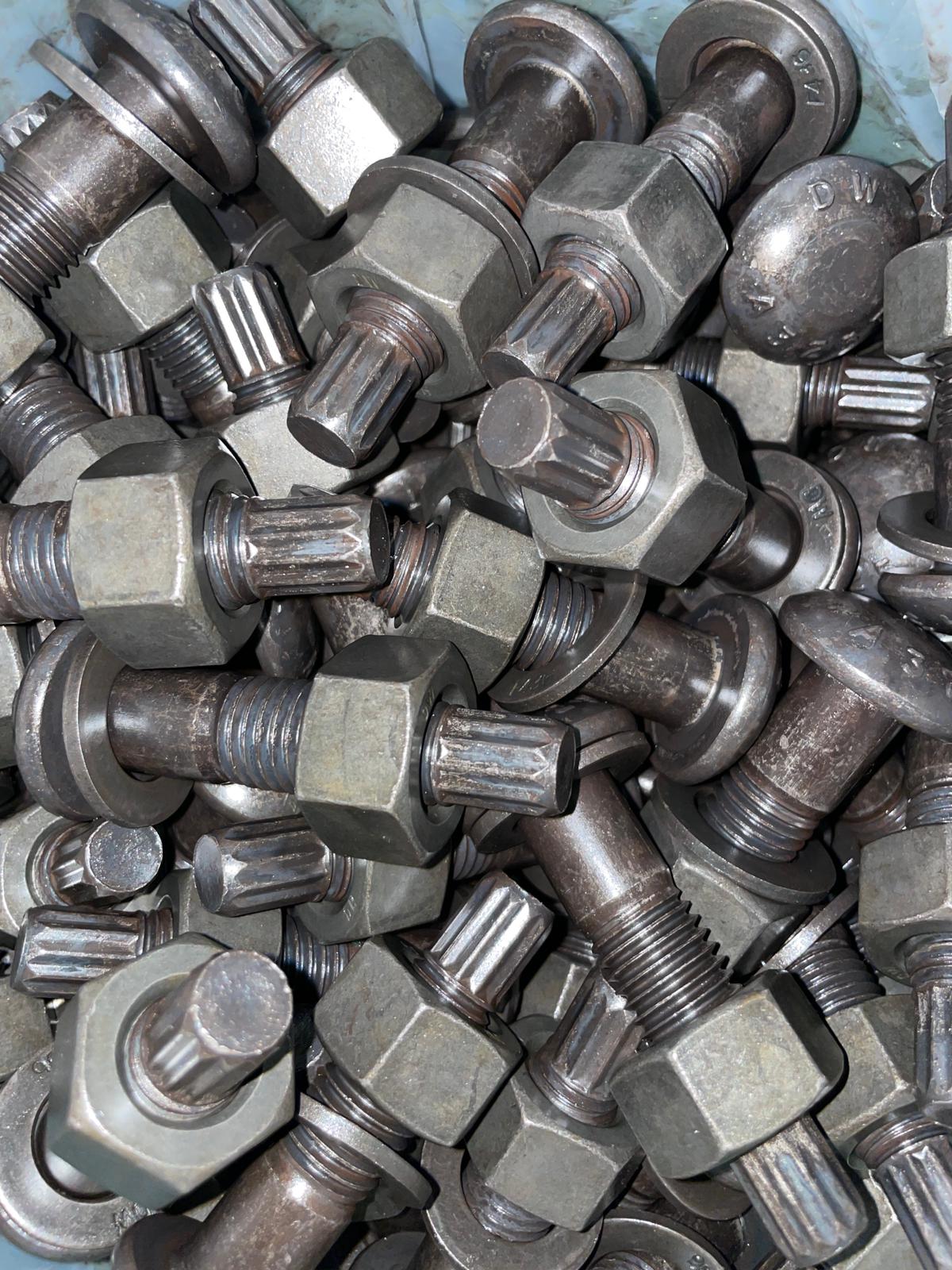
- Tension Control (TC) Bolts: Using specialized bolts with a splined end that shears off when the correct tension is reached.
- Direct Tension Indicators (DTIs): Using specialized washers with protrusions that flatten as the bolt is tightened.
Critical Applications for A490 Bolts
The superior strength of A490 bolts makes them indispensable in several high-stakes construction sectors. At LRKD Industries, we provide these fasteners for projects where structural failure is not an option.
High-Rise Building Construction
In modern skyscrapers, the gravity loads and lateral wind loads on the lower-tier columns are immense. A490 bolts allow for compact, high-strength connections in the core of the building, where space is at a premium and structural integrity is paramount.
Bridge and Highway Infrastructure
While many bridges use A325 bolts for their ductility, large-scale suspension bridges and heavy truss bridges often utilize A490 bolts in primary tension members. These projects require strict compliance with Department of Transportation (DOT) standards and rigorous material traceability.
Wind Energy
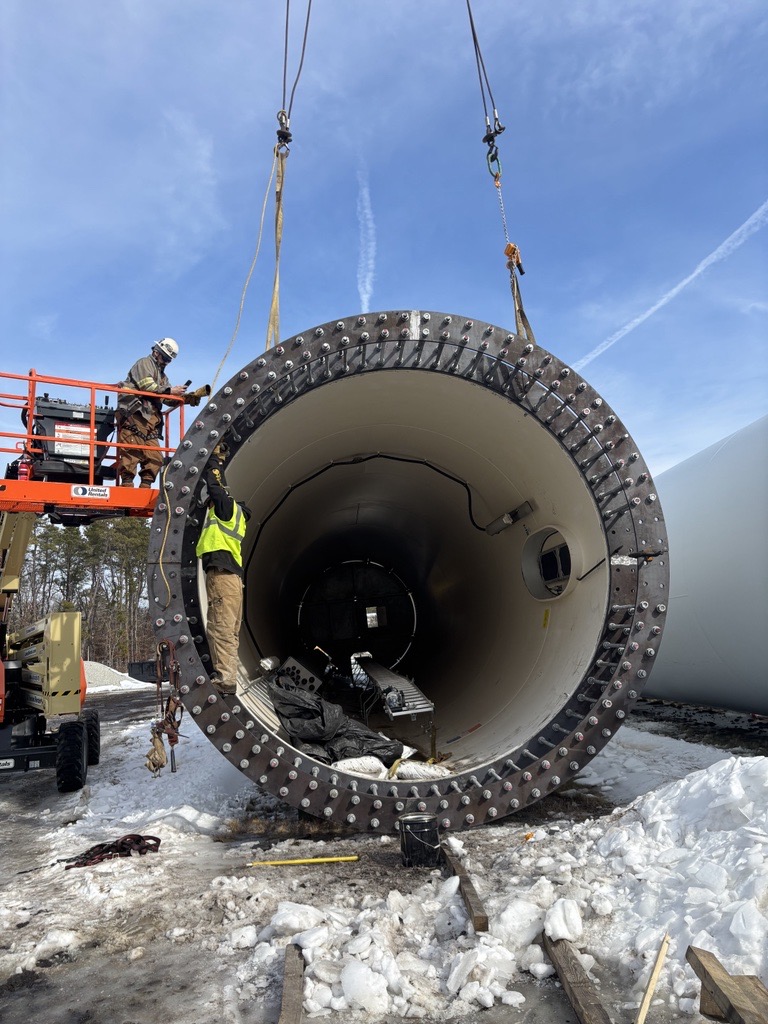
The assembly of wind turbine towers involves massive steel flanges that must withstand constant vibration and high-torque loads. A490 bolts (and their metric equivalent, PC 10.9) are frequently used to ensure the tower sections remain securely fastened throughout the turbine's operational life.
Reliability and Compliance with LRKD Industries
Sourcing A490 bolts requires more than just finding a supplier; it requires finding a partner that understands the technical stakes. At LRKD Industries, we emphasize reliability and industry standards compliance in every order.
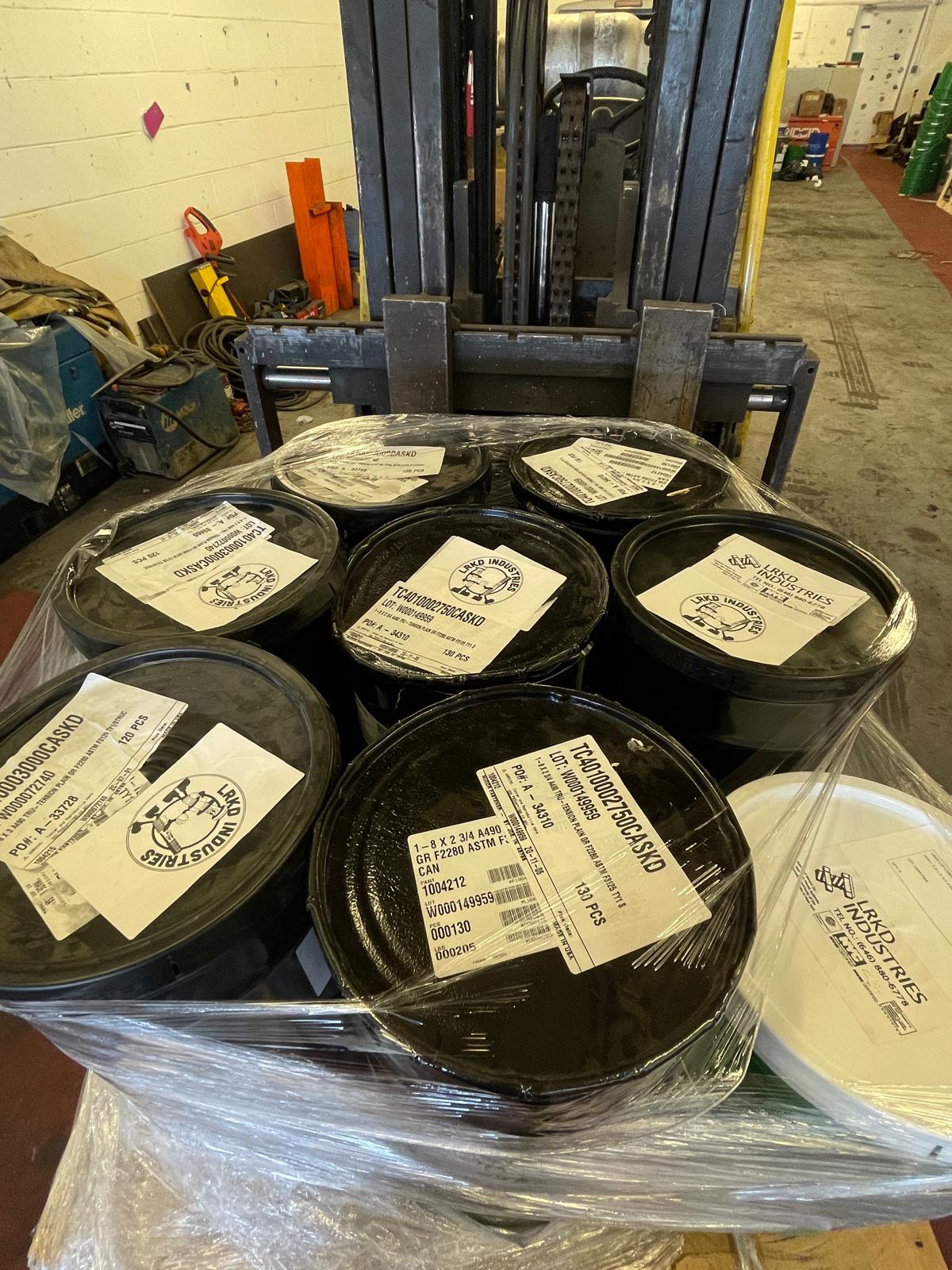
We provide comprehensive documentation, including Mill Test Reports (MTRs), to verify that every bolt meets the chemical and mechanical requirements of the ASTM F3125 Grade A490 specification. Our commitment to quality ensures that your project remains on schedule and, more importantly, remains safe.
We maintain a robust inventory of structural fasteners, including structural bolts and specialized heavy hex nuts. For projects requiring precision foundations, we also offer custom anchor bolt fabrication to ASTM F1554 standards, ensuring that your structure is secure from the base to the highest beam.
Final Thoughts on High-Strength Success
The ASTM A490 bolt is a pinnacle of fastener engineering. Its high tensile strength allows for the creation of some of the world's most impressive structures, but its use requires a deep understanding of material science and installation precision. By choosing the correct type, adhering to coating restrictions, and ensuring proper tensioning, you can guarantee the longevity and safety of your high-strength projects.
If you are currently planning a structural project and need expert guidance on fastener selection or a request for quote, our team is ready to assist. We pride ourselves on being a centralized resource for the construction industry, offering everything from technical expertise to streamlined delivery.
To learn more about our capabilities and commitment to excellence, visit our About Us page or explore our full Product Catalog.
Author: MEDIA_LRKD