

In the landscape of modern structural engineering, the integrity of a connection often rests on the precision of a single fastener. For contractors and engineers working on high-rise buildings, bridges, and industrial facilities, the Tension Control (TC) bolt has emerged as the industry standard for high-strength steel fastening. These assemblies, often referred to as twist-off bolts, are engineered to provide a built-in tension indicator, ensuring that the required preload is achieved without the need for manual torque measurements.
At LRKD Industries, we recognize that the success of a structural project is not just about the quality of the steel but the reliability of the system used to hold it together. We understand the pressures of the New York construction market, from the Bronx to Long Island, where efficiency and accuracy are paramount. This guide outlines our proven framework for managing TC bolts through three critical phases: Selection, Installation, and Inspection. By following this structured approach, your team can ensure compliance with RCSC and AISC standards while maintaining a streamlined workflow on-site.
SELECTION: MATCHING SPECIFICATIONS TO PROJECT NEEDS
The framework begins long before the first bolt reaches the job site. Selecting the appropriate TC bolt assembly is a matter of aligning design requirements with the mechanical properties of the fastener. Most structural projects specify TC bolts under ASTM F1852 (equivalent to A325) or ASTM F2280 (equivalent to A490). The choice between these grades depends on the required tensile strength and the environmental conditions of the project.
We recommend a meticulous review of the contract documents and structural drawings during the procurement phase. Our in-house detailing and engineering services can assist in verifying that the bolt diameters and grades match the design assumptions. Common structural diameters range from 5/8" to 1-1/8", and the length must be carefully calculated. A standard rule of thumb is to ensure the bolt length covers the total grip: the combined thickness of the plates and washers: plus an allowance for the nut engagement and the splined end.
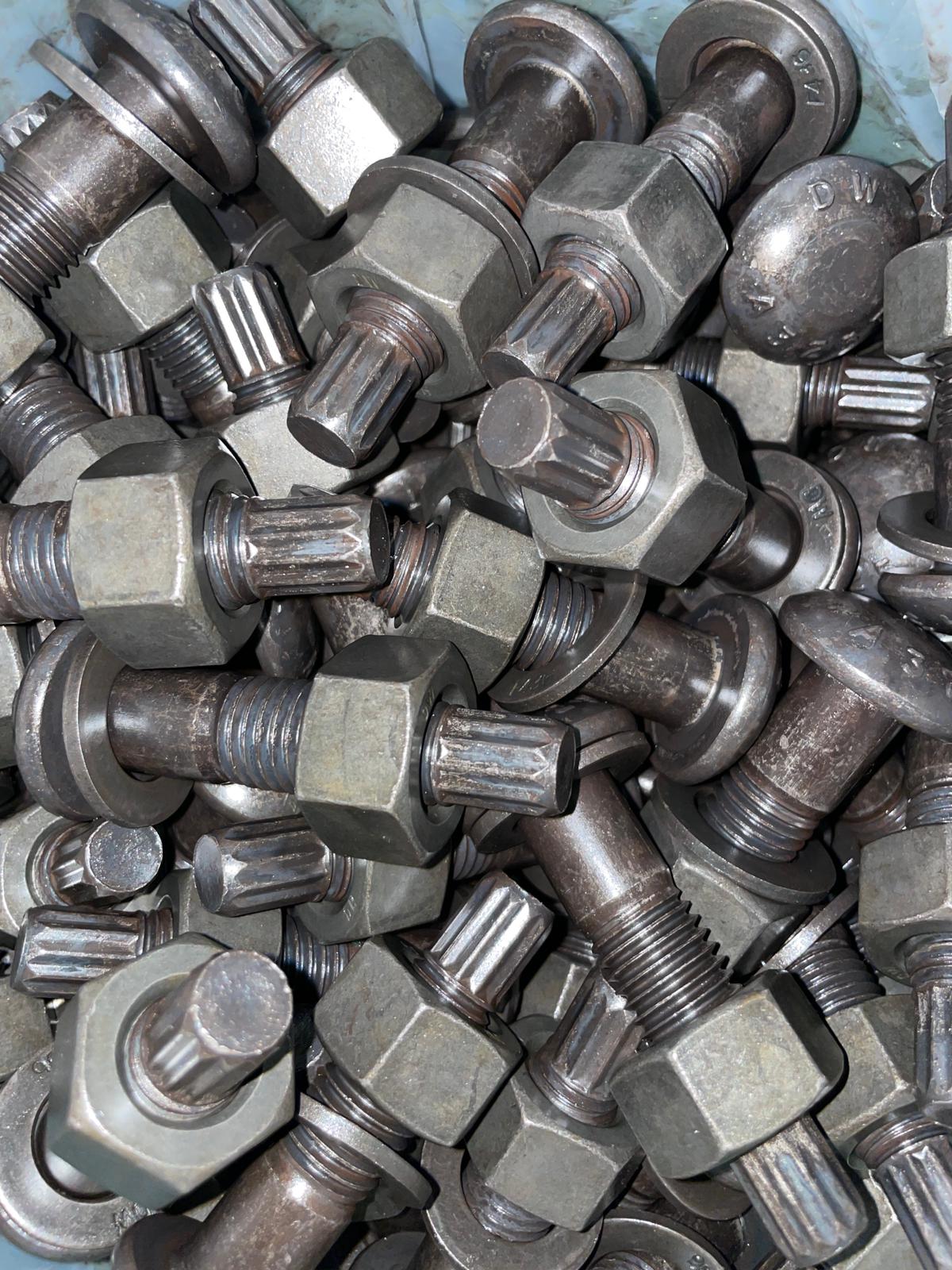
Logistics also play a vital role in selection. TC bolts must be ordered and maintained as matched assemblies: the bolt, the heavy hex nut, and the hardened washer are calibrated to work together as a single unit. We provide these components in sealed containers to ensure they remain lubricated and free from contamination. Mixing components from different lots or manufacturers can lead to inconsistent tension results and potential structural failure.
VERIFICATION: THE PRE-INSTALLATION STANDARD
Before production begins, the installation method must be verified. Pre-Installation Verification (PIV) is a mandatory step in our framework. This process uses a bolt tension calibrator, such as a Skidmore-Wilhelm, to confirm that the tools and the specific bolt lots can achieve the minimum required pretension.
We believe that onsite verification is the only way to account for the unique environmental conditions of a project. During PIV, at least three sample assemblies from each lot are tested. The goal is to achieve a tension that is at least 105% of the minimum required pretension specified by AISC. This step validates not only the fasteners but also the performance of the electric shear wrenches being used by the crew.

INSTALLATION: THE PRECISION SHEAR WRENCH PROCESS
The installation phase is where the "tension control" aspect of the fastener truly shines. Unlike traditional hex bolts that require a calibrated torque wrench, TC bolts are installed using a specialized electric shear wrench. This tool features two coaxial sockets: an inner socket that engages the splined end of the bolt and an outer socket that rotates the nut.
The process involves two distinct stages:
- The Snug-Tight Condition: Every bolt in the connection must first be brought to a snug-tight condition. This ensures that the steel plates are in firm contact before final pretensioning begins. We recommend starting from the most rigid part of the joint and working toward the free edges to ensure a uniform fit.
- Pretensioning: Once the joint is snug, the shear wrench is applied. As the nut is tightened, the tool creates a counter-force on the spline. When the calibrated tension is reached, the spline shears off, providing a clear visual indication that the bolt is properly tensioned.
We advocate for a systematic approach to wrenching. Operators should wait for the wrench to come to a complete stop before moving to the next fastener, ensuring that the tool’s motor and gears are not subjected to unnecessary wear.
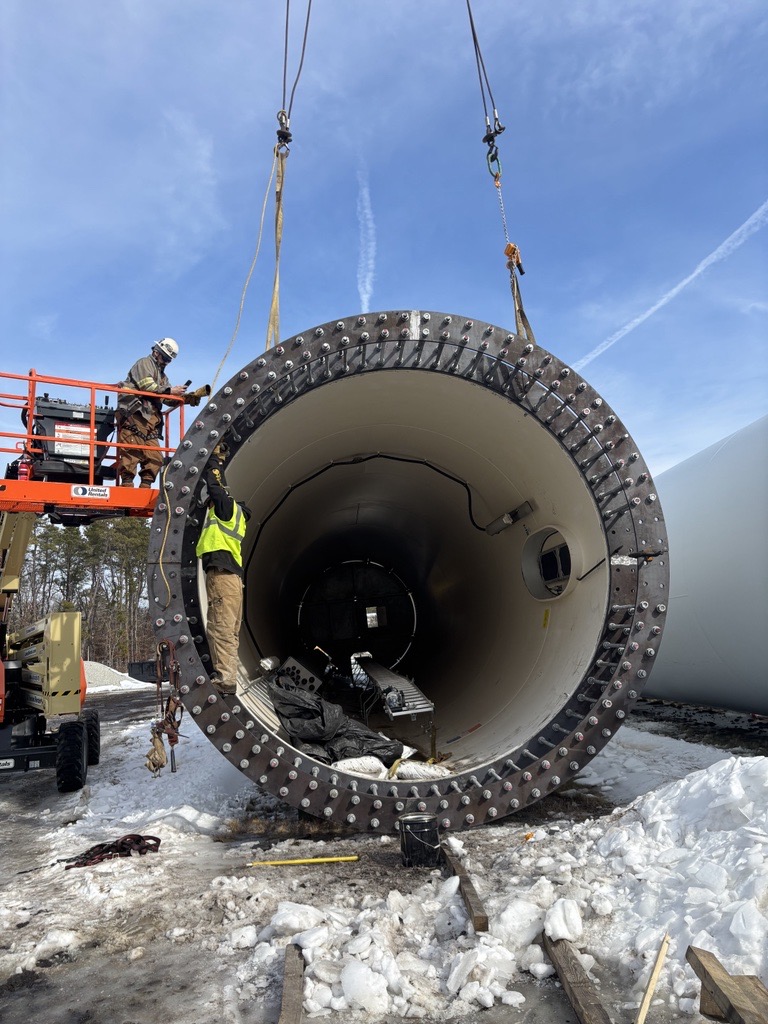
INSPECTION: VISUAL CONFIRMATION OF STRUCTURAL INTEGRITY
The final phase of the framework is inspection. One of the primary advantages of TC bolts is that they simplify the quality assurance process. Because the spline is engineered to shear off only when the required tension is met, the primary inspection method is visual.
An inspector's checklist should include:
- Spline Removal: Confirm that the splined end has been completely removed from every bolt in the connection. A remaining spline indicates an under-tensioned bolt.
- Nut Markings: Ensure that the identification markings on the heavy hex nuts are facing outward. This allows for verification of the bolt grade and manufacturer after the installation is complete.
- Washer Orientation: Verify that the hardened washers are present and oriented correctly, typically with the chamfered side facing the bolt head or nut as specified.
- Joint Contact: Check that the joint surfaces are in firm, continuous contact with no visible gaps.

While visual inspection is the standard, we also recognize the value of supplemental documentation. Keeping records of the PIV results and the specific bolt lots used in each section of the structure provides a layer of traceability that is essential for modern infrastructure projects.
THE LRKD ADVANTAGE: QUALITY, DIVERSITY, AND RELIABILITY
At LRKD Industries, we are more than just a supplier; we are a dedicated partner in your construction success. We take pride in our status as a Women-Minority Business Enterprise (WMBE), representing the diversity and strength of the global business community. Our commitment to quality is unwavering, from the precision of our TC bolts to our professional in-house detailing services.
We believe that by providing high-quality, affordable, and reliable fasteners, we empower our customers to build safer and more durable structures. Whether you are sourcing materials for a bridge in Long Island or a commercial development in the Bronx, our team is ready to provide the prompt service and technical support you require. For more information on our full range of products, including wedge anchors and custom steel solutions, we invite you to request a quote today.
By adhering to the Proven TC Bolt Framework: Select, Verify, Install, and Inspect: you ensure that your project meets the highest standards of safety and excellence. We are honored to support the professionals who shape our skylines and infrastructure.
Author: MEDIA_LRKD