

The renewable energy sector demands fasteners engineered to withstand extraordinary forces. Wind turbine foundations present unique challenges that require heavy-duty anchor systems capable of securing structures that reach hundreds of feet into the sky while enduring constant cyclical loading, environmental exposure, and the sheer mass of modern turbine assemblies.
We recognize that as turbines scale larger to capture more energy, every component in the foundation system must scale proportionally. The anchor bolts connecting turbine towers to concrete foundations serve as the critical interface between these massive structures and the earth itself. When these fasteners fail, the consequences extend far beyond repair costs: they threaten project timelines, safety records, and long-term operational integrity.
The Foundation Challenge at Scale
Modern wind turbines represent a significant engineering achievement. A single turbine tower can weigh several hundred tons before accounting for the nacelle, rotor assembly, and blades. The foundation system must resist not only this static load but also dynamic forces from wind, rotor rotation, braking events, and environmental conditions ranging from arctic cold to desert heat.
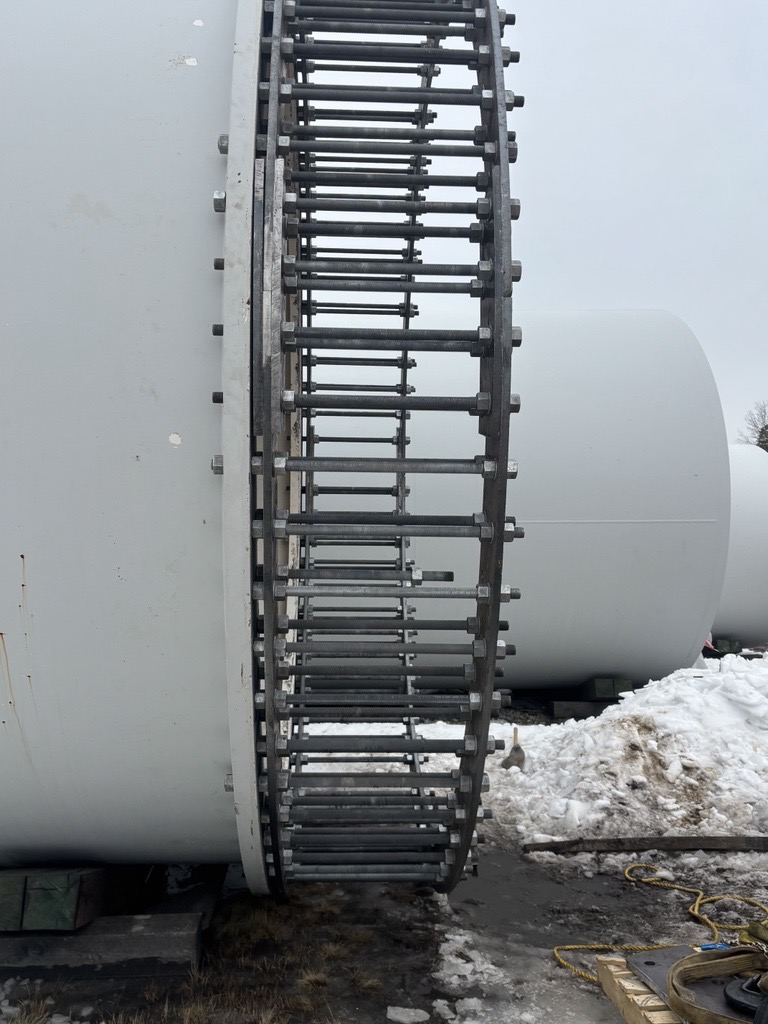
The anchor bolt assembly forms the structural connection point where all these forces transfer from steel tower to reinforced concrete foundation. This connection demands precision fabrication, material specification, and installation accuracy that leaves no margin for approximation. We approach windmill foundation projects with the understanding that proper anchor bolt specification and cage fabrication directly determine foundation performance over the turbine's 20-30 year operational life.
ASTM F1554 Anchor Bolts: The Standard for Wind Applications
Wind turbine foundations require anchor bolts manufactured to ASTM F1554 specification, which defines anchor bolts intended for anchoring structural supports to concrete foundations. Unlike structural bolts used for steel-to-steel connections, F1554 anchor bolts are specifically engineered for embedment in concrete and must meet distinct mechanical and chemical requirements.
F1554 anchor bolts are available in three grades, each offering different strength characteristics:
Grade 36 provides a minimum yield strength of 36,000 psi and minimum tensile strength of 58,000 psi. This grade offers excellent weldability and ductility, making it suitable for smaller turbine installations or applications where bolt replacement might be necessary during the structure's service life.
Grade 55 increases performance with a minimum yield strength of 55,000 psi and minimum tensile strength of 75,000 psi. This grade represents the most commonly specified material for mid-size wind turbine foundations, balancing strength requirements with cost considerations and material availability.
Grade 105 delivers high-strength performance with a minimum yield strength of 105,000 psi and minimum tensile strength of 125,000 psi. Large-scale turbine installations increasingly require Grade 105 material to manage the substantial loads generated by multi-megawatt turbines. This grade provides the load-bearing capacity needed without requiring impractical increases in bolt diameter that would complicate foundation design and cage fabrication.

The selection between these grades depends on turbine size, foundation design, soil conditions, and project-specific load calculations. We work with structural engineers to verify that bolt specifications align with the complete foundation system, ensuring that material grade, bolt diameter, thread length, and embedment depth all coordinate to achieve design performance.
Anchor Bolt Sizes Chart Considerations
Understanding anchor bolt sizes chart parameters becomes essential when scaling fasteners for wind infrastructure. The relationship between bolt diameter, embedment depth, material grade, and load capacity requires careful engineering to optimize foundation performance while maintaining constructability.
Wind turbine anchor bolts typically range from 2 inches to 4 inches in diameter, with lengths often exceeding 10 feet depending on foundation depth and required embedment. Larger diameter bolts provide increased load capacity but also increase the complexity of cage fabrication, shipping logistics, and field installation procedures.
We fabricate anchor bolt cages that maintain bolt position throughout the concrete pour, ensuring that each fastener remains within specified tolerances. This precision matters because even small deviations in bolt circle diameter or individual bolt location can prevent proper tower flange mating during erection. The consequences of out-of-tolerance anchor bolts include expensive remediation work, project delays, and in severe cases, foundation rejection.
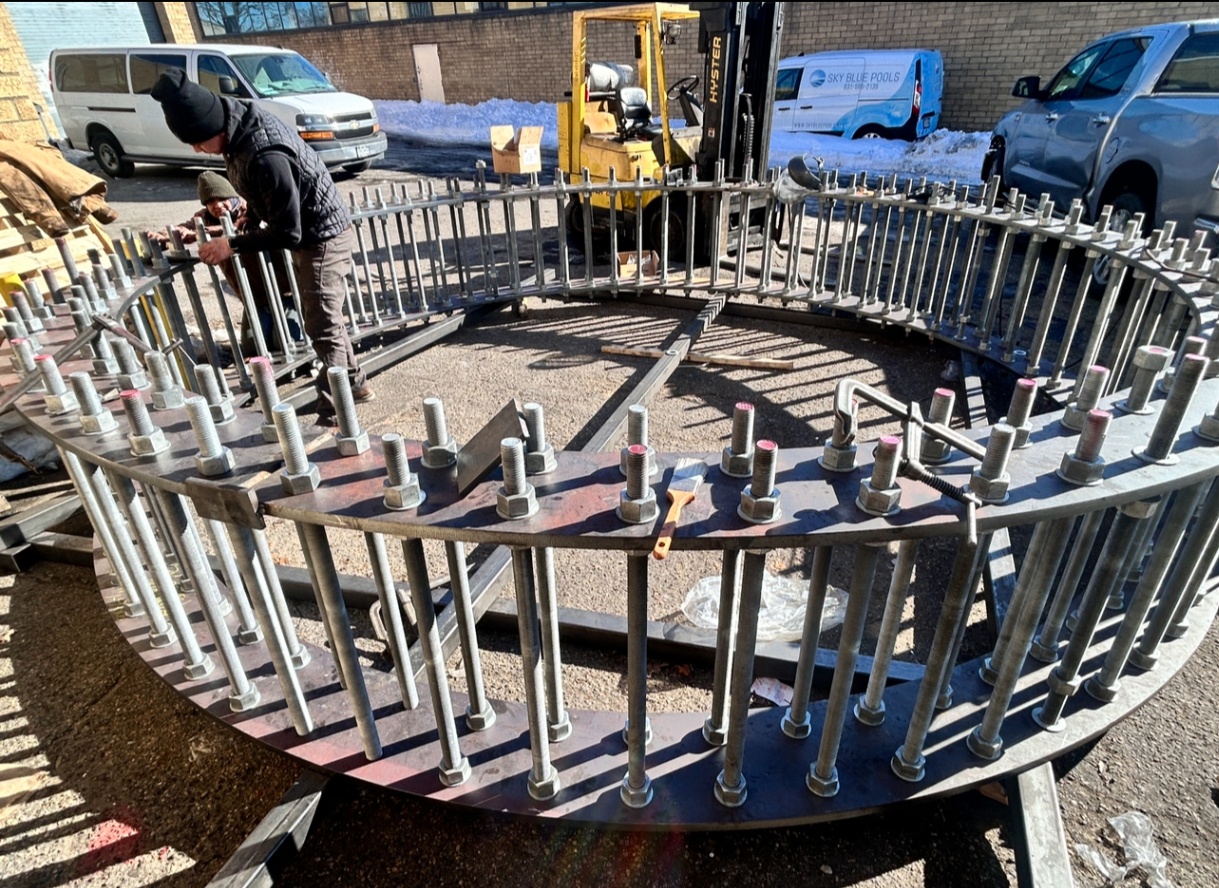
Our cage fabrication process begins with detailed shop drawings that incorporate project-specific dimensions, bolt quantities, spacing requirements, and template material specifications. We verify all measurements against structural drawings before fabrication begins, recognizing that precision at this stage prevents costly field corrections later.
Corrosion Protection for Long-Term Durability
Wind turbines operate in diverse environments, from coastal installations exposed to salt spray to inland locations experiencing temperature extremes and seasonal weather variations. The anchor bolt system must resist corrosion throughout the structure's operational life, which requires protective coatings appropriate to the exposure conditions.
Hot-dip galvanizing provides robust corrosion protection for F1554 anchor bolts, creating a metallurgically bonded zinc coating that sacrificially protects the base steel. We recommend galvanizing for most wind applications, particularly those in marine environments or locations with high humidity and temperature cycling.
Galvanizing the complete anchor bolt cage assembly: bolts, template plates, stiffeners, and all welded components: as a single unit ensures uniform coating coverage and eliminates vulnerable points where corrosion might initiate. This approach requires careful coordination between fabrication and galvanizing schedules but delivers superior long-term performance compared to field-applied coatings or individually galvanized components assembled on site.
Some projects specify additional protective measures beyond galvanizing, including epoxy coatings, greases, or specialized thread protectors. We accommodate these requirements while ensuring that protective systems remain compatible with installation procedures, particularly the hydraulic tensioning process used to achieve proper bolt preload.
Prefabricated Cage Systems: Precision and Efficiency
Prefabricated anchor bolt cages represent the industry standard for wind turbine foundations because they solve multiple challenges simultaneously. These cage assemblies hold bolts in precise position during concrete placement, eliminate field measurement errors, reduce installation time, and provide verifiable quality control documentation.
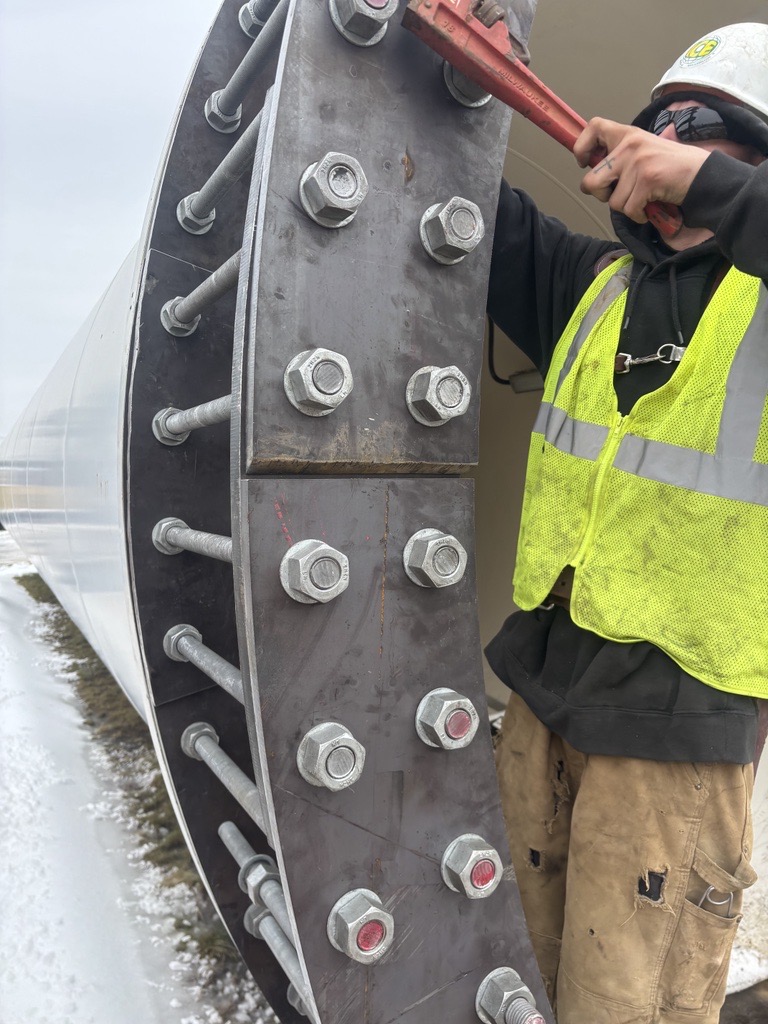
Our cage fabrication capabilities accommodate projects ranging from single-turbine installations to large wind farms requiring dozens of identical assemblies. We maintain strict tolerance control throughout the fabrication process, typically holding bolt circle diameter and individual bolt position to within ±1/8 inch of specified dimensions. This precision ensures that tower flanges will align properly during erection without requiring field modifications or bolt hole reaming.
The cage design must also address concrete pour logistics. Template plates require adequate openings to allow concrete flow around and beneath the bolt pattern, while stiffeners and bracing maintain dimensional stability under the hydrostatic pressure of fresh concrete. We engineer cage structures that balance these competing requirements, creating assemblies robust enough to maintain accuracy while allowing proper concrete consolidation.
Installation Considerations and Quality Assurance
Proper installation of heavy-duty anchor bolts requires attention to multiple factors beyond simply embedding fasteners in concrete. The complete process includes foundation excavation verification, cage placement and leveling, concrete placement procedures, consolidation around bolts, curing protocols, and final as-built surveys.
We provide detailed installation instructions with each cage assembly, specifying recommended placement procedures, concrete mix requirements, consolidation methods, and quality checkpoints. These instructions help ensure that the precision built into our fabricated cages translates to accurate as-installed conditions.
Hydraulic tensioning of F1554 anchor bolts during tower erection represents the final critical step in the anchor system. This process applies controlled preload to each bolt, compressing the tower flange against the foundation and creating the friction connection that ultimately resists lateral loads. The tensioning sequence, target load values, and verification procedures all require careful planning to achieve proper installation without damaging threads or exceeding bolt capacity.
Partnering for Renewable Energy Infrastructure
Wind energy projects move quickly once site permits are secured, and material delivery schedules often drive the overall project timeline. We recognize that our anchor bolt cage fabrication sits on the critical path for foundation construction, which means delivery reliability directly impacts your project schedule.
Our fabrication capabilities, material sourcing relationships, and quality systems align to support renewable energy development. We maintain F1554 material inventory in multiple grades and sizes, reducing lead times for standard configurations while retaining flexibility to accommodate custom specifications when projects require unique solutions.
Every cage assembly we fabricate receives dimensional verification before shipping, with detailed quality documentation that provides traceability for project records and enables confident concrete placement. We understand that foundation work must proceed on schedule, and that starts with fastener systems that arrive on time, meet specifications, and install without complications.
The scale of modern wind infrastructure demands fasteners engineered to perform at the highest level. We manufacture the heavy-duty anchor bolt systems that make reliable renewable energy generation possible.
For wind turbine foundation projects requiring F1554 anchor bolts and precision-fabricated cage assemblies, contact our team to discuss your specifications.
Author: MEDIA_LRKD