


When you're planning foundation work for offshore wind turbines or marine structures, the choice between prefabricated anchor bolt cages and field-set installation methods has real consequences. These aren't interchangeable approaches: each carries distinct advantages and trade-offs that directly impact your project timeline, budget, and structural integrity.
The decision becomes especially critical when working with ASTM F1554 anchor bolts in challenging environments where corrosion, dynamic loading, and installation precision cannot be compromised. We recognize that contractors and engineers in renewable energy and marine construction face unique pressures: aggressive timelines, harsh environmental conditions, and zero tolerance for costly rework.
Understanding the Two Approaches
Prefabricated anchor bolt cages arrive at your site as complete assemblies. The anchor bolts: typically ASTM F1554 Grade 55 or Grade 105 for high-strength applications: are already positioned, welded, and secured within a steel framework that maintains exact spacing and projection. The cage is manufactured in a controlled shop environment, inspected, and delivered ready for placement into formwork.
Field-set methods involve positioning individual anchor bolts on-site, either through templates, leveling plates, or direct measurement during the concrete pour. This traditional approach requires skilled labor to maintain tolerance while working around rebar, conduit, and other embed items.
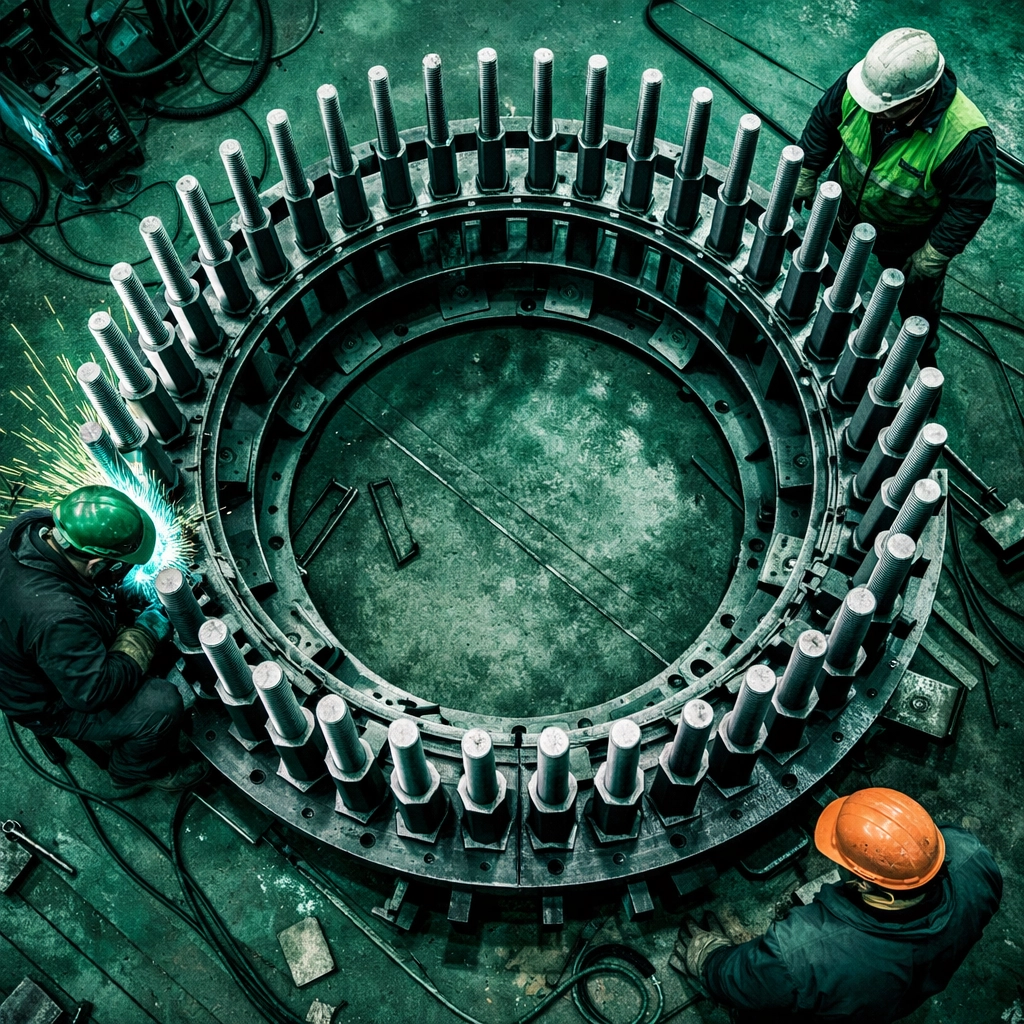
The distinction matters significantly in wind and marine applications where foundation loads are substantial and bolt placement accuracy directly affects the fit-up of tower sections or equipment bases. A misaligned anchor bolt pattern on a wind turbine foundation can halt installation and require expensive remediation that costs far more than the initial anchoring system.
Precision Requirements in Wind Applications
Offshore and onshore wind turbines demand exceptionally tight tolerances. Tower sections arrive with pre-drilled base plates that must align perfectly with the foundation anchor bolts. Industry standards typically require positioning accuracy within ±3mm (approximately 1/8 inch) across bolt circles that may span three to six meters in diameter.
Prefabricated cages excel in meeting these precision requirements. Shop fabrication allows for jig-based assembly, where anchor bolts are positioned using templates and welded to structural steel plates or rings. Each cage undergoes dimensional inspection before leaving the shop, ensuring compliance before transportation to the site.
Field-set installations face inherent challenges in maintaining this precision. Concrete pours generate significant forces that can shift templates or individual bolts. Wind, vibration from surrounding equipment, and the concrete placement process itself all introduce variables that complicate accuracy. Even experienced crews struggle to maintain tolerances when working with large-diameter bolt circles in dynamic field conditions.
The consequences of misalignment extend beyond the immediate installation. Wind turbine towers experience continuous cyclic loading and vibration. Any initial positioning error compounds stress concentrations at the anchor bolt connection, potentially accelerating fatigue and reducing the design life of both the anchor bolts and the tower connection.
Marine Environment Considerations
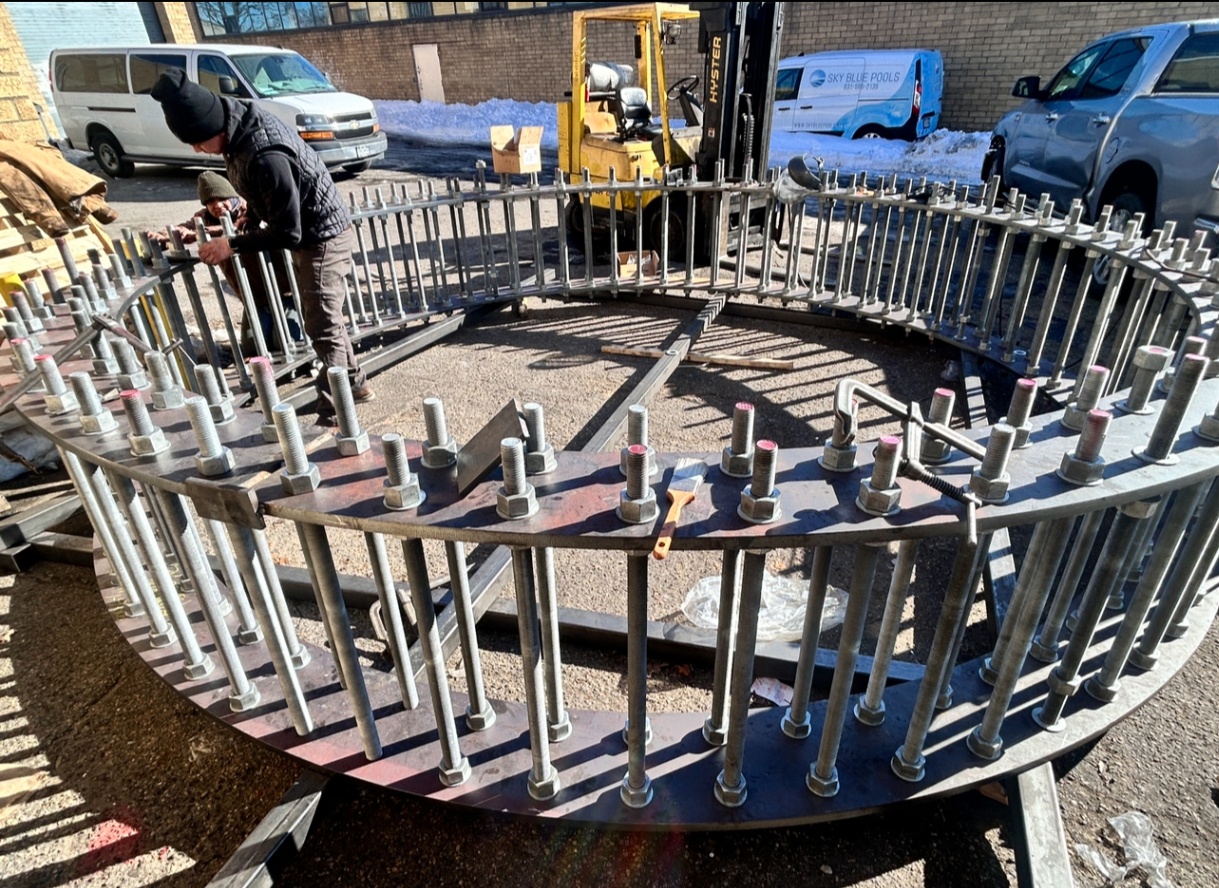
Marine construction introduces additional complications that favor prefabricated systems. Saltwater exposure, tidal cycles, and limited site access create conditions where installation speed and reliability become paramount.
Prefab cages reduce the weather-dependent window required for foundation work. A cage can be positioned, leveled, and secured in a fraction of the time needed for field-setting individual bolts. This speed advantage proves critical in marine environments where weather windows are narrow and crew access is constrained by tides or vessel availability.
Corrosion protection presents another consideration. ASTM F1554 anchor bolts used in marine applications typically require hot-dip galvanizing for atmospheric zones and specialized coatings for splash zones and submerged applications. Prefabricated cages allow for complete galvanizing of the entire assembly: anchor bolts, structural steel framework, and all attachment hardware: in a single process. This comprehensive coating provides superior corrosion resistance compared to field-applied coatings on individually set bolts.
We recognize that marine contractors face the dual challenge of maintaining structural integrity while working in corrosive environments. The fabricated cage approach addresses both concerns simultaneously through controlled manufacturing and comprehensive corrosion protection.
Cost Analysis and Project Economics
The cost comparison between prefab cages and field-set methods is rarely straightforward. Prefabricated systems carry higher upfront material and fabrication costs. A shop-built cage for a large wind turbine foundation may cost 40-60% more than the raw materials for equivalent field-set anchor bolts.
However, this material premium must be weighed against field labor, installation time, and risk mitigation. Prefab cages typically reduce on-site installation time by 50-70% compared to field-setting methods. For projects where crane time costs thousands of dollars per hour or where site access is severely restricted, this time savings translates directly to cost reduction.
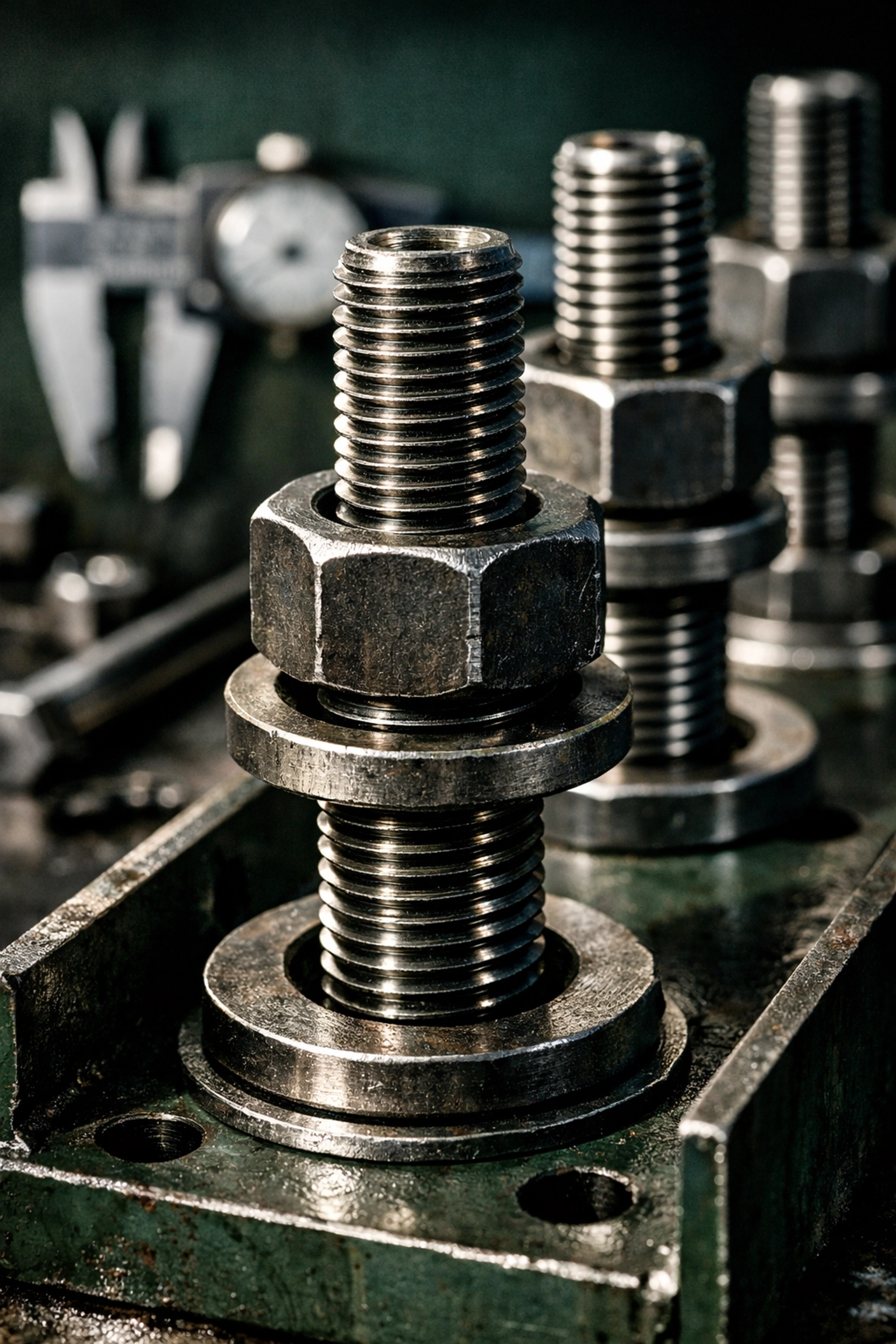
Risk costs also factor prominently. Field-set installations carry higher probability of tolerance violations requiring rework. A single out-of-tolerance anchor bolt pattern on a wind turbine foundation can cost $50,000 to $200,000 to remediate, depending on project location and timing. This rework involves concrete removal, bolt replacement, and schedule delays that cascade through the entire project.
Prefabricated cages shift quality control to the shop environment where corrections cost significantly less than field modifications. Dimensional errors discovered during shop inspection can be corrected before shipment, eliminating the risk of costly field discovery.
Quality Control and Inspection
Shop fabrication enables inspection protocols that are difficult or impossible to replicate in the field. Each prefabricated cage can be dimensionally verified using coordinate measuring equipment, ensuring bolt positions meet design tolerances before the assembly leaves the controlled environment.
Material traceability also improves with prefabricated systems. Each ASTM F1554 anchor bolt can be marked with heat numbers and material certifications that remain visible and accessible throughout fabrication. Shop documentation provides complete records of welding procedures, inspection results, and dimensional verification that satisfy quality assurance requirements for major projects.
Field-set installations rely heavily on individual craftsman skill and on-site inspection during concrete placement. Once concrete is poured, verification of bolt position becomes challenging and corrective action becomes expensive. The real-time nature of concrete placement creates pressure that can compromise quality control procedures.
We advocate for approaches that move quality verification upstream in the construction process. Prefabricated systems align with this principle by completing the most critical precision work in controlled conditions before site mobilization.
Material Specification Distinctions
It is essential to distinguish between anchor bolts used in foundation systems and structural bolts used for steel-to-steel connections. ASTM F1554 anchor bolts are specifically designed for cast-in-place or post-installed foundation applications. These fasteners connect structural elements to concrete and are available in Grade 36, Grade 55, and Grade 105 to match varying strength requirements.
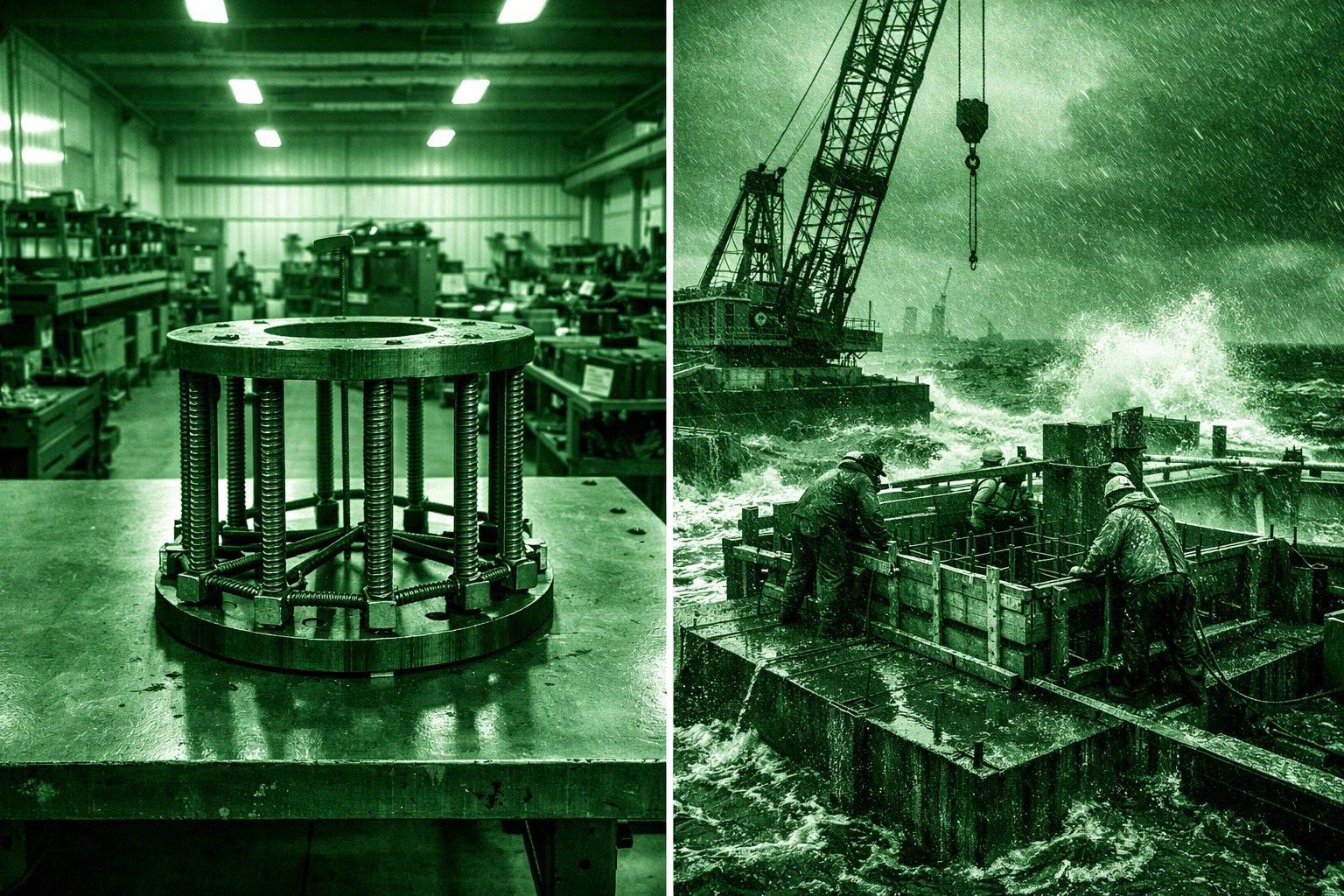
In contrast, ASTM A325 and ASTM A490 structural bolts serve entirely different applications. These high-strength bolts connect steel members in structural frames and are not appropriate for foundation anchoring applications. Confusing these specifications can lead to material selection errors with serious structural implications.
Wind and marine foundation work exclusively uses ASTM F1554 anchor bolts, with grade selection based on design loads and safety factors. The prefabrication process must account for the specific mechanical properties and installation requirements of F1554 fasteners, including thread engagement depth, projection requirements, and embedment lengths that differ substantially from structural bolt applications.
Making the Decision
The choice between prefabricated cages and field-set anchor bolts ultimately depends on project-specific factors. Large-diameter bolt circles, tight tolerances, aggressive schedules, and challenging site access conditions all favor prefabricated systems. Projects in marine environments or offshore locations gain particular advantage from the speed and reliability of shop-fabricated assemblies.
Field-set methods may remain appropriate for smaller foundations, projects with flexible schedules, or applications where bolt patterns are relatively simple and tolerances are less demanding. However, as wind turbines grow larger and marine structures become more complex, the industry trend clearly favors prefabricated anchor bolt cage systems.
We firmly believe that moving critical work into controlled shop environments improves outcomes for complex projects. The combination of precision manufacturing, comprehensive quality control, and accelerated installation timelines makes prefabricated cages the preferred solution for most wind and marine foundation applications.
The decision should be made during the design phase, allowing sufficient time for cage fabrication, inspection, and logistics. Early engagement between design engineers, fabricators, and contractors ensures that anchor bolt cage assemblies are optimized for both structural performance and installation efficiency.
When foundation integrity and project success are paramount, prefabricated anchor bolt cages deliver the precision, speed, and reliability that wind and marine construction demands.
Author: MEDIA_LRKD