

The offshore wind industry operates at a scale that challenges conventional construction principles. Modern turbines generate 18 to 20 megawatts, standing taller than most skyscrapers, anchored to foundations that must withstand hurricane-force winds, corrosive saltwater, and dynamic wave loads for 25 years or more. This is precision engineering at its most demanding, where tolerances measured in fractions of an inch determine whether a billion-dollar installation succeeds or fails.
Foundation Systems: Fixed-Bottom vs. Floating Structures
Two distinct foundation categories dominate offshore wind construction, each serving different water depths and seabed conditions.
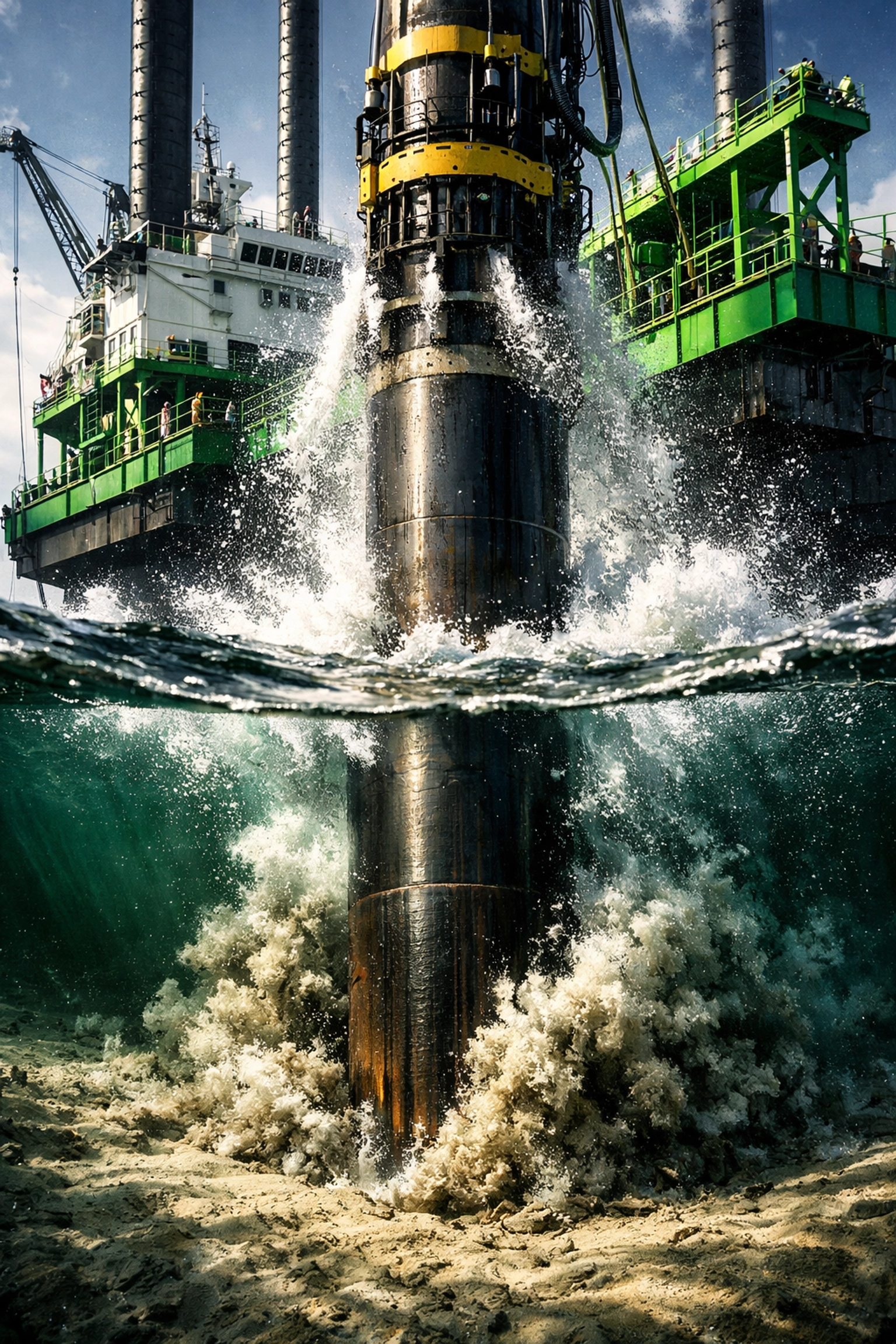
Fixed-bottom foundations anchor directly to the seabed in waters up to 60 meters deep. Monopile structures: massive steel tubes driven deep into the ocean floor: remain the most widely deployed design. These single-piece foundations provide exceptional stability, but installation requires precision pile-driving equipment and careful consideration of geotechnical conditions. Weak soils can cause excessive penetration during installation. Excessively hard layers can halt pile advancement entirely, creating costly delays and potential structural compromises.
Floating foundations operate in waters 50 to 100 miles offshore, where depths exceed the practical limits of fixed structures. Semi-submersible and spar-buoy designs are secured by mooring systems rather than driven piles, allowing construction to proceed in shipyards before offshore deployment. The assembled wind turbine gets towed to location, where moorings and subsea cables are connected to create a functional installation.
The Critical Role of Anchor Bolt Assemblies
Foundation performance depends on the anchor bolt cages that connect concrete or steel substructures to tower sections. These assemblies must transfer enormous loads from the turbine structure into the foundation itself, all while maintaining precise alignment across temperature variations, material expansion, and environmental stresses.
ASTM F1554 anchor bolts serve as the industry standard for these applications. Grade 36 provides baseline strength for lighter-duty connections. Grade 55 offers enhanced tensile strength for standard offshore installations. Grade 105 delivers maximum strength for extreme load conditions or compact bolt patterns where space limitations require fewer, stronger fasteners.
The distinction between anchor bolts and structural bolts matters significantly in offshore wind applications. ASTM A325 and ASTM A490 structural bolts connect steel members to steel members: joining flanges, splicing tower sections, or assembling lattice structures. These are not foundation anchors. F1554 anchor bolts embed into concrete or grout, creating the critical interface between foundation and superstructure. Confusing these specifications leads to material failures, installation delays, and compromised structural integrity.
Fabrication Precision for Marine Environments
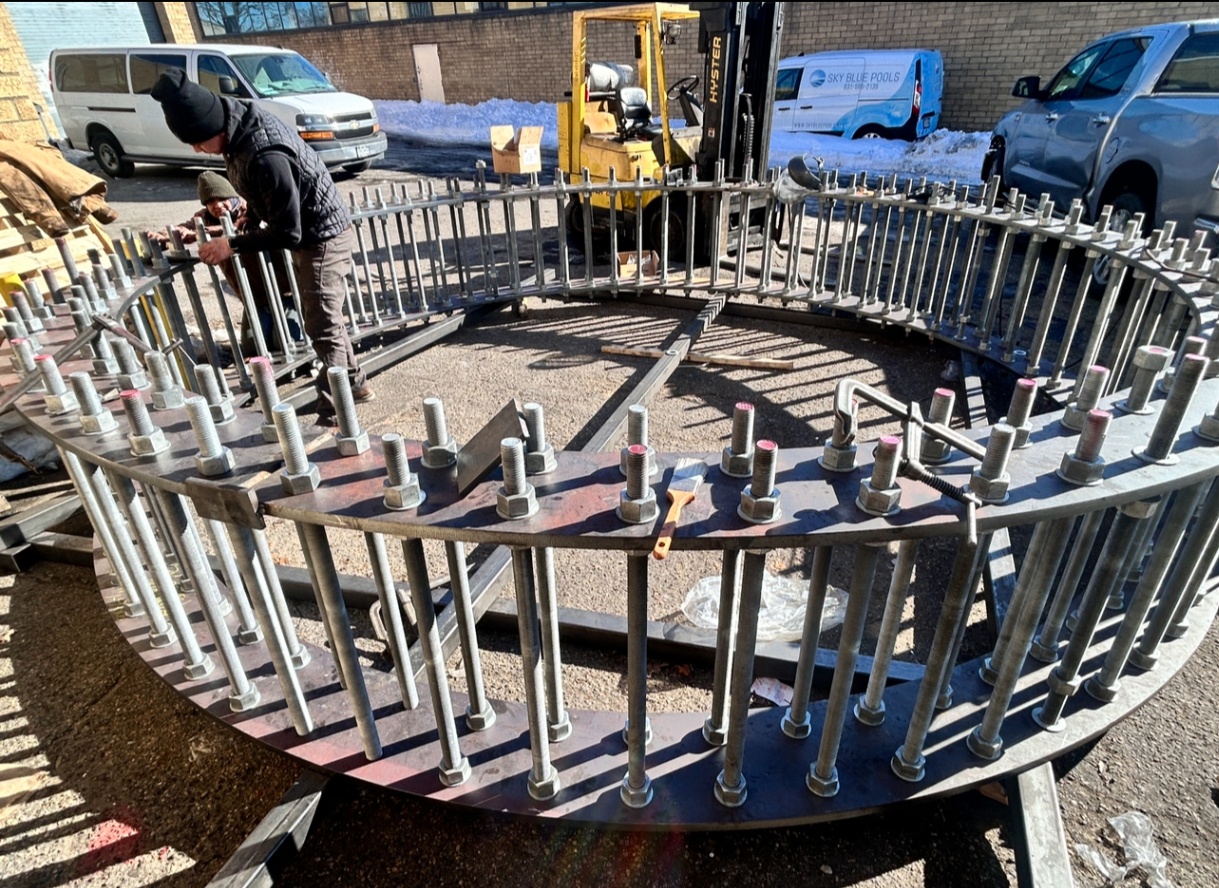
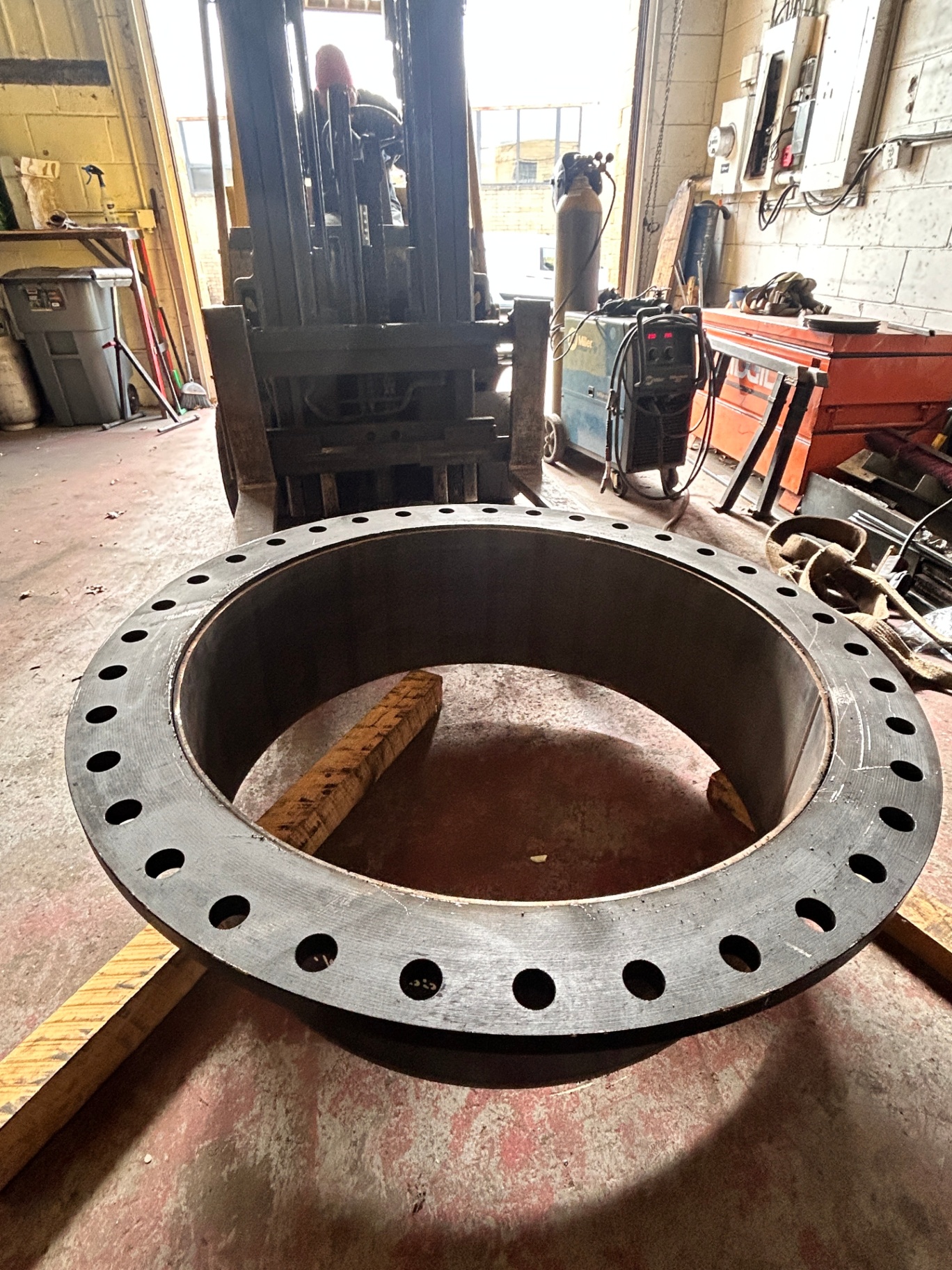
Anchor bolt cage fabrication for offshore wind foundations requires precision that exceeds typical construction standards. A tolerance of ±1/8 inch may seem generous on paper, but when multiplied across a bolt circle measuring 4 to 6 meters in diameter, minor angular deviations compound into alignment problems that prevent tower installation.
We recognize these challenges because we fabricate bolt cages daily for marine and infrastructure projects where field corrections are prohibitively expensive. Template assemblies are built on precision jigs, with each bolt position verified before welding. Hot-dip galvanizing protects the entire assembly from saltwater corrosion, creating a zinc coating that bonds metallurgically to the steel substrate. This is not paint. This is sacrificial protection that corrodes before the base metal does, extending service life in the harshest marine conditions.
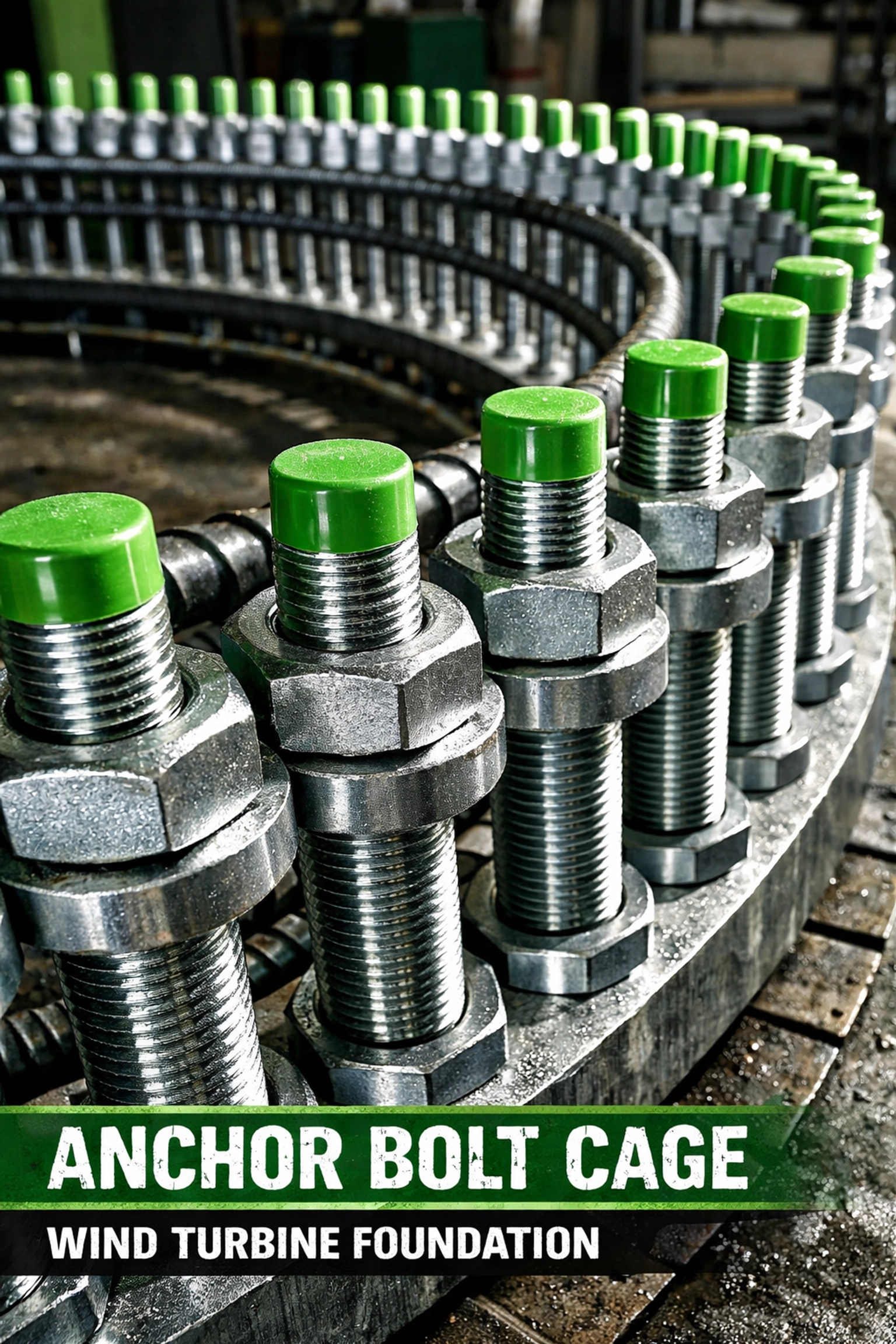
The assembly process demands careful material selection. F1554 bolts are supplied with heavy hex nuts and hardened washers sized for the specific grade and diameter. Grade 105 bolts require hardened washers to prevent embedment under high preload. Anchor bolt threads are protected during concrete pours with plastic caps or tape, ensuring clean threads for final tower connection.
Installation Challenges and Coordination Requirements
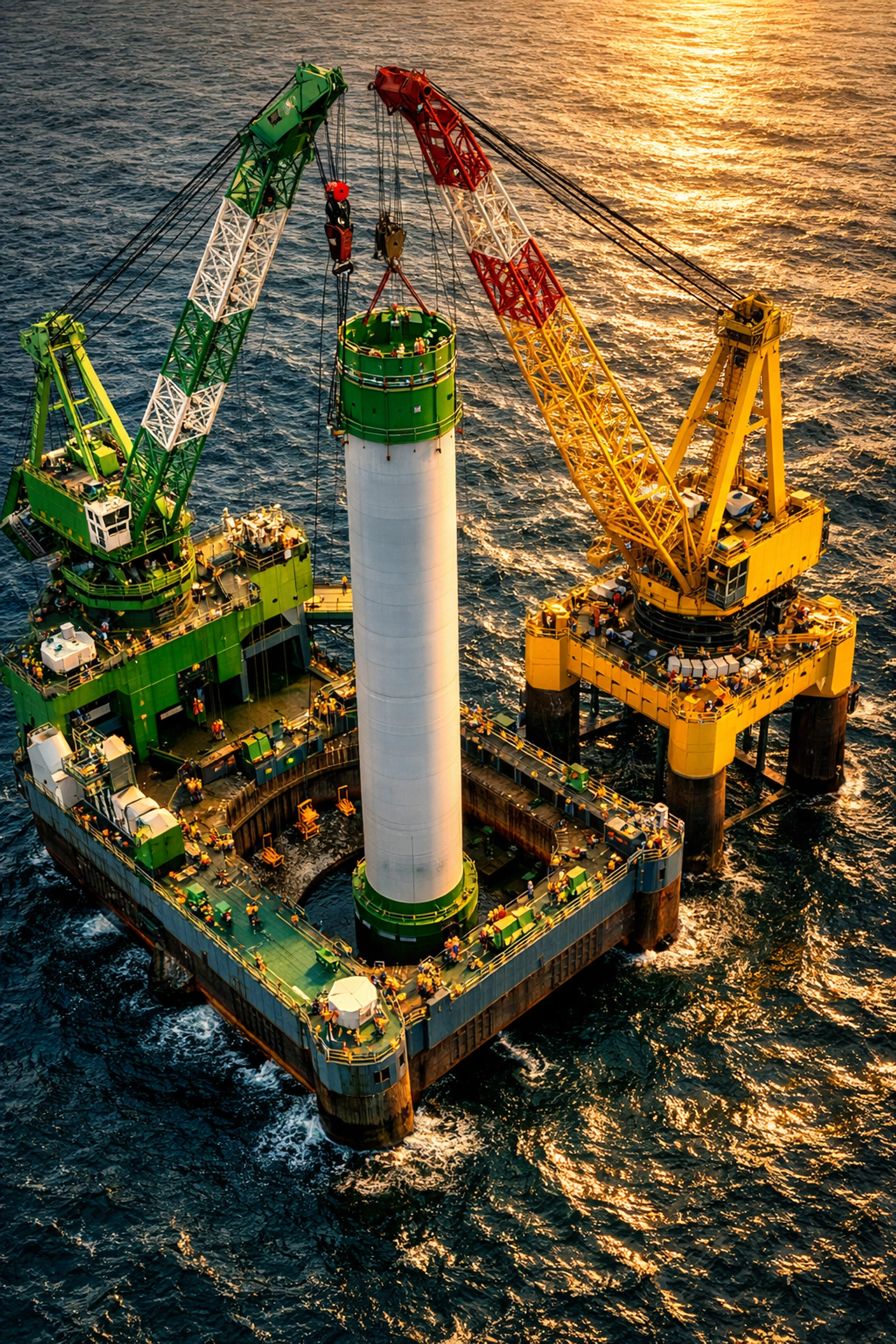
Offshore wind foundation installation requires coordination across multiple specialized vessels, each operating within narrow weather windows. Jack-up barges provide stable platforms for grouting operations, but they require water depths between 10 and 60 meters. Floating crane vessels handle deeper installations but operate with reduced precision in dynamic sea states.
Component alignment during installation determines long-term structural performance. Tower flanges must mate flush with foundation flanges, distributing loads evenly across the bolt pattern. Misalignment creates eccentric loading that accelerates fatigue damage, particularly under the cyclic loading conditions offshore turbines experience.
Foundation grouting presents additional precision requirements. High-strength cementitious grout fills the annular space between tower base and foundation, transferring shear loads and providing corrosion protection. Grout must flow completely around anchor bolts without creating voids, requiring careful material selection, temperature control, and placement procedures. Marine-grade grouts incorporate corrosion inhibitors and are formulated for underwater placement when necessary.
Onshore Wind Foundations: Different Scale, Similar Precision
Onshore wind foundations face different challenges but require comparable precision. Pier and drilled shaft foundations extend 20 to 40 feet into the ground, with anchor bolt cages positioned at the top of each pier. These cages must maintain position during concrete placement, when fluid concrete generates significant buoyant forces that can shift the assembly.
We supply anchor bolt cages for onshore wind projects with positioning templates that maintain bolt location throughout the concrete pour. These templates are engineered to resist uplift forces while allowing concrete flow around each anchor bolt. The result is a precisely positioned bolt pattern that aligns with tower base flanges during erection.
The bolt pattern for a typical 3 to 5 MW onshore turbine consists of 60 to 80 anchor bolts arranged in a circular pattern, each bolt extending 3 to 5 feet into the concrete foundation. These are not off-the-shelf components. Each cage is fabricated to project-specific drawings, with bolt projections, thread lengths, and positioning verified before shipment.
Material Specifications and Testing Requirements
F1554 anchor bolts for wind applications must meet stringent material testing and certification requirements. Mill test reports verify chemical composition and mechanical properties for each heat of steel. Tensile testing confirms yield strength, ultimate strength, and elongation values meet or exceed specification minimums. Impact testing at reduced temperatures ensures material toughness in cold-weather installations.
Galvanizing for marine applications requires coating thickness verification. ASTM A153 specifies minimum zinc coating weights, but offshore wind projects often require enhanced coating thickness for extended service life. We coordinate with galvanizing facilities to ensure coating specifications match project requirements, providing coating thickness measurements and galvanizing certifications with each shipment.
Thread inspection prevents installation problems. Anchor bolt threads are manufactured to Class 2A tolerances and inspected with thread gauges before galvanizing. Post-galvanizing thread chasing removes zinc buildup that would prevent nut engagement, ensuring proper fit during tower installation.
The Business Case for Prefabricated Assemblies
Prefabricated anchor bolt cages eliminate field measurement errors and reduce installation time by days or weeks. Field-setting individual anchor bolts requires precise surveying, temporary positioning systems, and multiple verification steps before concrete placement. A single mispositioned bolt requires concrete removal, structural repairs, and project delays that cost thousands per day.
We manufacture complete bolt cage assemblies that arrive at the jobsite ready for installation. Positioning templates attach to formwork, maintaining bolt locations during concrete placement. The assembly is removed after concrete cures, leaving precisely positioned anchor bolts ready for tower erection. This approach shifts quality control from the field to the shop, where precision equipment and experienced fabricators ensure consistent results.
Looking Forward: Larger Turbines, Greater Precision Demands
The offshore wind industry continues scaling upward. Turbines exceeding 15 MW are already in commercial operation, with 20 MW designs entering development. These larger machines generate proportionally larger foundation loads, requiring anchor bolt assemblies with enhanced capacity and precision.
We are not simply supplying fasteners. We are engineering foundation connection systems that enable reliable renewable energy infrastructure. Our fabrication capabilities, material expertise, and understanding of marine construction requirements position us to support the offshore wind industry as it continues to grow. Precision at massive scale is not a slogan. It is an engineering requirement we meet with every anchor bolt cage we fabricate.
For more information about our structural bolts and custom fabrication capabilities, or to discuss your specific project requirements, contact our team directly.
Author: MEDIA_LRKD