

Wind energy projects demand precision at every level. The foundation anchor system for a turbine isn't something you get to adjust once the concrete is poured. That's why we fabricate our windmill anchor bolt cages in-shop, under controlled conditions, where we can verify every measurement before the assembly ever reaches your site.
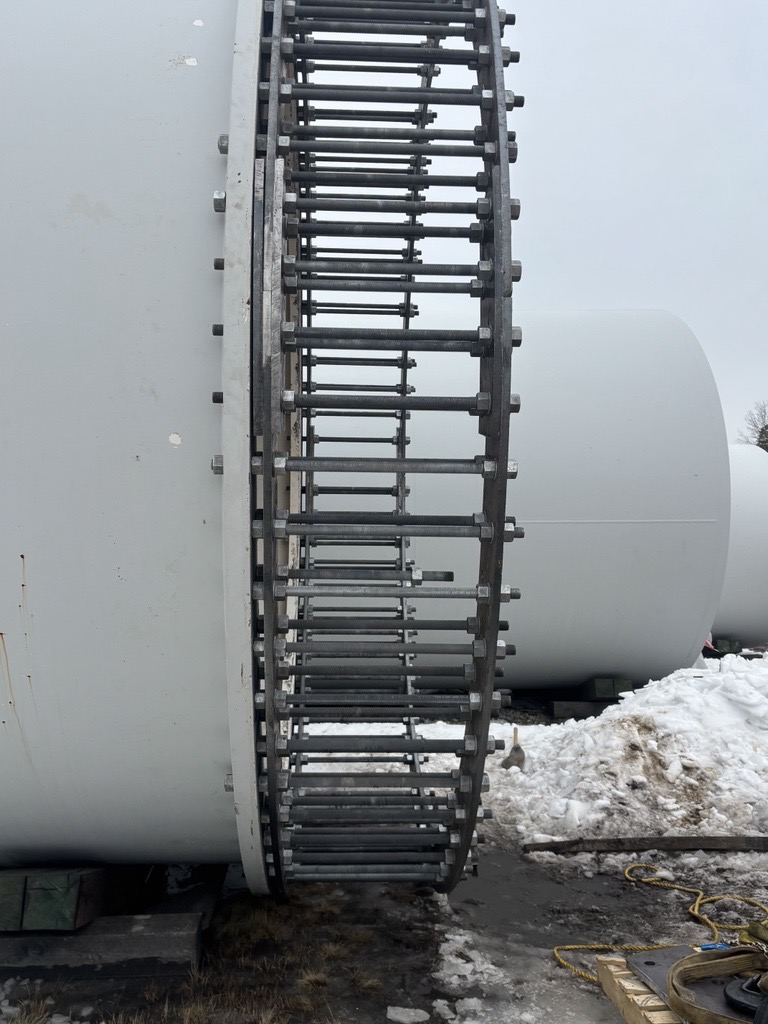
An anchor bolt cage is the structural framework that holds foundation anchor bolts in their exact position during a concrete pour. For wind turbines, we're typically working with large-diameter circular templates: often 12 to 18 feet across: securing anywhere from 60 to 144 anchor bolts in a precise bolt-circle pattern. These assemblies must hold dimensional accuracy within ±1/8 inch across the entire diameter. Field conditions don't offer that level of control. Our shop does.
Engineering and Design: Where Precision Starts
Every anchor bolt cage we fabricate begins with engineered drawings. We receive foundation plans from structural engineers that specify bolt-circle diameter, bolt quantity, bolt size, embedment depth, and projection above the concrete. We don't guess at tolerances or "make it work" in the field. We build to the specifications provided, and we verify those specs against ASTM F1554 anchor bolt standards and ACI 318 concrete anchor tolerances before we cut the first piece of steel.
Our engineering review includes checking for:
- Bolt-circle radius and circumferential spacing
- Template plate thickness and stiffness requirements
- Reinforcement bar placement to avoid interference with rebar cages
- Anchor bolt grade, thread length, and protective coatings
- Load distribution plate design for even stress transfer
We coordinate with general contractors and foundation engineers early in the process. If there's a conflict between rebar layout and anchor bolt positioning, we catch it at the design stage: not after you've already mobilized crews and poured half the foundation.
Material Selection: High-Strength Steel That Holds
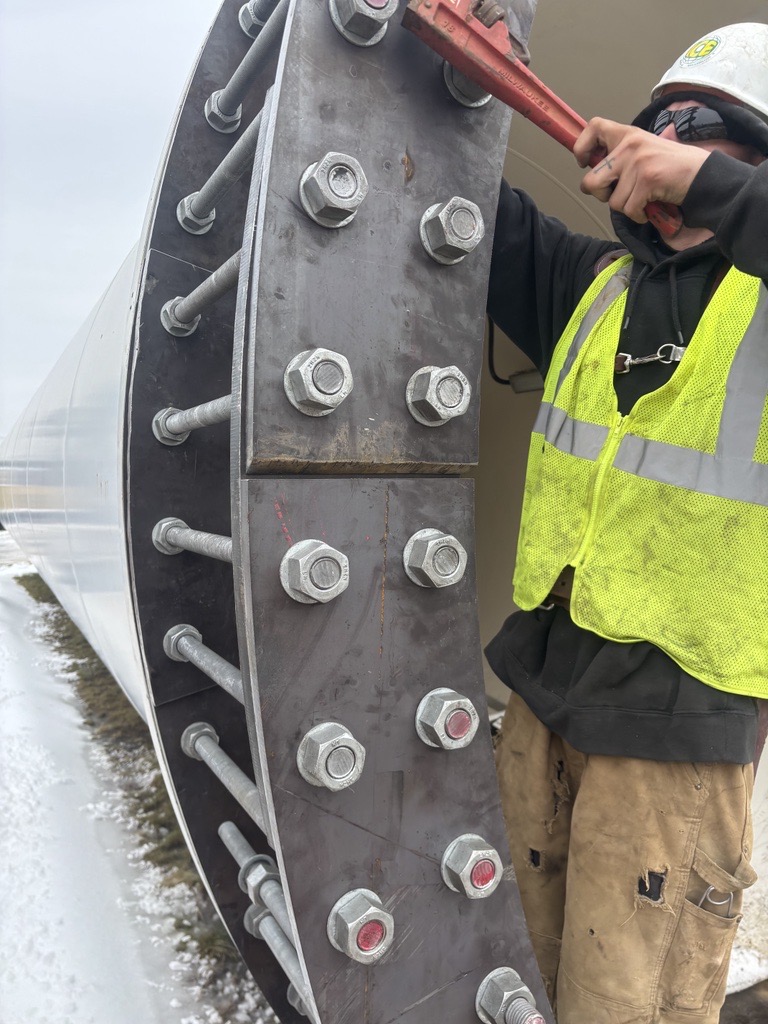
Wind turbine foundations generate massive tensile and shear loads. Anchor bolts for these applications are typically fabricated from ASTM F1554 Grade 55 or Grade 105 steel, depending on design loads. Grade 55 offers a minimum yield strength of 55,000 psi, suitable for moderate wind zones. Grade 105 pushes that to 105,000 psi for high-wind or offshore applications where storm loading is a serious concern.
We stock F1554 anchor bolts in diameters from 1 inch to 4 inches, with custom lengths up to 20 feet. Longer bolts require careful handling during fabrication: thread protection, straightness verification, and proper support during welding or assembly to prevent warping. Every bolt we use is mill-certified with material test reports that confirm chemistry, tensile strength, and elongation properties.
Template plates are fabricated from ASTM A36 or A572-50 structural steel plate, cut to diameter using CNC plasma or waterjet cutting for clean, burr-free edges. Plate thickness ranges from 3/8 inch to 1 inch depending on cage diameter and the number of bolts. Thicker plates resist deflection during concrete placement, which is critical when you're pouring 150+ cubic yards of concrete in a single placement.
Fabrication Process: Building the Cage
Anchor bolt cage fabrication follows a structured sequence. We don't improvise. Each step is verified before we move to the next.
Step 1: Template Plate Preparation
We begin by cutting upper and lower template plates to the specified diameter. Bolt hole locations are laid out using CNC-controlled drilling or plasma cutting, indexed from a central reference point to maintain radial accuracy. Holes are drilled slightly oversized (typically 1/16 inch larger than bolt diameter) to allow for minor field adjustment if needed, but tight enough to prevent excessive movement during the pour.
Step 2: Anchor Bolt Installation
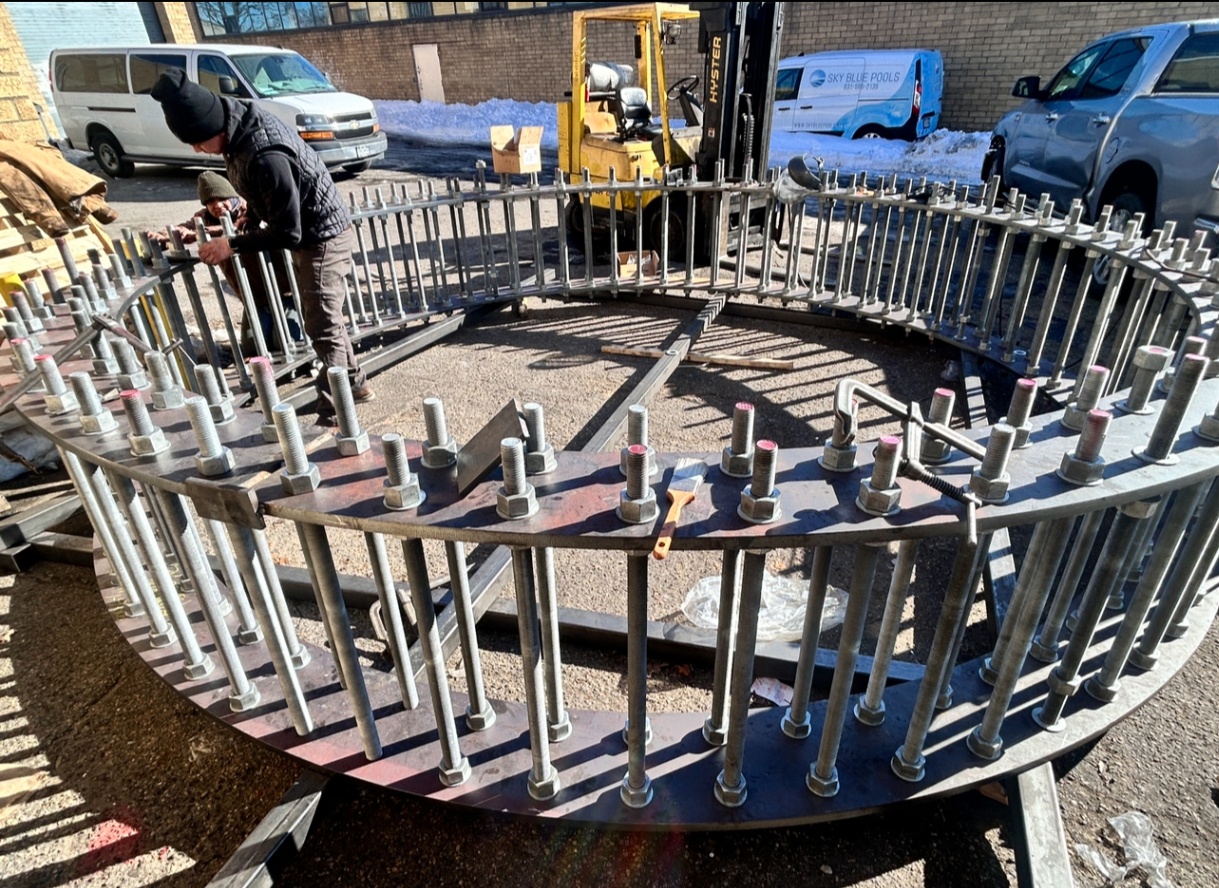
Anchor bolts are inserted through both template plates and secured with heavy hex nuts and washers top and bottom. Bolts are positioned with threaded ends projecting upward: these threads will eventually connect to the turbine tower base flange. We protect threads with PVC sleeves or heat-shrink tubing to prevent concrete intrusion and damage during handling.
At this stage, we verify bolt projection heights using a laser level or digital measuring system. Every bolt must project to the same elevation within ±1/8 inch. Uneven projections create alignment problems during turbine erection, and fixing that after the fact means grinding down high bolts or shimming low ones: both of which compromise structural integrity.
Step 3: Reinforcement and Bracing
Large-diameter cages require internal bracing to maintain rigidity during transport and installation. We weld cross-bracing between upper and lower plates using structural angle or tube steel. Bracing is positioned to avoid interference with rebar and to provide lifting points for crane placement.
For cages over 15 feet in diameter, we often incorporate intermediate distribution plates between the upper and lower templates. These plates add stiffness and help distribute concrete pressure more evenly during the pour, reducing the risk of template deflection.
Step 4: Hot-Dip Galvanizing
Wind turbine foundations are long-term infrastructure. These installations are designed for 20 to 30 years of service, often in harsh environments: coastal wind farms, high-elevation mountain passes, offshore platforms. Corrosion protection isn't optional.
We hot-dip galvanize fully assembled anchor bolt cages after fabrication. The entire cage: bolts, plates, bracing, and hardware: goes through the galvanizing process as a single unit. This provides complete coverage, including weld zones and interior surfaces that would be impossible to coat effectively in the field. The zinc coating thickness meets ASTM A123 or ASTM A153 standards, providing a minimum 3.9 mils of protection per surface.
Galvanizing after assembly also eliminates galvanic corrosion between dissimilar metals. If you mix ungalvanized bolts with galvanized plates, or vice versa, you create an electrochemical cell that accelerates corrosion at the interface. Full-assembly galvanizing prevents that.
Quality Control and Dimensional Verification
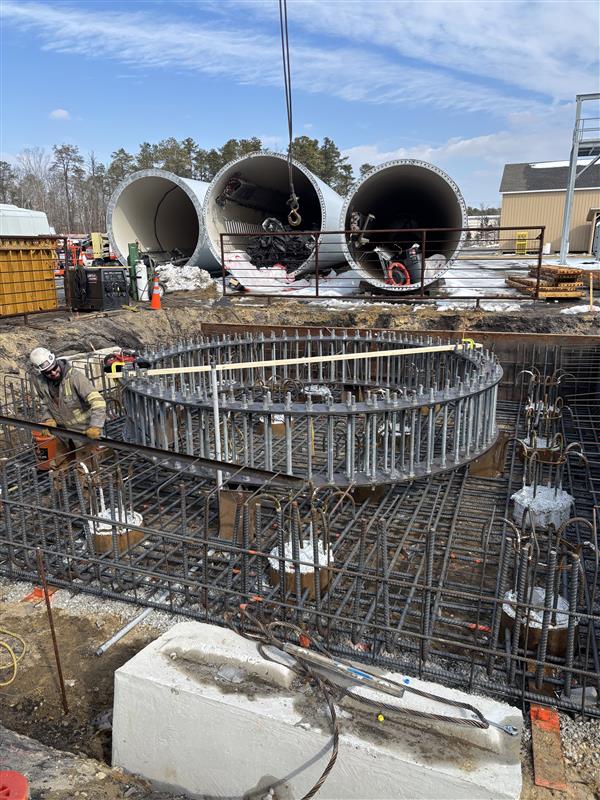
Before any cage leaves our shop, we conduct a full-dimensional inspection. We're checking:
- Bolt-circle diameter at multiple points around the circumference
- Radial spacing between adjacent bolts
- Bolt perpendicularity (plumbness) relative to the template plates
- Thread projection heights above the upper template
- Template plate flatness and absence of warping
We use calibrated measurement tools: digital calipers, laser distance meters, optical levels: and document results on inspection reports that ship with the cage. If a cage is out of tolerance, we correct it before it leaves the shop. You shouldn't have to discover a fabrication error after you've set the cage in the foundation excavation.
We also inspect welds visually and, when specified, with magnetic particle or dye penetrant testing. Weld quality directly affects cage rigidity and load transfer. Poor welds can crack during concrete placement or under service loads, compromising the entire foundation.
Why Shop Fabrication Outperforms Field Assembly
Some contractors still assemble anchor bolt cages on-site, building templates and setting bolts in the field. We understand the appeal: it eliminates transportation costs for large assemblies and allows for last-minute adjustments. But field assembly introduces variables you can't control:
Weather and Environmental Conditions
Outdoor fabrication exposes materials to moisture, temperature swings, and contamination. Welding in the rain or freezing temperatures compromises weld quality. Dirt and debris interfere with thread protection and bolt alignment.
Tooling and Measurement Accuracy
Field crews don't have access to CNC equipment, laser measurement systems, or climate-controlled workspaces. Bolt layout is often done with tape measures and string lines, introducing cumulative error across large diameters.
Schedule Pressure
Foundation pours operate on tight schedules. When your concrete trucks are rolling, there's pressure to set the cage quickly, even if measurements aren't perfect. Shop fabrication removes that time pressure. We verify dimensions when there's no concrete clock ticking.
Quality Documentation
Shop-fabricated cages come with full material certifications, dimensional inspection reports, and galvanizing certificates. Field-assembled cages rarely include that level of documentation, which can create problems during project inspections or warranty claims.
Transportation and Site Delivery
We understand that large anchor bolt cages present transportation challenges. Cages over 12 feet in diameter often require oversized load permits and escort vehicles. We coordinate shipping logistics as part of our service, working with specialized heavy-haul carriers who have experience moving structural steel assemblies.
Cages are braced and secured to prevent shifting during transport. Lifting points are clearly marked, and we provide rigging instructions for crane placement. Thread protectors remain in place until just before the concrete pour to prevent damage during unloading and positioning.
We also offer on-site installation support when needed. Our field technicians can assist with cage placement, final alignment verification, and coordination with your concrete crews to ensure proper embedment and positioning.
The LRKD Approach to Wind Foundation Hardware
We fabricate anchor bolt cages because we recognize that foundation work sets the baseline for every vertical component that follows. If the anchor bolts are out of position, your turbine tower won't plumb correctly. If the bolt projection is inconsistent, your flange connection won't seat properly. If corrosion protection is inadequate, you'll face expensive repairs within the first decade of operation.
Our fabrication process eliminates those risks through controlled shop conditions, verified measurements, and complete material traceability. We're not just bending steel and drilling holes. We're building the structural connection that transfers millions of foot-pounds of overturning moment from a 300-foot tower into the earth below.
That's precision work. That's why it happens in our shop, not in a muddy excavation on a windy hillside.
If you're planning wind turbine construction and need anchor bolt cages fabricated to exact specifications, reach out to our team. We'll review your foundation drawings, confirm material requirements, and provide a detailed fabrication schedule that aligns with your pour date. Precision starts here.
Author: MEDIA_LRKD