

Wind energy infrastructure demands precision that most construction projects never approach. A turbine tower rising 80 to 100 meters must remain secure through decades of variable loads, wind shear, and environmental exposure. That security begins below grade: in the foundation where steel meets concrete and where millimetre-level accuracy determines whether installation proceeds smoothly or demands costly field corrections.
At LRKD Industries, we recognize that foundation work sets the trajectory for every phase that follows. We fabricate anchor bolt cages and supply ASTM F1554 anchor bolts engineered to eliminate the variables that lead to misalignment, schedule delays, and expensive rework. This is how precision happens at ground level.
The Critical Role of Anchor Bolt Cages
Foundation construction for wind turbines centers on a deceptively simple requirement: anchor bolts must align with the tower flange bolt pattern within tight tolerances. Tower flanges arrive with pre-drilled holes positioned to specifications that allow minimal deviation. If the embedded anchor bolts don't match that pattern, installation crews face delays while they assess remediation options: or worse, structural engineers must approve field modifications that compromise load transfer.
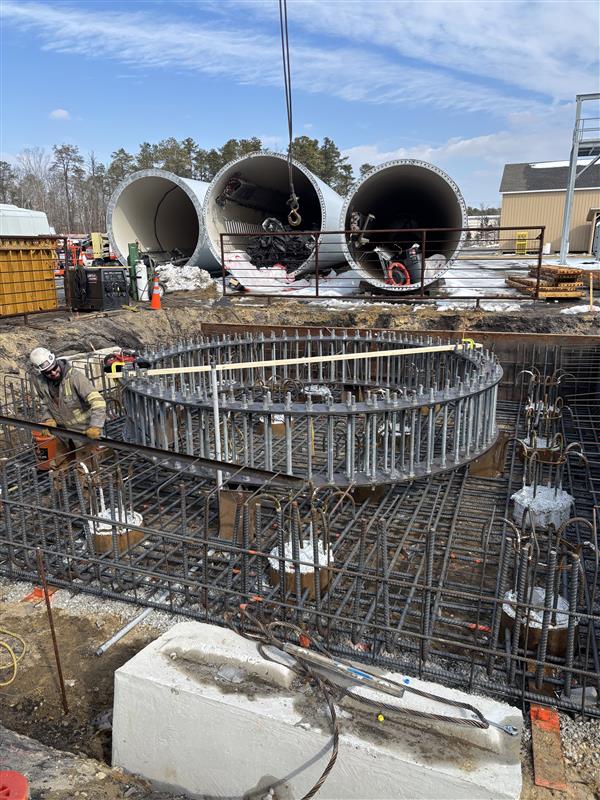
Anchor bolt cages prevent this scenario. A properly fabricated cage positions each F1554 anchor bolt in precise relation to the others, maintaining that geometry through the concrete pour and curing process. The cage acts as a rigid template, resisting displacement from concrete flow, vibration, or incidental contact during construction. We manufacture these cages to match project-specific bolt circle diameters and bolt quantities, ensuring compatibility with turbine models and foundation designs.
Each cage undergoes dimensional verification before it leaves our facility. We confirm bolt spacing, radial positioning, and elevation to ensure the assembly meets project tolerances: typically ±3 mm for bolt circle diameter and ±6 mm for individual bolt position. These measurements matter because turbine tower flanges don't accommodate improvisation.
Site-Level Execution: Where Precision Meets Practical Challenges
Field conditions introduce variables that shop fabrication eliminates. Temperature fluctuations affect steel expansion. Concrete placement generates lateral forces. Workers navigate crowded rebar assemblies while managing formwork, embedments, and inspection requirements. A loose anchor bolt in this environment drifts. A bolt secured only by a flimsy template shifts during the pour. A cage fabricated without adequate rigidity flexes under load.
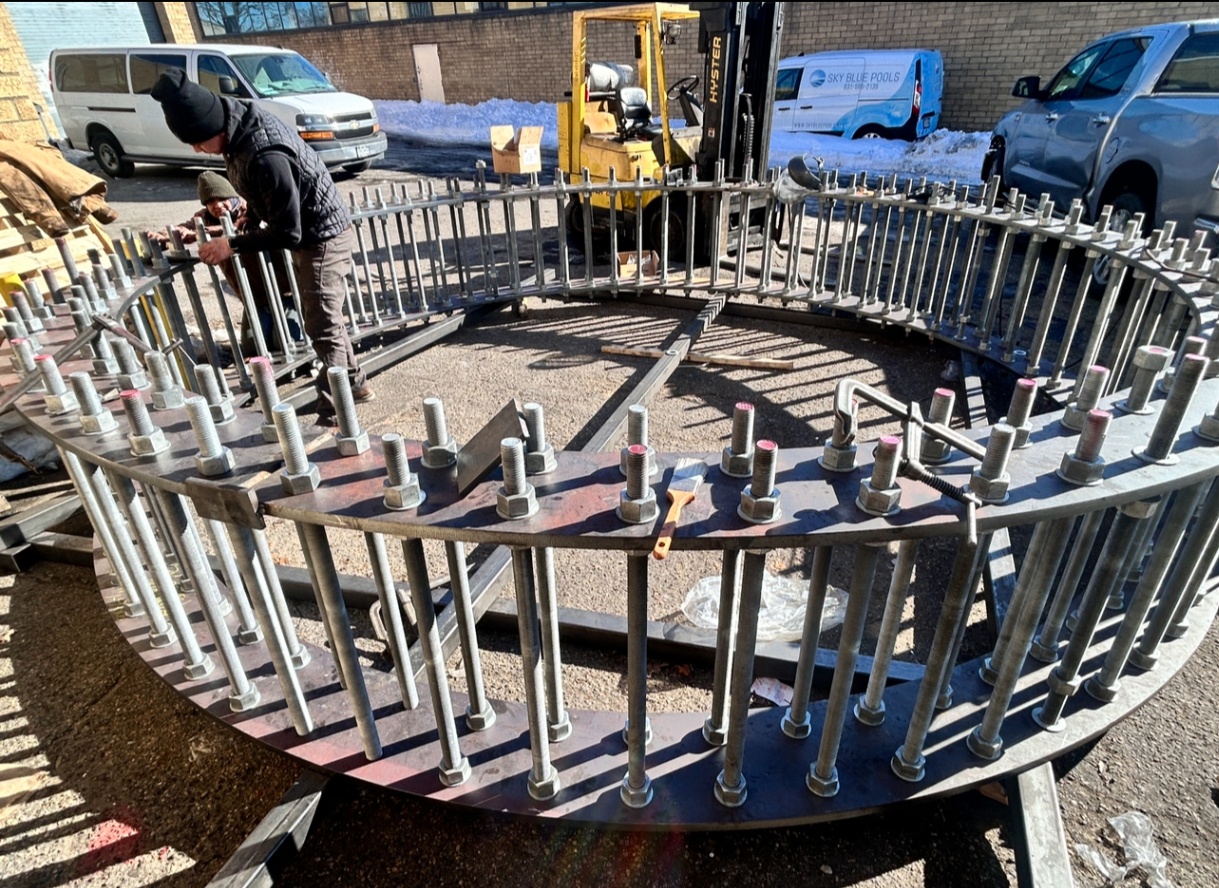
LRKD Industries designs anchor bolt cages to withstand these conditions. We use structural steel plate for templates and tie plates, with cross-bracing that maintains geometry under field handling and concrete pressure. Bolt threads receive protective coating to prevent damage and ensure proper engagement with tower flange nuts during installation. The result is an assembly that arrives on-site ready for immediate placement, reducing labor hours and minimizing the risk of misalignment.
When installation crews lower a prefabricated cage into prepared formwork, they're working with a component that has already been measured, verified, and proven. The cage positions itself relative to the foundation perimeter and grade elevation. Surveyors confirm final placement. Concrete placement proceeds without concern that bolts will migrate or tilt.
Material Specifications: Why F1554 Grade 55 Dominates Wind Foundations
Wind turbine foundations require anchor bolts that combine tensile strength with ductility and weldability. ASTM F1554 addresses these requirements through three strength grades: 36, 55, and 105: with Grade 55 emerging as the standard for most utility-scale installations.
Grade 55 anchor bolts provide minimum tensile strength of 75 ksi and yield strength of 55 ksi, sufficient to resist the overturning moments and lateral loads that turbines generate during operation. The material exhibits predictable elongation characteristics, allowing the anchor system to accommodate minor foundation movements without brittle failure. F1554 steel also supports welding without special procedures, enabling cage fabrication methods that prioritize structural integrity.
We supply F1554 anchor bolts in diameters ranging from 1 inch to 4 inches, with lengths customized to match foundation depth and embedment requirements. Each bolt includes continuous threading or strategically positioned thread sections, depending on design specifications. Nuts and washers meet corresponding ASTM standards to ensure load transfer occurs as engineered.
Hot-dip galvanizing provides corrosion protection for anchor assemblies exposed to moisture during foundation curing or installations in coastal environments. The zinc coating extends service life and maintains bolt condition through years of subsurface exposure.
Fabrication Standards: How Shop-Built Cages Eliminate Field Variables
Precision fabrication begins with accurate project information. We receive detailed foundation drawings showing bolt patterns, embedment depths, and cage geometry. Our engineering team reviews these specifications against turbine manufacturer requirements to identify any discrepancies before fabrication starts.
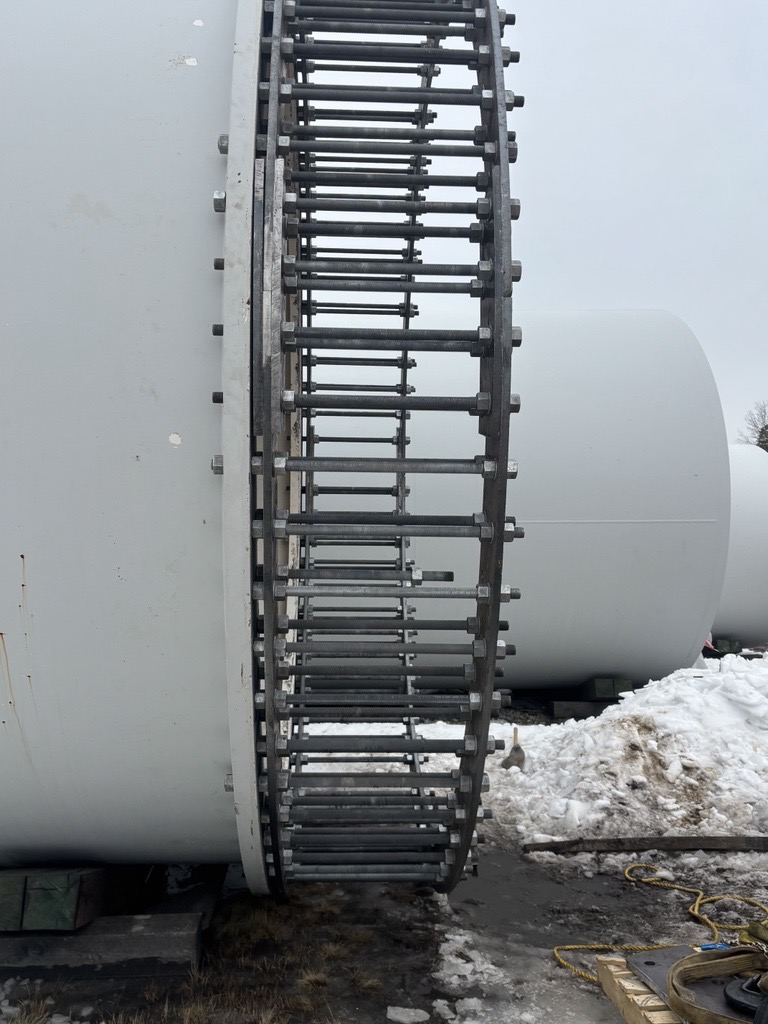
Template plates undergo CNC drilling or plasma cutting to establish exact bolt hole locations. We position anchor bolts through these plates and secure them with double-nutting or tack welding, depending on project requirements. Cross-bracing connects template plates at specified intervals, creating a rigid framework that resists deflection. Lifting points integrate into the cage structure, allowing crane placement without disturbing bolt alignment.
Quality control occurs at multiple stages. We verify dimensions after initial assembly, after welding, and before shipment. Any deviation from specification triggers corrective action before the cage leaves our facility. This front-loaded verification process prevents field discoveries that halt concrete pours or require expensive remediation.
Cages ship to project sites protected against damage and ready for installation. Bolt threads remain covered. Lifting points are clearly marked. Assembly drawings accompany each cage, providing installation crews with the information they need for proper placement and alignment verification.
The Cost of Misalignment: Why Precision Prevents Rework
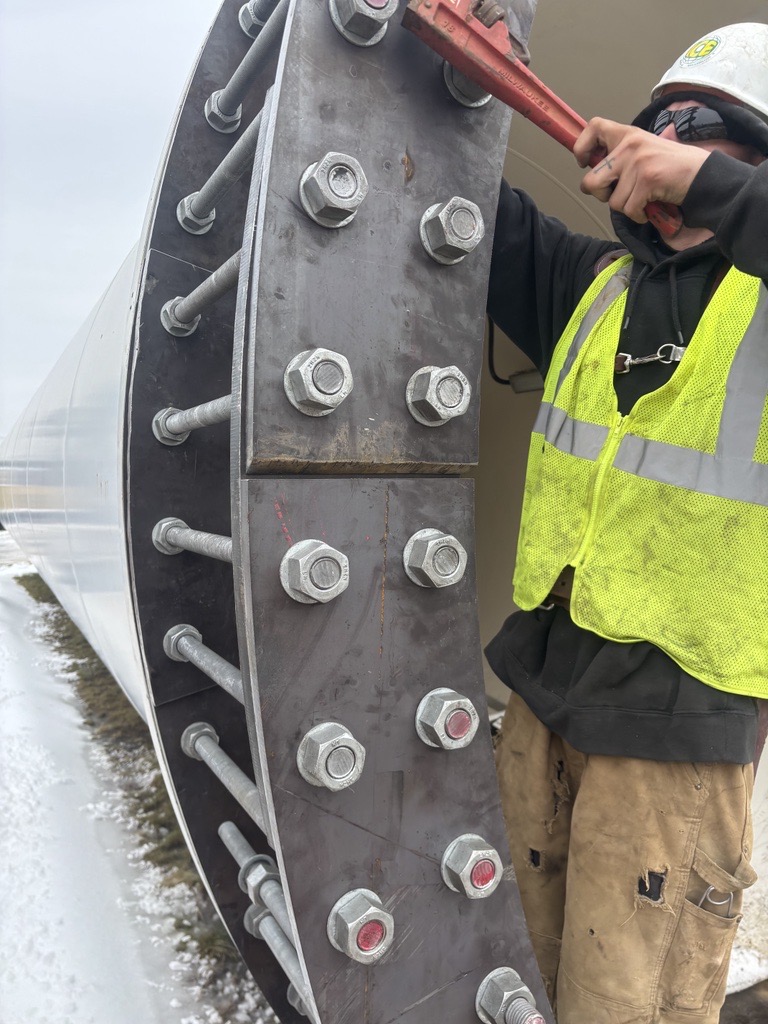
Foundation rework represents one of the most expensive failure modes in wind farm construction. Once concrete has cured around misaligned anchor bolts, correction options narrow considerably. Crews may attempt to ream oversized holes in the tower flange: a modification that requires engineering approval and reduces connection capacity. Alternatively, they might drill new holes in the foundation, install supplemental anchors, or in extreme cases, demolish and repour the foundation.
Each of these scenarios extends the construction schedule, increases labor costs, and potentially delays turbine commissioning and revenue generation. A prefabricated anchor bolt cage eliminates this risk by delivering verified accuracy before concrete placement begins.
We understand that construction schedules compress and site conditions evolve. Our fabrication capacity allows us to produce cages that arrive when installation crews need them, supporting just-in-time delivery that minimizes on-site storage requirements while maintaining construction momentum.
Moving Forward: Precision as Standard Practice
Wind energy development continues to scale, with turbines growing larger and foundations bearing greater loads. This evolution demands suppliers who understand that components must perform as engineered, without field adjustment or compromise. LRKD Industries provides anchor bolt cages and F1554 hardware that meet this standard.
We work directly with contractors, structural engineers, and foundation specialists to deliver assemblies that match project requirements and support efficient installation. Our approach eliminates variables, reduces risk, and ensures that foundation work proceeds according to schedule.
Precision in wind turbine foundation construction isn't an aspiration: it's a requirement. We build that precision into every cage we fabricate and every anchor bolt we supply. Your foundation work deserves nothing less.
For technical specifications, cage design support, or project consultation, contact our team. We're here to ensure your foundation work starts right.
Author: MEDIA_LRKD