

Structural engineers and commercial contractors face critical fastening decisions on every project. Selecting the correct anchorage for structural foundations, high-rise buildings, and bridge infrastructure demands precise calculation and absolute reliability. When your design calls for anchor rods, the ASTM F1554 standard governs the specification. Within this standard, choosing between Grade 55 and Grade 105 determines the mechanical capacity, ductility, and constructability of your connection.
At LRKD Industries, we supply high-performance steel fasteners and custom construction solutions to professionals across the New York area and nationwide. We recognize the complexities of structural engineering, which is why we provide dependable materials engineered to meet rigorous industry standards. Understanding the exact distinctions between F1554 Grade 55 and Grade 105 ensures your structural foundations perform under load without compromising safety.
Understanding the ASTM F1554 Specification
The ASTM F1554 standard covers straight and bent anchor bolts in three distinct grades: 36, 55, and 105. The grade designation directly corresponds to the minimum yield strength in ksi. For heavy commercial and industrial applications, Grade 55 and Grade 105 are the primary choices for structural engineers managing demanding load paths.
ASTM F1554 was developed specifically for anchor rods used to transfer structural loads into concrete foundations. That distinction matters. In foundation work, engineers are not selecting general-purpose threaded rod or repurposing structural bolts for embedded anchorage. They are specifying anchor bolts manufactured and certified for embed applications, including headed rods, bent rods, and fully fabricated assemblies used in columns, equipment supports, bridge bearings, sign structures, and heavy industrial bases.
For professionals searching for f1554 anchor bolts, the standard establishes a reliable framework for:
- Material grade selection
- Mechanical property requirements
- Identification and traceability
- Dimensional consistency for straight and bent configurations
- Supplementary requirements, including weldability when specified
In practice, ASTM F1554 anchor bolts serve as the connection point between the concrete foundation and the steel structure above it. They secure base plates, equipment frames, bearing plates, and anchor bolt cages. They resist tension, shear, and combined loading while maintaining alignment through erection and final tightening. This is the starting point for every sound foundation connection.
Why Grade Selection Matters
The choice between F1554 Grade 55 and F1554 Grade 105 is not simply a question of stronger versus weaker material. It is a question of connection behavior, fabrication requirements, load demand, and field conditions.
We recognize that structural engineers need clear specification guidance, which is why grade selection should always be tied to the demands of the connection:
- Required tensile and yield capacity
- Expected ductility
- Need for shop welding
- Seismic detailing considerations
- Geometry of the anchor bolt cage or embed assembly
- Access for field installation and final erection
A higher-strength anchor rod is not automatically the better specification. In many projects, Grade 55 provides the balanced performance needed for constructability and connection resilience. In others, Grade 105 is the efficient solution for concentrated loads and large overturning forces. The correct specification is the one that matches the load path and the fabrication strategy.
Grade 55 vs. Grade 105 Mechanical Properties
For most structural foundation applications, the most important comparison comes down to three core mechanical properties: yield strength, tensile strength, and elongation. These values shape how the anchor rod performs under service load, overload, and installation stress.
F1554 Grade 55 Mechanical Properties
Grade 55 anchor bolts provide a minimum yield strength of 55 ksi and a minimum tensile strength of 75 ksi. They also offer greater elongation than Grade 105, which supports ductile performance in demanding connections.
In practical terms, Grade 55 is selected when the design team values a combination of solid strength, fabrication flexibility, and more forgiving deformation characteristics. This grade is widely used in commercial construction, support steel, equipment anchorage, and many structural base connections.
F1554 Grade 105 Mechanical Properties
Grade 105 anchor bolts provide a minimum yield strength of 105 ksi and a minimum tensile strength of 125 ksi. Their higher strength makes them well suited for heavily loaded foundations and connections where anchor quantity or rod diameter must be controlled without sacrificing capacity.
That increase in strength comes with reduced elongation compared with Grade 55. Grade 105 is a high-strength solution, but it is not the default solution for every anchor rod application.
Side-by-Side Comparison
| Property | ASTM F1554 Grade 55 | ASTM F1554 Grade 105 |
|---|---|---|
| Minimum Yield Strength | 55 ksi | 105 ksi |
| Minimum Tensile Strength | 75 ksi | 125 ksi |
| Minimum Elongation | 24% | 14% |
This comparison defines the core engineering tradeoff. Grade 55 delivers greater ductility and better accommodation for welded applications when specified appropriately. Grade 105 delivers substantially higher strength for heavy-load conditions. The right choice depends on how the connection is expected to perform, not just on the desire for a higher number.
Weldability of Grade 55 vs. Grade 105
Weldability is one of the most important practical differences between these two grades.
Grade 55 Weldability
ASTM F1554 Grade 55 can be ordered with a supplementary requirement for weldability. When weldable Grade 55 is specified, the chemistry is controlled to support welding in fabricated assemblies such as anchor bolt templates, plate-washer assemblies, and custom foundation hardware. This makes Grade 55 a strong choice when the anchor rod must integrate into a more complex fabricated system.
For many fabricators and erectors, this matters as much as strength. If the anchor rod assembly requires welding, Grade 55 is often the more efficient and reliable specification.
Grade 105 Weldability
Grade 105 is generally not selected for routine welded anchor applications. Its higher-strength material chemistry and performance profile make welding more restrictive and less practical in typical fabrication workflows. When a project calls for both high strength and welding, the specification must be reviewed carefully, and the fabrication approach must be aligned with the material requirements from the start.
We recognize that field performance begins in the shop, which is why weldability should be addressed during design and detailing, not after fabrication begins. That discipline reduces rework and preserves the integrity of the connection.
When to Specify F1554 Grade 55
Grade 55 is the right specification when the project requires a combination of dependable strength, ductility, and fabrication flexibility.
Grade 55 for Ductility
Where connection behavior and deformation capacity matter, Grade 55 provides an advantage through higher elongation. That makes it a practical fit for projects where the engineer wants anchor rods that can accommodate demanding loading without shifting immediately into a more brittle response profile.
Grade 55 for Weldable Applications
When the anchor assembly includes welded plates, templates, or custom fabricated components, weldable Grade 55 is commonly the preferred solution. It supports coordinated fabrication and simplifies the production of custom anchor bolt cages and embed hardware.
Grade 55 for Seismic Regions
In seismic applications, ductility is a critical design consideration. Grade 55 is often specified where the connection benefits from a more ductile anchor rod response and where the project team needs a material that aligns with seismic detailing priorities. The specific design still belongs to the engineer of record, but from a product-selection standpoint, Grade 55 often aligns well with that performance objective.
In short, Grade 55 is not only a strength specification. It is also a constructability and behavior specification.
When to Specify F1554 Grade 105
Grade 105 is the right specification when the design requires high tensile and yield capacity in a compact, efficient anchorage solution.
Grade 105 for High-Strength Applications
Where large axial tension forces, uplift demands, or concentrated reactions govern the design, Grade 105 provides the required capacity without immediately forcing larger diameters or more anchor rods into the connection. This is valuable in tower bases, heavy equipment foundations, industrial support frames, and heavily loaded column bases.
Grade 105 for Heavy Loads
Projects with major overturning forces or heavy vertical and lateral loading often benefit from Grade 105 anchor bolts. In these conditions, the higher strength supports efficient design and helps maintain manageable anchor patterns in congested base plate layouts.
This is where the distinction becomes clear. Grade 105 is the specification for high-capacity anchorage where the connection demand justifies the higher-strength material. It is not chosen because it is available. It is chosen because the load path requires it.
How F1554 Anchor Bolts Work with A325 and A490 Structural Bolts
Anchor bolts and structural bolts serve different functions within the same connection sequence, and they should never be treated as interchangeable products.
ASTM F1554 anchor bolts are embedded into concrete foundations. Their role is to transfer load from the steel structure into the concrete through tension, shear, bearing, and anchorage development. They are part of the foundation interface.
ASTM A325 and ASTM A490 bolts are structural connection bolts used above the foundation level in steel-to-steel assemblies. They join members such as columns, beams, gusset plates, splice plates, and flange connections. Their role is to clamp structural steel components together with the required pretension or bearing behavior defined by the connection design.
A typical foundation connection works in sequence:
- F1554 anchor bolts are placed accurately in the concrete foundation, often with a template or anchor bolt cage.
- The concrete cures around the embedded rods, establishing the structural anchorage.
- The steel column base plate is set over the exposed anchor bolts.
- Leveling nuts, grout, washers, and top nuts are installed to secure the base.
- Above that base connection, structural steel framing is assembled using A325 or A490 bolts in the steel-to-steel joints.
This distinction is essential. A325 and A490 are structural bolts for steel framing connections. F1554 Grades 36, 55, and 105 are anchor bolt specifications for embedded foundation connections. Accurate specifications keep procurement aligned with design intent and prevent costly errors in fabrication and installation.
How TC Bolts Are Used Alongside Anchor Bolts in Structural Steel Erection
TC bolts, or tension control bolts, play a different but complementary role during structural steel erection.
Anchor bolts establish the steel structure at the foundation. They fix the location of the base plate, hold the column or support frame in position, and transfer foundation-level loads into the concrete. Once the structure is set and aligned at the base, the erection sequence moves upward into steel framing connections.
That is where TC bolts become valuable. TC bolts are used in steel-to-steel connections where controlled pretension, installation speed, and consistency matter. In high-rise construction, bridge work, and industrial facilities, crews use TC bolts for beams, braces, diaphragms, and other structural joints that require reliable tensioning.
The relationship is straightforward:
- F1554 anchor bolts secure the structure to the foundation.
- TC bolts secure the structural steel members to each other above the foundation.
- A325 and A490 bolts continue to serve as key structural bolt specifications where the connection design calls for them.
We recognize the need for coordinated supply across the full connection package, which is why contractors often source anchor bolts, TC bolts, and structural fasteners together. That coordination improves sequencing, documentation, and jobsite readiness.
The Role of Anchor Bolts in NYC Infrastructure Projects
In New York City and the surrounding market, anchor bolts are central to the performance of major infrastructure and building systems. The region’s structural demands are exacting, and the connection between steel and concrete must be accurate from the first layout through final erection.
Bridges
Bridge projects rely on anchor bolts for bearing assemblies, structural supports, sign structures, railing systems, and heavy foundation interfaces. Whether the work involves rehabilitation or new construction, accurate anchor placement and grade selection directly affect fit-up and long-term performance.
High-Rise Buildings
High-rise construction depends on anchor bolts at column bases, core support assemblies, equipment pads, and transfer points between concrete and structural steel. In these projects, tolerances are tight, sequencing is compressed, and anchor bolt coordination has a direct impact on erection efficiency.
Industrial Facilities
Industrial facilities require anchor bolts for machinery foundations, process support steel, equipment anchorage, tanks, and heavy-duty base connections. These installations often involve high loads, vibration, and tight fabrication schedules. Properly detailed F1554 anchor bolts are central to keeping the foundation connection dependable.
For contractors, erectors, and engineers working across NYC infrastructure, anchor bolts are not a minor line item. They are a foundational component of constructability, alignment, and structural performance.
LRKD Industries’ Anchor Bolt and Fabrication Capabilities
At LRKD Industries, we provide more than material supply. We support foundation connection packages with the capabilities professionals need to keep projects moving accurately and efficiently.
Custom Fabrication
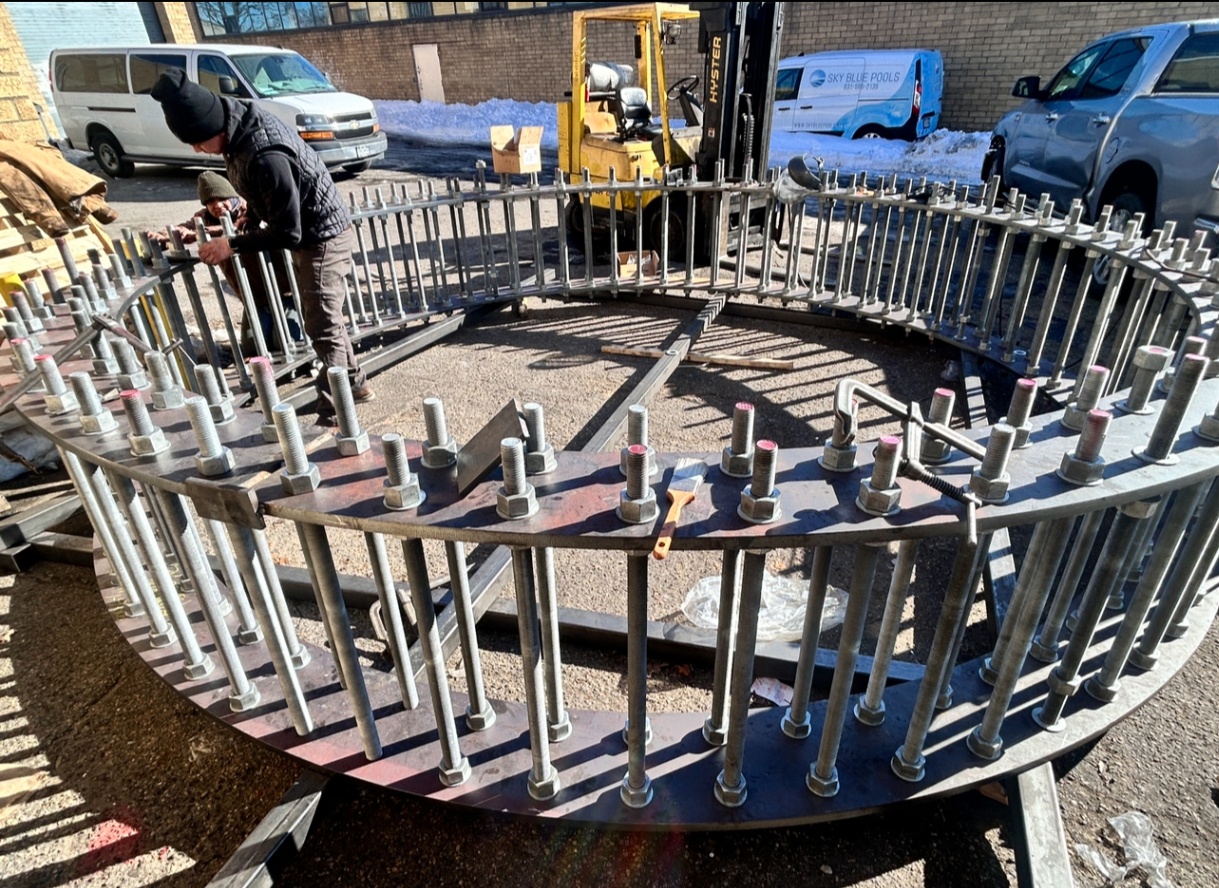
We fabricate anchor bolt assemblies tailored to project drawings and connection demands. That includes custom anchor rods, anchor bolt cages, plate assemblies, and related foundation hardware built for commercial, industrial, and infrastructure applications. We recognize that standard inventory does not solve every foundation condition, which is why custom fabrication remains central to our service model.
In-House Detailing
Our in-house detailing and drafting capabilities allow us to build virtual project components before fabrication begins. This process reduces dimensional conflicts, improves fit-up, and supports more streamlined production. For engineers, fabricators, and contractors, accurate detailing translates directly into fewer field issues and more dependable installation.
WMBE Certification
We are proud representatives of the global community of Women-Minority Business Enterprises. Our WMBE standing reflects not only who we are as a company, but also how we approach partnership, accountability, and long-term industry impact. We firmly believe that diversity, equity, and inclusion strengthen supply chains, strengthen business relationships, and strengthen the construction industry itself.
Our role is not just to deliver fasteners, but also to support the broader success of the project team through dependable supply, professional coordination, and values-driven partnership.
Final Guidance on Specifying Grade 55 vs. Grade 105
When the application calls for weldability, ductility, and balanced structural performance, F1554 Grade 55 is often the correct specification.
When the application calls for concentrated capacity, heavy loads, and high-strength anchorage, F1554 Grade 105 is often the correct specification.
That distinction gives engineers and contractors a clear framework:
- Specify Grade 55 when ductility and weldable fabrication matter.
- Specify Grade 105 when high-strength anchor performance governs the design.
- Coordinate F1554 anchor bolts with A325, A490, and TC bolts according to each product’s role in the structural system.
At LRKD Industries, we supply high-quality steel fasteners and custom construction solutions for bridges, high-rise buildings, industrial facilities, and other demanding structural applications. We provide dependable anchor bolt fabrication, in-house detailing, and coordinated support that aligns with the realities of foundation and steel erection work.
The right anchor bolt specification protects the integrity of the structure from the foundation up. That is why clear material selection, accurate fabrication, and disciplined coordination remain essential on every project.
Author: MEDIA_LRKD