

When you're stacking 300-foot steel towers in the middle of a field: sometimes in weather that makes you question your career choices: the last thing you want is fastener failure. We've worked with enough wind contractors to know that tower section assembly is where the rubber meets the road. Or more accurately, where high-strength structural bolts meet precision-machined flanges.
The connection between tower sections isn't just important. It's everything. Get it wrong, and you're looking at rework, delays, and the kind of liability that keeps project managers up at night. Get it right, and those turbines will be generating power for decades.
Why Bolted Connections Are the Standard
Steel wind turbine towers are built in sections: typically three to five segments that get stacked and secured on-site. Each section is fabricated with welded flanges at both ends, creating a bolt circle with anywhere from 80 to 200+ bolt holes depending on tower diameter and design loads.
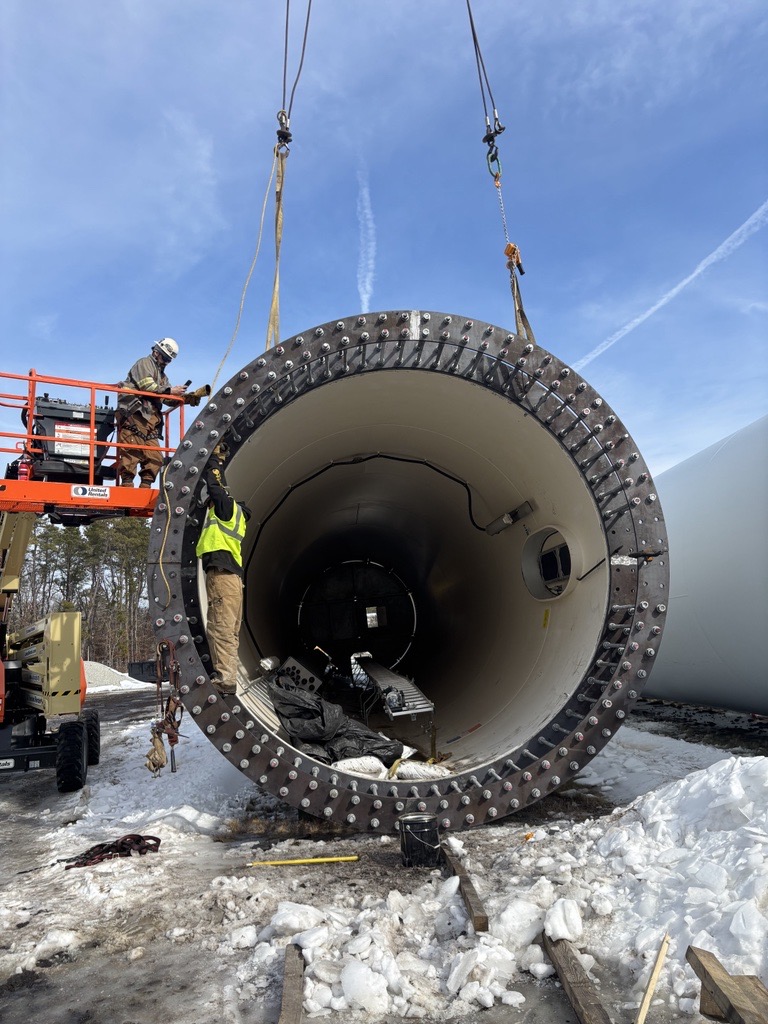
These flanges are where the magic happens. Bolted connections offer several advantages over field welding:
Speed. Tower sections can be lifted and bolted in sequence without waiting for weld cooling, inspection, or weather delays that stop welding operations.
Inspection and QC. Bolted joints are easier to verify. Torque values, bolt tension, and joint integrity can be measured and documented systematically.
Disassembly. If a tower ever needs to come down: for decommissioning, relocation, or major component replacement: bolted connections make that process manageable.
But none of that matters if you're using the wrong fasteners or installing them incorrectly.
TC Bolts: Built-In Quality Control
For wind tower assembly, tension control (TC) bolts have become the go-to fastener. If you've worked with them, you know why. If you haven't, here's the short version: TC bolts eliminate guesswork.
Traditional structural bolting requires torque wrenches, calibration, and constant monitoring of bolt tension. You're relying on torque as a proxy for tension, which works: until it doesn't. Variations in thread condition, lubricant, or flange surface can throw off your readings.

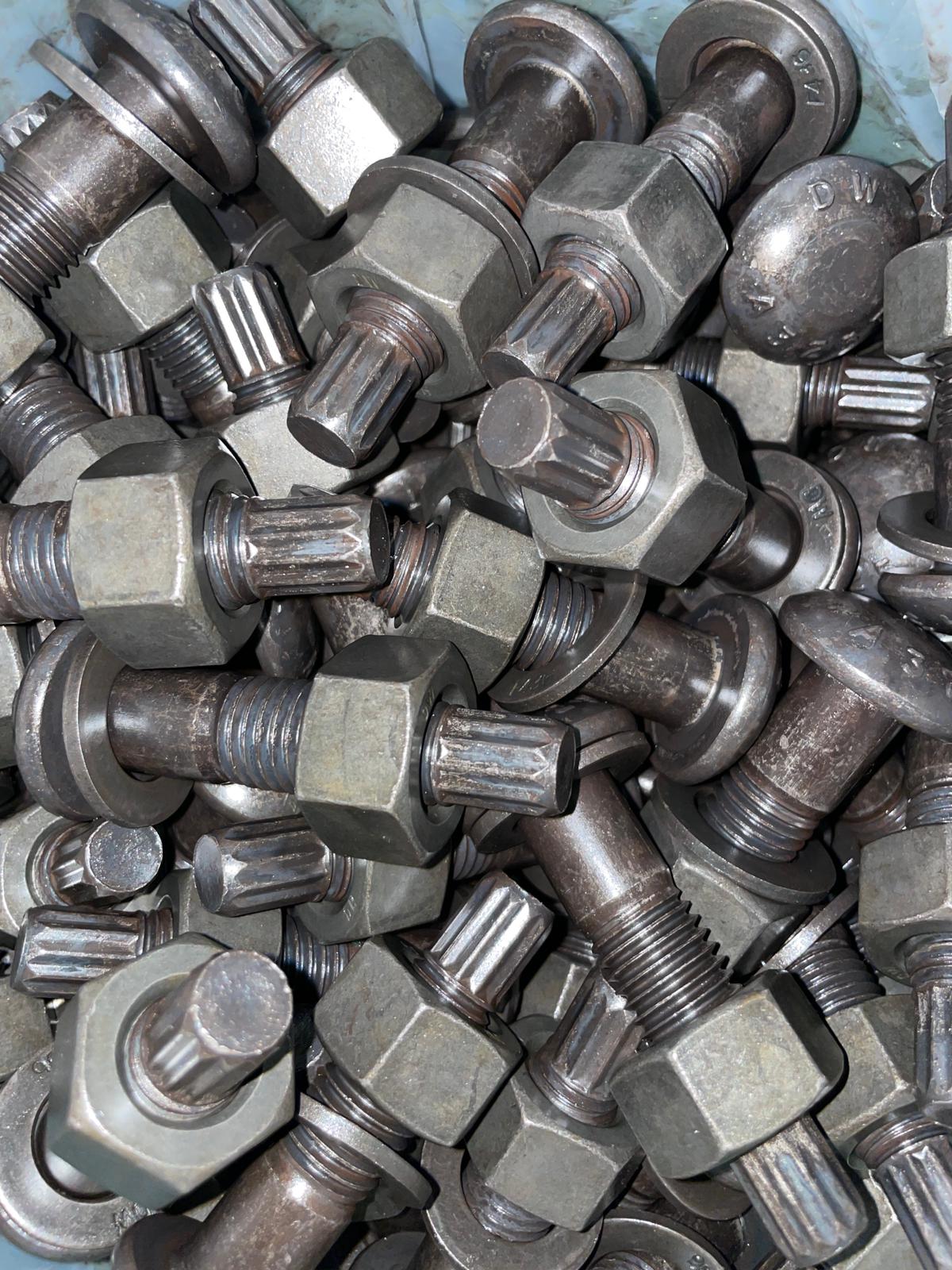
TC bolts solve this with a built-in spline that shears off at a predetermined tension level. The installer uses a special impact wrench that grabs the spline, applies torque, and when the bolt reaches the correct preload, the spline snaps. Clean. Consistent. Verifiable.
For wind projects, this consistency matters. Tower sections experience dynamic loading from wind, turbine operation, and environmental factors. Every bolt in that flange needs to carry its share of the load. Under-tensioned bolts lead to joint slip. Over-tensioned bolts risk thread stripping or bolt fracture. TC bolts bring every fastener to the same tension level, cycle after cycle.
We supply TC bolts in bulk for wind projects because we've seen what happens when contractors try to cut corners with cheaper alternatives. The time saved during installation doesn't offset the risk of callbacks or: worse: structural issues down the road.
A325 and A490: The Workhorses of Structural Steel
When we talk about high-strength structural bolts for tower connections, we're talking about ASTM A325 and ASTM A490 specifications. These aren't interchangeable with anchor bolts or general-purpose fasteners. They're engineered specifically for steel-to-steel connections in structural applications.
ASTM A325 bolts offer a minimum tensile strength of 120 ksi (for diameters up to 1 inch) and are the standard for most wind tower flange connections. They're heat-treated, medium-carbon steel bolts designed to be installed in a snug-tight condition and then tensioned to a specified preload.
ASTM A490 bolts step up the strength to 150 ksi minimum tensile. These are used in higher-load applications or where design engineers want additional safety margin. They're also heat-treated but use alloy steel for that extra performance.
Both specifications require heavy hex heads and nuts to distribute clamping force across the joint. Both are tested and certified to strict mechanical and chemical property standards. And both are available as TC bolts, which is how we typically supply them for wind work.
The bolt grade matters. We've seen projects where someone spec'd A307 bolts (a lower-strength grade intended for non-critical connections) because they were cheaper. Those bolts didn't fail immediately: but they didn't maintain preload under dynamic loading, either. Loose bolts lead to fretting, joint movement, and accelerated wear. Eventually, you're looking at a maintenance nightmare.
When contractors ask us for substitutions to save a few bucks, we point them to the engineering drawings. If the spec calls for A325 or A490, there's a reason. Wind turbine structures are designed with specific load paths and safety factors. Changing the bolt grade changes those calculations.
Weather Doesn't Stop for Wind Projects
One reason we emphasize robust fastener supply for wind projects is the reality of field conditions. Wind farms are built in remote locations: often in regions with high wind resources, which also means high weather variability.
Tower erection doesn't pause for light snow, cold temperatures, or gusty conditions. Crews work in what most people would call challenging weather because project schedules are tight and weather windows are limited.
That photo of workers installing tower sections in the snow? That's not an anomaly. That's Tuesday. TC bolts perform reliably in cold weather because the tension control mechanism is mechanical, not dependent on friction coefficients that change with temperature. Hydraulic torque wrenches can struggle in freezing conditions. Impact wrenches designed for TC bolts keep running.
Galvanized finishes on structural bolts provide corrosion protection during storage, transport, and the initial months after installation. Wind projects often span multiple seasons from groundbreaking to commissioning. Fasteners sit on-site, exposed to weather, before they're ever installed. Hot-dip galvanizing (HDG) ensures they're still in spec when installation day arrives.
We stock galvanized A325 and A490 TC bolts in the sizes wind projects demand: typically ranging from 3/4-inch to 1-1/2-inch diameter, in lengths from 3 inches to 10+ inches depending on flange thickness. Projects don't have time to wait for special orders when a shipment arrives short or a bucket gets damaged in transit.
Supply Chain Reliability for Wind Construction
Wind projects move fast once the turbines arrive on-site. Tower sections, nacelles, and blades are staged in sequence, and crane time is expensive. A missing shipment of structural bolts can idle a 500-ton crawler crane and a crew of 15+ workers. That's not a cost anyone wants to absorb.
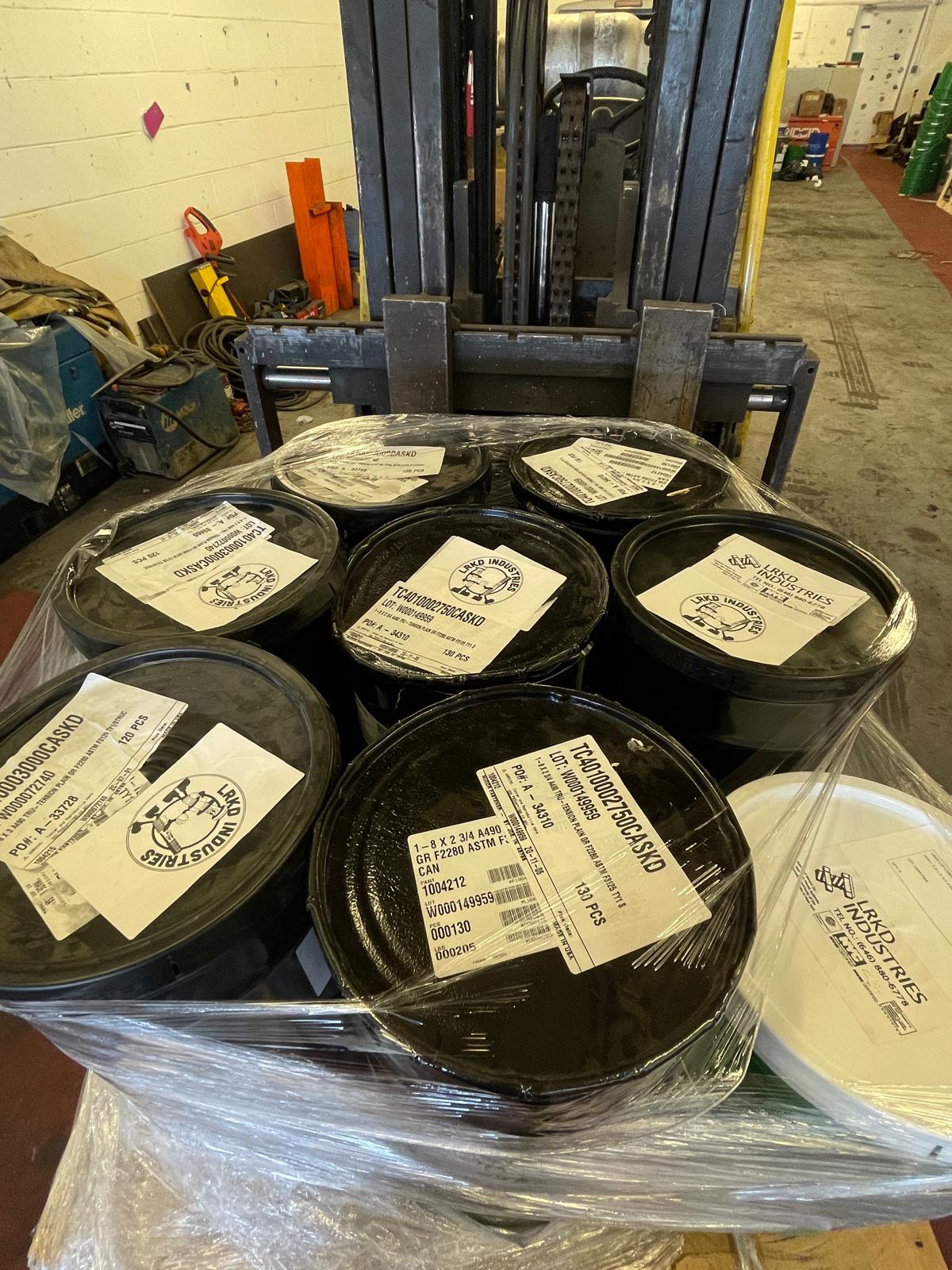
We've built our wind supply business around the understanding that construction schedules are non-negotiable. Projects need fasteners on-site when the tower sections arrive, not three days later. Our inventory management and logistics systems are designed to support just-in-time delivery without the risk of shortages.
We also provide full traceability. Every lot of structural bolts we supply includes mill test reports (MTRs) documenting material chemistry, mechanical properties, and heat treatment. Wind projects operate under strict quality control regimes. Contractors need documentation that proves every fastener meets specification.
Certification isn't optional. It's table stakes. But speed, consistency, and communication separate suppliers who understand wind construction from those who treat it like any other order.
Beyond the Bolts: Nuts, Washers, and Complete Assemblies
Tower section assembly requires more than just bolts. Heavy hex nuts: engineered to match A325 or A490 bolt properties: are part of the connection system. Hardened washers distribute load and protect flange surfaces. Some designs use locking mechanisms or additional hardware to prevent loosening under vibration.
We supply complete fastener packages for wind projects because piecemeal sourcing creates compatibility risks. A325 bolts require A563 Grade DH or DH3 nuts. Washers need to meet F436 hardness requirements. Mix and match from different suppliers, and you're gambling that everything plays nicely together.
Our approach is to provide matched, certified assemblies that arrive ready to install. Contractors open the bucket, load the impact wrench, and start connecting tower sections. No questions about whether the nut grade matches the bolt spec or whether the washer thickness is within tolerance.
That level of supply chain integration makes our clients' lives easier. It also reduces risk, which is what everyone cares about when you're building structures that need to stand for 20+ years in the toughest environments.
Final Thoughts
Wind energy is growing, and that means more towers going up every year. The engineering behind those towers is sophisticated: stress analysis, fatigue modeling, dynamic load calculations. But at the end of the day, it all comes down to whether the connections hold.
High-strength structural bolts and TC fasteners are what make modern wind turbine assembly possible. They're reliable, verifiable, and proven in thousands of installations worldwide. We're proud to supply them because we know the work they're doing: and we know the projects we support are built to last.
If you're planning a wind project or need to restock fastener inventory for ongoing construction, reach out to our team. We'll make sure you have the right fasteners, in the right quantities, delivered when you need them.
Author: MEDIA_LRKD