

For decades, the engineering community has grappled with a fundamental conflict: the need for the immense tensile strength of A490 bolts and the necessity of corrosion protection in harsh environments. Traditionally, hot-dip galvanizing and A490 fasteners were considered a prohibited pairing. The risk of hydrogen embrittlement: a silent, catastrophic failure mechanism: made zinc-coated high-strength fasteners a liability many project managers were unwilling to accept.
As we move through 2026, the regulatory landscape has shifted. With the introduction of ASTM F3125-26a and the new ASTM F3472-26, the industry now has a clear, data-driven path toward safely coating high-strength fasteners. At LRKD Industries, we recognize that your projects in the Bronx, Long Island, and across the New York metro area require both the structural integrity of Grade 150 fasteners and the longevity provided by modern coating technologies.
The Chemistry of Risk: Understanding Hydrogen Embrittlement
Hydrogen embrittlement is often described as the "invisible threat" in structural engineering. When high-strength steel, specifically those with a tensile strength exceeding 145 ksi like a490 bolts, is exposed to atomic hydrogen during the cleaning or coating process, the hydrogen atoms can migrate into the crystalline structure of the metal.

Once inside, these atoms collect at grain boundaries and tiny inclusions. When the bolt is subsequently placed under tension, this internal hydrogen pressure causes the steel to become brittle, leading to sudden, microscopic cracks that can result in total fastener failure without warning. Because A490 bolts are designed to operate at near-maximum capacity in critical joints, the margin for error is non-existent.
We believe that understanding this risk is the first step toward mitigation. The traditional prohibition against galvanizing A490 bolts was rooted in the unpredictability of the acid pickling and hot-dip processes. However, 2026 standards have replaced broad prohibitions with rigorous qualification protocols.
The 2026 Regulatory Landscape: F3125-26a and F3472-26
The release of ASTM F3125-26a in May 2026 marked a pivotal moment for structural fastening. This revision introduced mandatory Hydrogen-Induced Delayed Fracture (HIDF) validation for any Grade 150+ fastener intended for high-risk environments. It specifically bridges the gap between material manufacturing and environmental performance.
Complementing this is the newly ratified ASTM F3472-26, which provides a centralized framework for the "Standard Practice for the Control and Qualification of Coatings on High-Strength Structural Fasteners." This standard effectively dictates how a coating system: be it mechanical galvanizing, thermal diffusion, or specific electroplating: must be tested before it can be applied to an A490 bolt.
We recognize that navigating these updates can be complex. The core takeaway for 2026 is that galvanizing is no longer a simple "yes" or "no" question; it is a question of process qualification. Under the new rules, any zinc-based coating system for A490 bolts must pass a two-pronged validation:
- Internal Hydrogen Embrittlement (IHE): Testing per ASTM F1940 to ensure the manufacturing process itself does not introduce hydrogen.
- Environmental Hydrogen Embrittlement (EHE): Testing per ASTM F2660 to ensure the coating does not generate hydrogen during the natural corrosion process in the field.
Selecting the Right Coating for High-Strength Projects
If your project requires the 150 ksi minimum tensile strength of an A490 bolt but is located in a corrosive coastal environment like Long Island, you must select a qualified coating system. Not all "galvanizing" is created equal in the eyes of the 2026 standards.
Mechanical Galvanizing
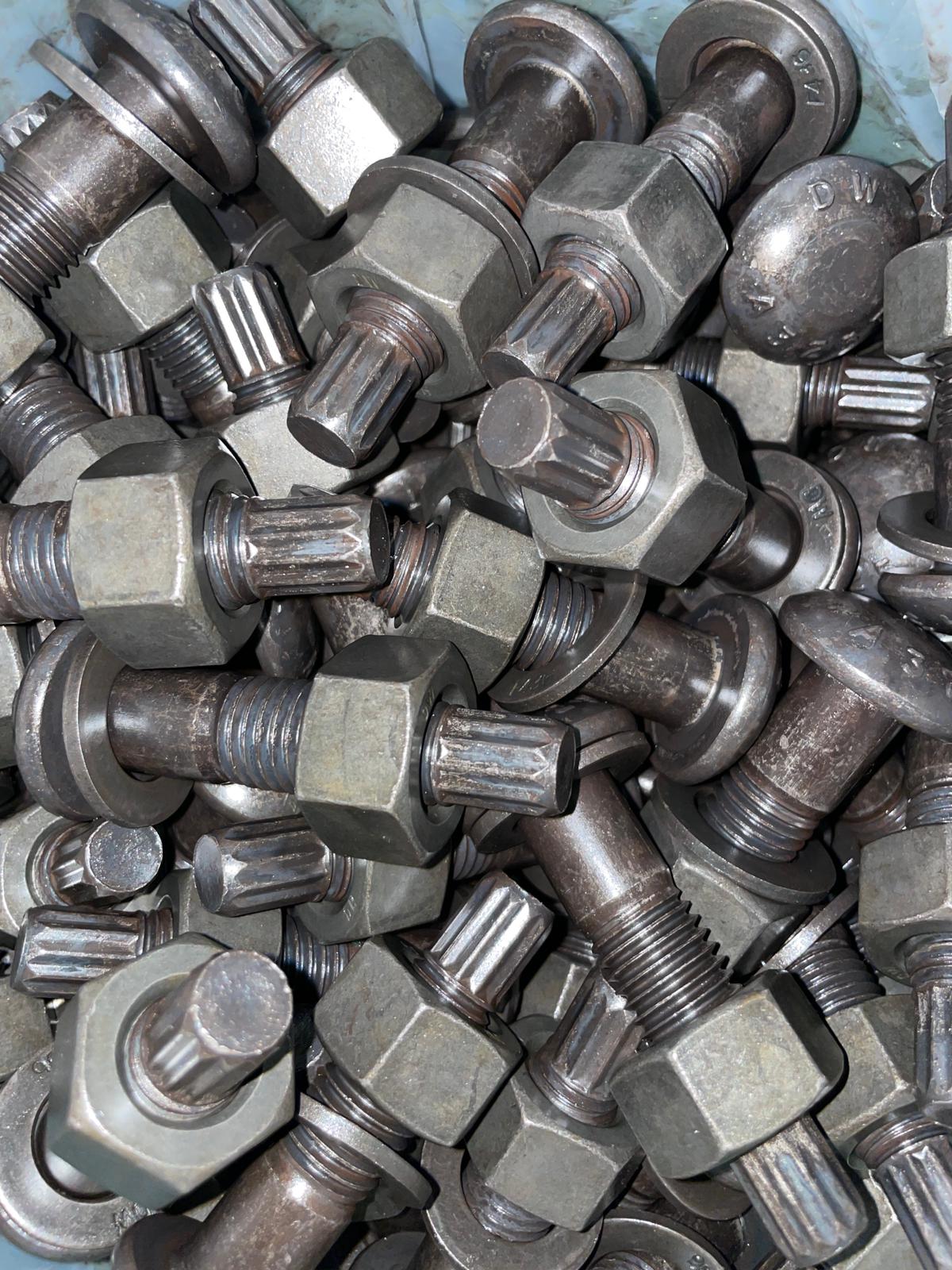
Mechanical galvanizing remains a preferred choice for many high-strength applications. Unlike hot-dip galvanizing, which involves molten zinc and acid pickling, mechanical galvanizing uses a room-temperature "cold" process where zinc powder is mechanically fused to the bolt surface using glass beads. This process significantly reduces the introduction of hydrogen, making it a naturally safer profile for A490 fasteners.
Thermal Diffusion Coating
Gaining significant traction in 2026, thermal diffusion (often referred to as Sherardizing) provides a highly uniform, sacrificial zinc-iron alloy layer. Because it is a dry process, it bypasses many of the hydrogen-generating steps associated with traditional plating, meeting the strict requirements of ASTM F3472-26 with ease.
Specialized Hot-Dip Protocols
While traditional hot-dip galvanizing is still treated with extreme caution, certain high-tech galvanizing lines have achieved qualification for A490 bolts by utilizing flash-pickling or mechanical descaling (shot blasting) instead of prolonged acid baths, followed by immediate, mandatory baking cycles to "out-gas" any residual hydrogen.
Beyond the Bolt: Integrated Structural Solutions
At LRKD Industries, we understand that a high-strength bolt is only as effective as the system it supports. While a490 bolts and their Tension Control (TC) variants are the workhorses of vertical steel, they must be integrated into a broader foundation of quality.
For structural foundations, machinery base plates, and bridge abutments, we provide comprehensive solutions that include ASTM F1554 anchor bolts (Grades 36, 55, and 105). It is essential to note that while A490 bolts are used for steel-to-steel connections, the F1554 specification is the industry standard for foundation anchors. We provide professional in-house detailing and engineering services to ensure that every embed plate, foundation cage, and heavy-duty wedge anchor is accurately specified for your site's specific load and corrosion requirements.
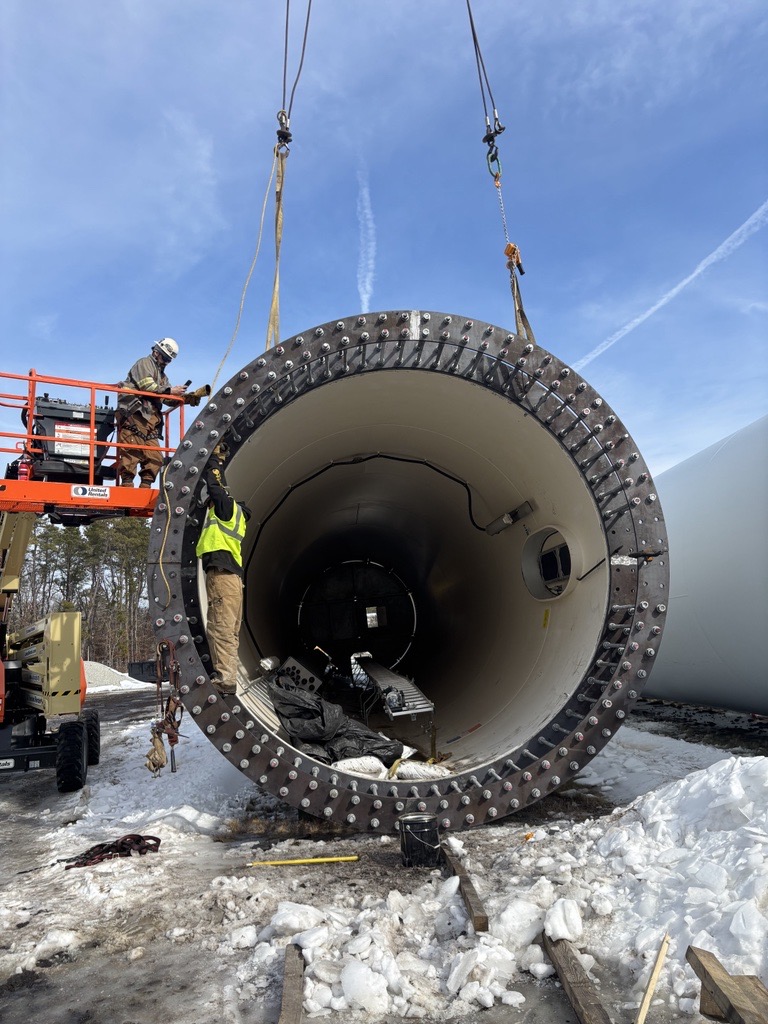
We utilize in-house drafting to build virtual projects before a single bolt is shipped. This "virtual first" approach allows us to identify potential interference issues in complex structural joints, ensuring that when our high-strength A490 fasteners arrive at your site in the Bronx or Long Island, they fit perfectly and perform exactly as engineered.
Commitment to Quality and Compliance
The transition to the 2026 standards represents an advancement in safety and durability. LRKD Industries is proud to be at the forefront of this shift. As a certified Women-Minority Business Enterprise (WMBE), we are dedicated to breaking barriers in the construction supply chain by providing not just hardware, but technical expertise.
We firmly believe that transparency is the key to structural integrity. When you source A490 bolts from us, you aren't just getting steel; you are getting a partner who understands the nuances of ASTM F3125-26a and F3472-26. We provide full traceability and documented testing for all coated high-strength fasteners, ensuring your project meets the highest levels of regulatory compliance.
Summary: The Current Truth
Can A490 bolts be galvanized in 2026? Yes: but only through qualified, validated coating systems that have been proven to mitigate hydrogen embrittlement. The days of "buyer beware" are being replaced by a culture of "engineered assurance."
Whether you are working on a high-rise in Manhattan, a bridge in the Bronx, or an industrial facility on Long Island, the choice of fastener and coating is a critical safety decision. We invite you to leverage our engineering services and high-quality inventory to ensure your next project is built on a foundation of reliability and accuracy.
Author: MEDIA_LRKD