

Navigating structural fastener standards requires precision, accuracy, and absolute clarity. For engineers, specifiers, and contractors sourcing materials for high-stakes projects across the New York area, standards govern everything from structural integrity to site inspections. When specification revisions occur, your detailing and procurement workflows must adapt immediately.
The consolidation and evolution under ASTM F3125: including recent updates culminating in F3125-26a: represent the most significant shift in structural bolting standards in decades. We recognize that staying ahead of these updates is essential for maintaining compliance on bridges, high-rise buildings, and industrial facilities.
Below, we examine the five critical changes under the unified ASTM F3125 framework that directly impact your a325 bolts, a325 tension control bolts, and broader structural bolts specifications.
1. Unified Consolidation Under ASTM F3125
We live in an era where specification streamlining drives project efficiency. Historically, structural engineers and contractors referenced multiple distinct ASTM standards for high-strength bolts. ASTM A325, A490, A325M, A490M, F1852, and F2280 each lived in separate documents, creating complex cross-referencing demands.
The overarching specification consolidated these into a single, comprehensive standard: ASTM F3125 / F3125M.
- What were once standalone standards are now categorized as specific Grades within F3125.
- Traditional a325 bolts are now formally designated as ASTM F3125 Grade A325.
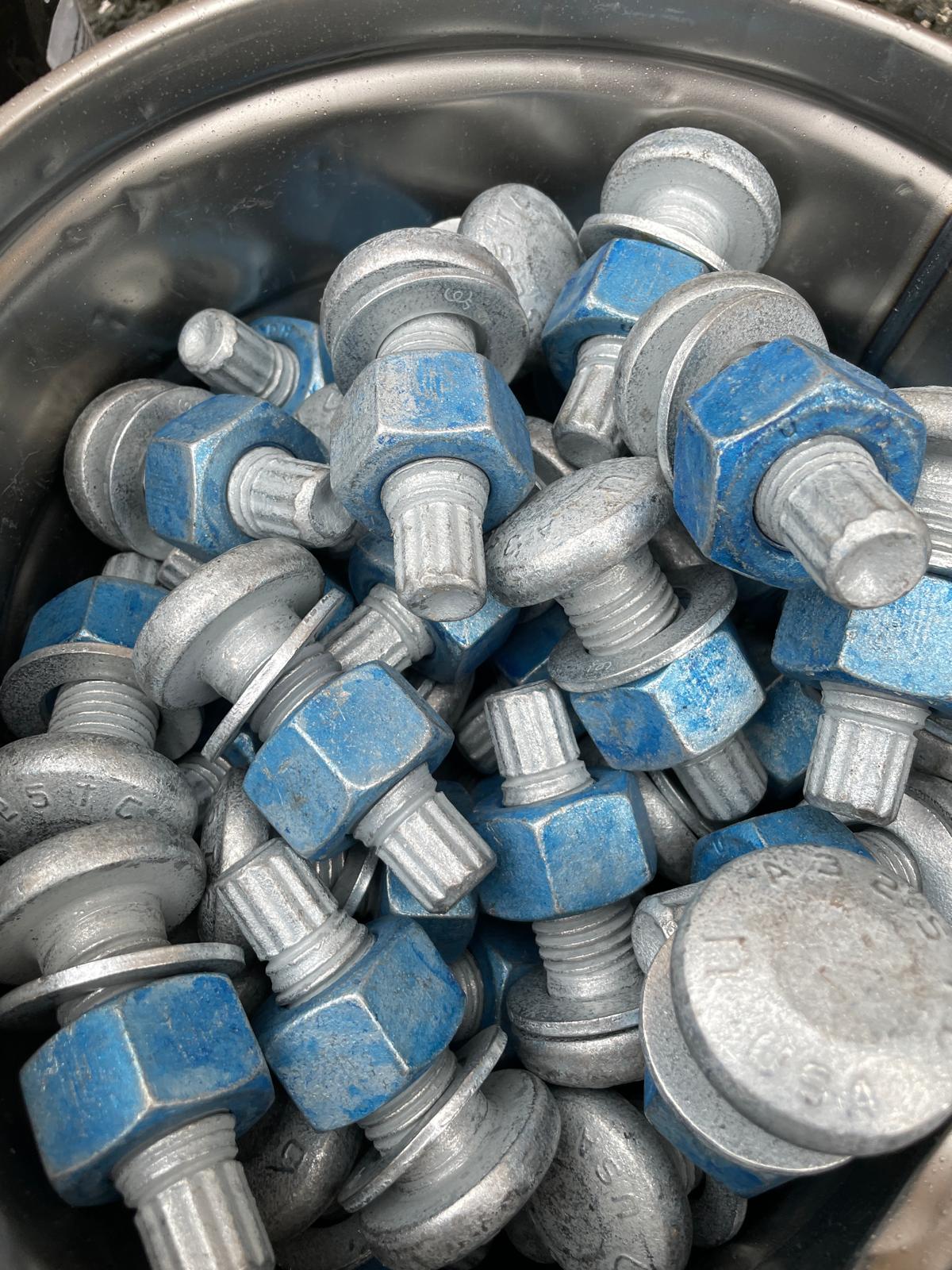
- a490 bolts and heavy hex structural fasteners sit alongside twist-off tc bolts and a325 tension control bolts under one unified document.
To eliminate confusion on the job site and in the fabrication shop, physical head markings remain reassuringly familiar. Your fasteners continue to display standard head markings like "A325," while procurement documents and structural calculations reflect the updated F3125 Grade classification.
2. Elimination of the Size-Based Tensile Strength Drop
The most consequential technical update within the standard addresses a long-standing discrepancy in mechanical properties for larger-diameter fasteners.
Under legacy standards, a325 bolts manufactured in diameters from ½ inch up to 1 inch required a minimum tensile strength of 120 ksi. However, bolts with diameters greater than 1 inch dropped to a 105 ksi minimum tensile strength. This discrepancy frequently forced engineers to manually reconcile material test reports with design assumptions.
ASTM F3125 Grade A325 eliminates this drop entirely:
- All diameters from ½ inch up to 1½ inches now require a uniform 120 ksi minimum tensile strength.
- Minimum yield strength remains at 92 ksi across the entire size range.
- Hardness requirements are standardized across all applicable sizes.
This change aligns material manufacturing strictly with modern AISC and RCSC design practices, which had already assumed 120 ksi for design calculations across all structural bolts. Consequently, minimum pretension values for large-diameter fasteners have been updated in engineering tables, ensuring uniform performance across every connection on your job site.
3. Expanded Flexibility Through Supplement S2 and Special Markings
Modern architectural designs and complex industrial retrofits often demand fastener geometries that deviate from standard ASME B18.2.6 dimensions. Sourcing nonstandard lengths or unique shank configurations used to introduce compliance ambiguity.
ASTM F3125 introduces Supplement S2, providing formal mechanisms for ordering nonstandard bolt dimensions:
- Purchasers can specify alternative head shapes, customized thread lengths, and non-standard shank dimensions.
- Fasteners ordered under Supplement S2 must carry a distinct “S” marking (such as A325S) on the bolt head.
- This explicit marking gives field inspectors immediate visual verification that nonstandard dimensions are fully certified and compliant with engineering drawings.
We utilize in-house drafting and engineering detailing to build virtual projects before fabrication. When unique structural geometries require specialized tc bolts or custom fasteners, Supplement S2 integration ensures zero guesswork during installation.
4. Standardized Coatings and Rotational Capacity Protocols
Coating selection directly influences installation torque, tension accuracy, and corrosion resistance. Previous standards scattered coating guidance across multiple appendices and external references.
ASTM F3125 establishes a centralized, rigorous framework for protective finishes:
- Annex A1 provides a single, unambiguous table detailing permitted coatings and required nut over-tapping tolerances.
- Strict prohibitions remain enforced: hot-dip and mechanical galvanizing are strictly prohibited for a490 bolts due to hydrogen embrittlement risks. Advanced zinc-aluminum coatings (such as F1136 and F2833) are explicitly accommodated for Grades A325 and A490.
- Annex A2 standardizes the rotational capacity test for heavy hex assemblies and a325 tension control bolts, ensuring verifiable pre-tensioning performance in the field.
Whether you require mechanical galvanizing for coastal infrastructure or plain finish for interior industrial framing, our centralized inventory of structural supplies meets every coating specification without delay.
5. Clearer Integration with Foundation Details and Anchor Hardware
Structural stability begins at the foundation. While high-strength a325 bolts and tc bolts secure superstructure steel, connection integrity often depends on robust anchor assemblies embedded in concrete.
It is vital to maintain clear distinctions between structural superstructure bolting and foundation anchor specifications:
- Superstructure assemblies rely on ASTM F3125 Grade A325 and Grade A490 specifications.
- Concrete foundations, base plates, and embedded anchor cages utilize dedicated anchor specifications such as f1554 anchor bolts (Grades 36, 55, and 105).
ASTM F3125 brings unprecedented clarity to structural packages, allowing engineers to seamlessly integrate superstructure steel specifications with foundation anchoring plans. When coordinating complex steel supply packages for commercial and industrial builds across the New York metropolitan area, utilizing unified, fully traceable standards minimizes errors and accelerates project closeouts.
Partner With Proven Expertise
Adapting to evolving standards like ASTM F3125-26a requires a reliable supply partner who understands engineering precision. As a proud Women-Minority Business Enterprise (WMBE), we combine prompt customer support, in-house detailing expertise, and an extensive inventory of certified structural fasteners to keep your projects moving forward.
We recognize that your timeline depends on absolute accuracy, which is why every fastener we supply is fully traceable and engineered to meet current industry demands. Contact our team today to discuss your next structural supply requirement.
Author: MEDIA_LRKD