


When a steel erector arrives on site and discovers that anchor bolts don't align with base plate holes, the entire project timeline shifts. Concrete has already cured. Equipment is staged. Crews are ready. But those bolts are off by a quarter inch, and suddenly you're looking at drilling out concrete, re-pouring sections, or fabricating custom shim solutions.
The tolerance you specify for anchor bolt cages determines whether your foundation work proceeds smoothly or becomes a costly field modification exercise. We've seen projects where a ±1/8" tolerance standard prevented thousands of dollars in rework, and we've seen projects where loose tolerances created weeks of delays.
The Industry Tolerance Conflict
The American Institute of Steel Construction and the American Concrete Institute operate with fundamentally different tolerance philosophies. AISC demands precision because structural steel connections require it. ACI allows more flexibility because concrete work involves variables that resist tight control.
AISC specifies that anchor bolts must be located within ±1/16 inch of their design position. This tolerance reflects the realities of base plate fabrication, where holes are typically drilled or punched to exact dimensions with minimal oversize allowance.
ACI permits more generous tolerances, recognizing that concrete placement, formwork movement, and curing dynamics introduce variability. The conflict arises when these two standards must be satisfied simultaneously on the same foundation.

To meet both AISC and ACI requirements, anchor bolts theoretically need placement accuracy within ±1/16 inch. Field crews using traditional string lines, templates, or hand-held measurements cannot consistently achieve this precision. The American Society of Concrete Contractors acknowledges this reality by recommending practical tolerances based on bolt diameter.
For smaller diameter bolts: 3/4 inch and 7/8 inch: ASCC suggests ±1/4 inch tolerance. For 1-inch through 1-1/2-inch bolts, ±3/8 inch becomes the practical standard. Larger diameter bolts receive ±1/2 inch allowances.
These recommendations represent what field crews can realistically achieve under typical conditions. They do not represent what structural connections actually require for smooth assembly.
Why ±1/8" Represents the Practical Sweet Spot
A ±1/8-inch tolerance bridges the gap between theoretical precision and achievable accuracy. This standard recognizes that modern fabrication techniques: specifically factory-assembled anchor bolt cages: can consistently deliver accuracy that field methods cannot match.
When we fabricate anchor bolt cages in a controlled shop environment, we position F1554 anchor bolts within rigid steel framework. Jigs, templates, and welding fixtures maintain dimensional accuracy throughout assembly. The bolts cannot shift during transport because structural steel holds them in precise relationship to one another.
This tolerance level accommodates minor variations in concrete placement while remaining tight enough to eliminate most field adjustment scenarios. Base plate holes with standard oversize allowances can accommodate bolt positions held to ±1/8 inch without requiring slotted holes or oversized openings.
The ±1/8-inch standard also reflects the capabilities of modern surveying equipment and concrete formwork systems. When foundation contractors know that anchor bolt cages will arrive with precision shop fabrication, they can implement placement procedures that maintain that accuracy through the pour.
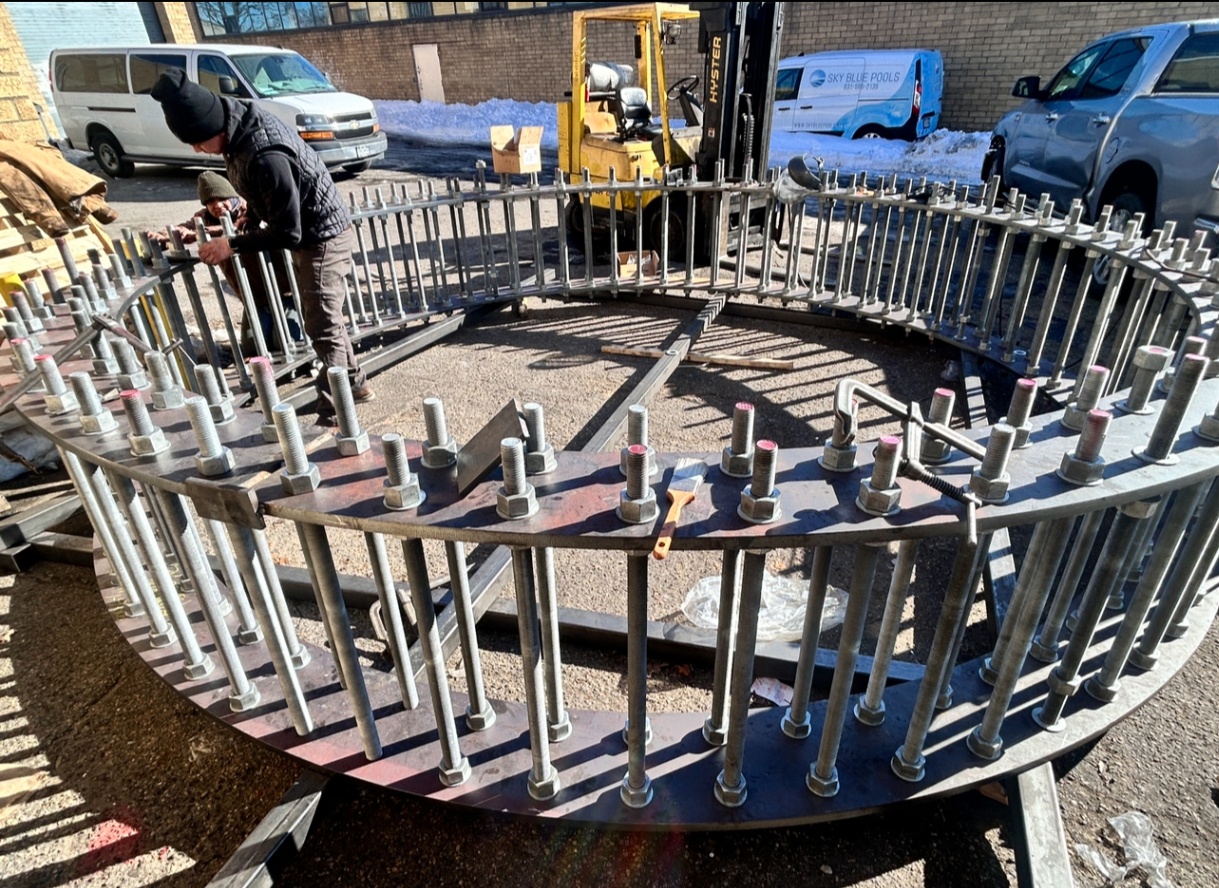
Projects involving circular or complex bolt patterns particularly benefit from tight tolerances. Wind turbine foundations, bridge pier caps, and industrial equipment bases often feature dozens of anchor bolts arranged in precise geometric patterns. Field placement of individual bolts to these patterns invites cumulative error. Factory-fabricated cages eliminate that risk.
Factory Fabrication Versus Field Placement
Consider the typical field placement scenario. Bolts get tied to rebar or suspended from wood templates. During concrete placement, vibration from pumping and consolidation equipment creates movement. Workers walking on forms introduce additional disturbance. As concrete rises around the bolts, buoyancy forces and flow patterns push against them.
Each of these factors contributes to dimensional drift. A bolt that starts in the correct position may shift by 1/4 inch or more during the pour. Multiply this by twelve or twenty bolts in a single foundation, and the likelihood of achieving acceptable overall tolerance drops significantly.
Factory-fabricated anchor bolt cages eliminate these variables. Bolts are welded or mechanically fastened to steel template plates or structural shapes. The entire assembly sits on designed embedment depth, positioned and braced as a single rigid unit. Concrete flows around the cage without displacing individual bolts.
We fabricate these cages using F1554 Grade 36, Grade 55, or Grade 105 anchor bolts depending on design loads. Grade selection determines material strength and elongation characteristics, but all three grades work within precise cage assemblies. The key distinction: F1554 specifies anchor bolts designed for concrete embedment, not the structural bolts like A325 or A490 used in steel-to-steel connections.
F1554 Anchor Bolts in Precision Cage Assemblies
ASTM F1554 covers straight, bent, headed, or headless anchor bolts intended for anchoring structural supports to concrete foundations. The specification includes three grades with increasing strength levels. Grade 36 provides minimum yield strength of 36,000 psi. Grade 55 delivers 55,000 psi yield. Grade 105 reaches 105,000 psi minimum yield strength for high-load applications.
When we design anchor bolt cages, material selection follows the structural engineer's specifications for load capacity, embedment length, and thread engagement requirements. The cage fabrication process remains consistent across grades. What changes is the bolt material itself and the welding procedures required to maintain material properties.

Thread protection represents a critical consideration during cage fabrication and concrete placement. Threads must remain clean and undamaged for proper nut engagement during steel erection. We protect threads with removable caps or coatings that prevent concrete intrusion without interfering with template accuracy.
Galvanizing requirements add another layer of consideration. Hot-dip galvanized anchor bolt cages provide corrosion protection essential for marine environments, coastal installations, and outdoor industrial equipment foundations. The galvanizing process introduces dimensional changes that must be accommodated in the initial fabrication tolerances.
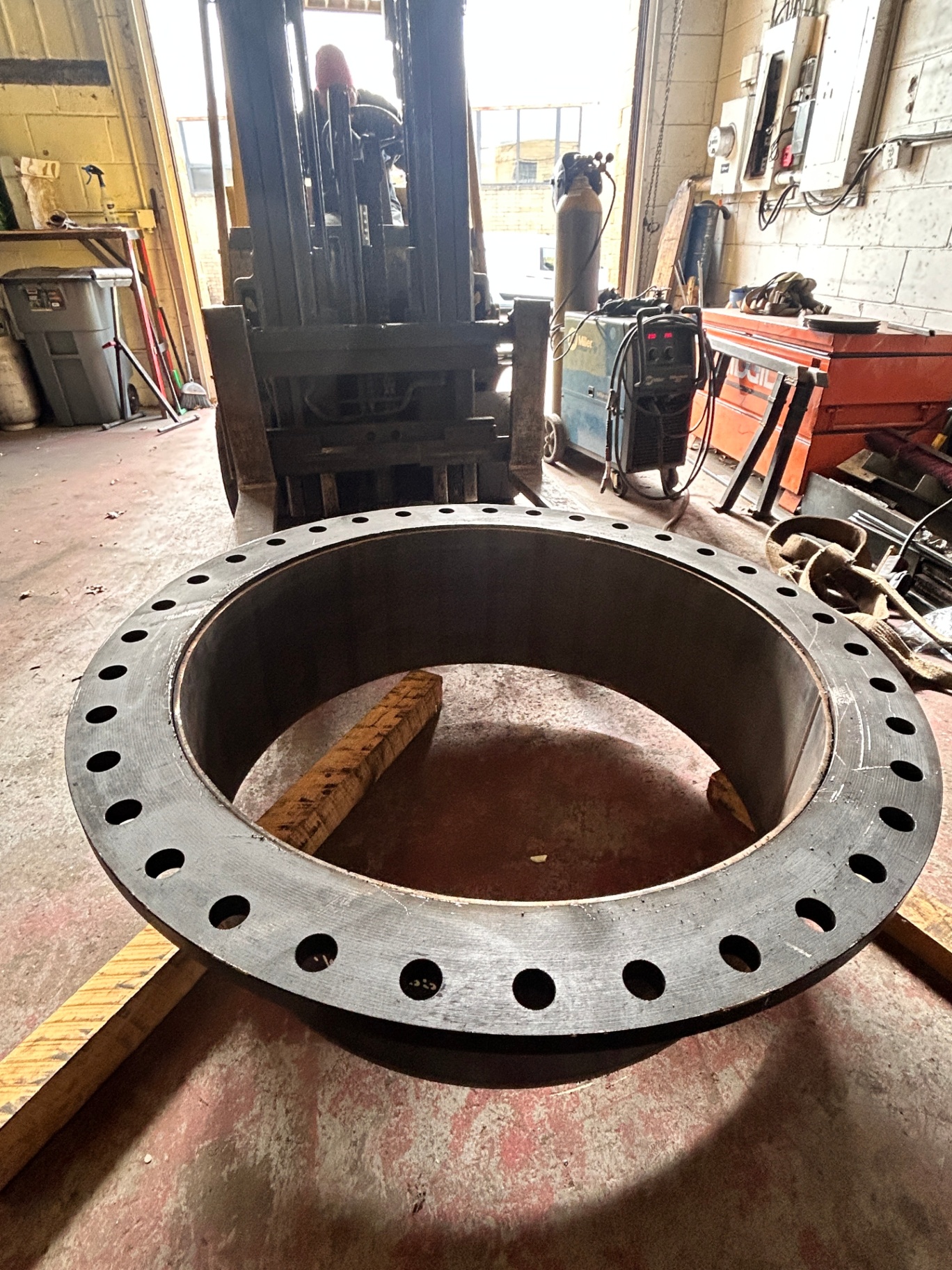
Cage geometry varies based on foundation type and bolt pattern complexity. Simple rectangular patterns use steel plate templates with precision-drilled holes. Circular patterns for wind turbine or tank foundations employ ring-shaped templates. Complex three-dimensional patterns might require full structural steel framework to maintain bolt positioning throughout the pour.
Concrete Pour Preparation and Inspection
The precision of factory-fabricated cages means nothing if placement and bracing procedures allow movement during the concrete pour. We recommend specific inspection points before, during, and after concrete placement.
Before the pour begins, verify cage position using total station surveying equipment or comparable precision instruments. Document bolt positions at multiple points within the pattern. Check elevation at all corners or key reference points. Confirm that bracing systems provide rigid support capable of resisting concrete flow forces.
During concrete placement, station observers to monitor the cage for any movement. Concrete should flow evenly around the cage without creating unbalanced pressure. Vibration for consolidation should occur away from the cage structure when possible. If movement is detected, stop placement immediately and re-establish correct positioning before proceeding.
After concrete placement but before initial set, verify bolt positions again. This represents the last opportunity for adjustment if minor movement occurred. Once concrete achieves initial set, positional changes become exponentially more difficult and expensive.
Final verification occurs after concrete curing when formwork is removed. Survey bolt positions and compare to design dimensions. Document any deviations and assess whether they fall within acceptable tolerances. This data becomes critical if field modifications are required during steel erection.
Real-World Consequences of Tolerance Failures
When anchor bolts fall outside acceptable tolerances, contractors face limited options. None are inexpensive. None are quick.
Drilling out concrete and installing new anchors requires specialized equipment and expertise. The original bolts remain embedded, potentially interfering with new anchor placement. Epoxy anchors or mechanical post-installed anchors may lack the capacity of properly embedded cast-in-place bolts.
Slotting base plate holes creates stress concentrations not accounted for in the original structural design. Engineers must review and approve modified connections. The slotted holes may require oversize washers or backing plates to distribute loads properly.
Shimming and field welding can compensate for minor misalignments, but these solutions add cost and complicate erection sequences. Shim stacks reduce effective bolt engagement length. Field welding requires qualified welders and inspection procedures not originally scheduled.
The most expensive consequence remains schedule delay. Steel erection crews demobilize while solutions are engineered and implemented. Equipment rentals continue. Other trades waiting for steel superstructure completion face their own delays. The ripple effects compound through the entire project timeline.
Best Practices for Maintaining ±1/8" Tolerances
Achieving consistent ±1/8-inch accuracy requires commitment across multiple project phases. Design documents must clearly specify tolerance requirements and reference them to industry standards. Ambiguous callouts like "standard tolerances" leave room for interpretation and conflict.
Shop drawings for anchor bolt cages should detail all critical dimensions, including bolt spacing, pattern geometry, embedment depth, and thread projection above finished concrete elevation. These drawings require structural engineer review and approval before fabrication begins.
Quality control during cage fabrication includes dimensional verification at multiple stages. Check bolt positions after initial assembly, after welding or mechanical fastening, and after any heat treatment or galvanizing processes. Document measurements and maintain records for project files.
Coordination between concrete contractor and steel erector prevents misunderstandings about tolerance requirements and inspection procedures. Both parties should review cage placement procedures before the pour. Clear communication about acceptable tolerances and verification methods eliminates ambiguity when questions arise in the field.
We recognize that precision foundation work establishes the success of everything built above it. The ±1/8-inch tolerance standard represents achievable accuracy that serves structural requirements without imposing unrealistic demands on field construction. Factory-fabricated anchor bolt cages deliver this precision consistently, project after project, eliminating the costly rework that loose tolerances invite.
For detailed specifications and custom anchor bolt cage fabrication, contact our team at LRKD Industries. We engineer precision foundation solutions for projects where tolerance isn't negotiable.
Author: MEDIA_LRKD