

In the demanding world of structural steel construction, the margin for error is non-existent. Engineers and project managers require fastening solutions that provide not just strength, but absolute reliability under the most extreme loads. We recognize that selecting the right hardware is a fundamental pillar of site safety and structural integrity. Among the various grades available to the industry, the A490 bolt stands out as the high-performance workhorse for heavy-duty applications.
This guide provides a comprehensive technical deep-dive into A490 bolts, covering their mechanical properties, material composition, and the critical installation standards required for modern infrastructure. Whether you are working on high-rise commercial developments or complex bridge systems, understanding the nuances of these high-strength fasteners is essential for compliance and performance.
The Evolution of the A490 Specification
For decades, ASTM A490 was the primary standard for high-strength alloy steel structural bolts. However, the industry has transitioned toward a consolidated standard. In 2016, ASTM International withdrew the standalone A490 specification and incorporated it into ASTM F3125. Specifically, it is now officially known as ASTM F3125 Grade A490.
Despite this change in documentation, the industry continues to refer to them simply as "A490 bolts." This grade is designed specifically for structural connections that require higher tensile strength than what the standard A325 bolt can offer. We provide these fasteners to professionals who understand that superior load-bearing capacity is often the difference between a standard build and an engineering marvel.
Mechanical Superiority: Strength by the Numbers
The defining characteristic of an A490 bolt is its exceptional tensile strength. While standard structural bolts provide reliable performance for general applications, A490 bolts are engineered for high-stress environments.
The mechanical requirements for Grade A490 are stringent:
- Tensile Strength: 150 to 173 ksi (kilopounds per square inch).
- Yield Strength: 130 ksi minimum.
- Hardness: Rockwell C 33 to 38.
Compared to A325 bolts, which typically offer a tensile strength of 105 to 120 ksi, A490 bolts provide approximately 25% more strength. This increased capacity allows engineers to use fewer bolts or smaller diameter fasteners to achieve the same structural requirements, potentially reducing the overall weight and complexity of a steel connection. We recognize that efficiency in design is just as important as the materials used, which is why we maintain a comprehensive product catalog to support these technical requirements.
Material Composition: Why Alloy Steel is Essential
A490 bolts are manufactured from quenched and tempered alloy steel. Unlike lower-grade fasteners that may use medium carbon steel, the alloy composition of the A490 allows it to reach higher hardness levels and maintain its structural integrity under tension.
There are two primary types of A490 bolts specified by the standard:
- Type 1: Made from medium carbon alloy steel. This is the most common version used in standard structural applications.
- Type 3: Manufactured from weathering steel. This version is designed to develop a protective oxide coating when exposed to the elements, making it the preferred choice for bridges and unpainted structures where atmospheric corrosion resistance is required.
The quenching and tempering process is a thermal treatment that refines the grain structure of the steel, ensuring that the bolt possesses both high strength and the necessary ductility to resist brittle failure.
Design for Durability: Heavy Hex and Thread Lengths
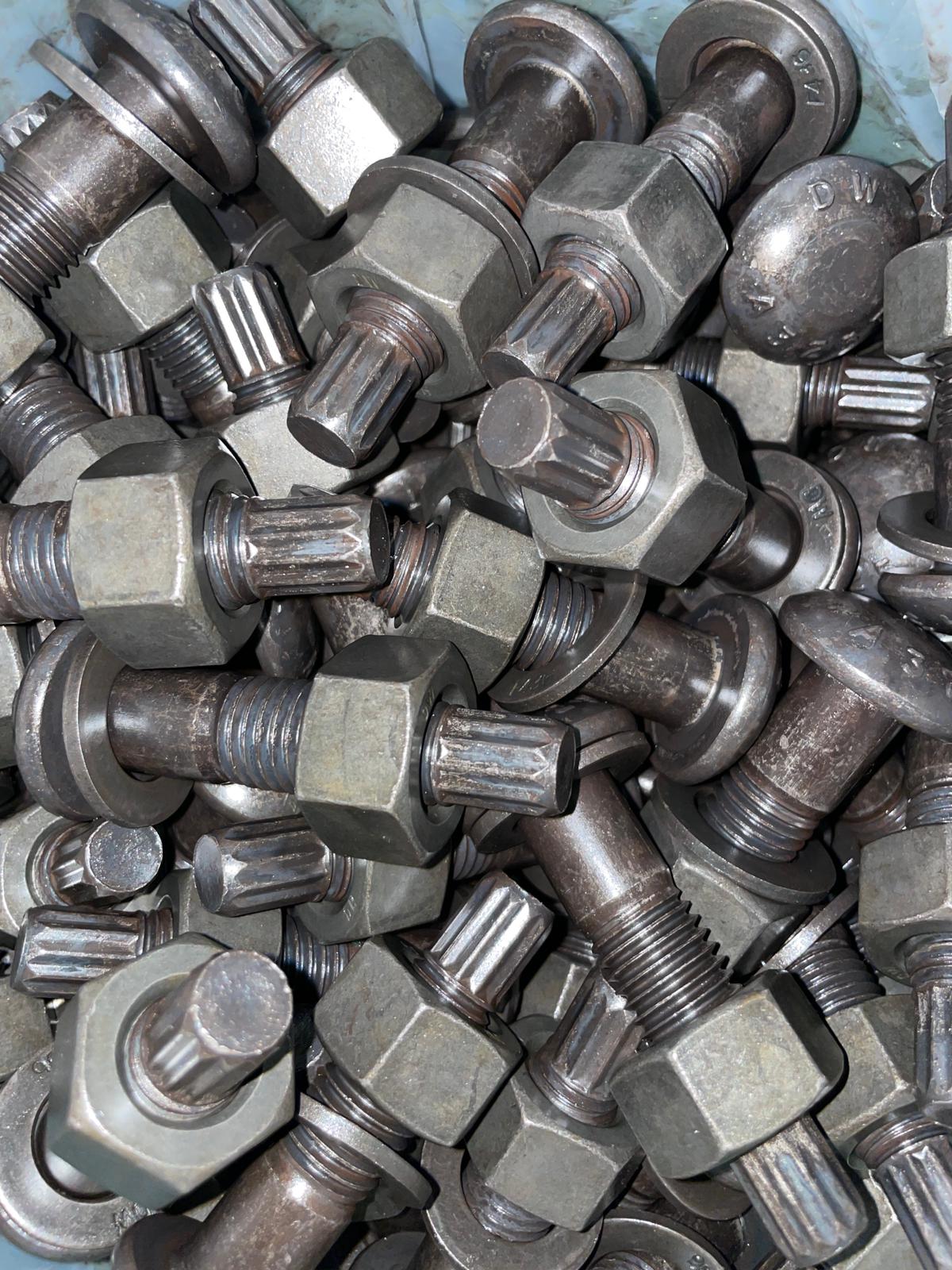
A490 bolts are characterized by their heavy hex head geometry. This larger head provides a greater bearing surface, which distributes the clamping force more effectively across the structural steel members. This is vital in preventing the bolt head from "crushing" the material or pulling through under extreme tension.
Another critical design feature is the thread length. Structural bolts like the A490 have shorter thread lengths compared to standard hex bolts. This is an intentional engineering choice to ensure that the threads do not reside within the "shear plane": the point where two steel plates meet. By keeping the unthreaded shank in the shear plane, the connection utilizes the full cross-sectional area of the bolt, maximizing its shear strength.
When ordering fasteners for high-stakes projects, ensuring that you have the correct bolt length to keep threads out of the shear plane is a non-negotiable step in the procurement process. For detailed technical assistance on bolt sizing, you can view our services page.
Pairing and Hardware Requirements
A high-strength bolt is only as effective as the hardware it is paired with. To achieve the intended clamping force and maintain the integrity of the joint, A490 bolts must be used with specific nuts and washers.
- Nuts: A490 bolts require ASTM A563 Grade DH or DH3 heavy hex nuts. These nuts are heat-treated to match the strength of the bolt. Using a lower-grade nut with an A490 bolt can lead to thread stripping or failure to reach the required pre-tension.
- Washers: Hardened circular washers (ASTM F436) are typically required under the element being turned (either the nut or the bolt head) to provide a consistent surface for tensioning and to prevent galling of the base metal.
In many modern applications, A490 bolts are supplied as Tension Control (TC) bolts. These feature a splined end that shears off when the correct tension is reached, providing a visual indicator of a proper installation. For more information on this installation method, we recommend reading our technical article on whether TC bolts need pre-tensioning.

Safety Considerations: Managing Hydrogen Embrittlement
One of the most critical technical aspects of A490 bolts is their sensitivity to hydrogen embrittlement. Because of their high hardness (Rockwell C 33-38), these bolts are susceptible to a phenomenon where hydrogen atoms enter the steel lattice, causing the bolt to become brittle and fail unexpectedly under load.
Because of this risk, ASTM F3125 Grade A490 bolts cannot be hot-dip galvanized. The pickling process used in hot-dip galvanizing introduces hydrogen into the steel, and the high temperatures of the zinc bath can exacerbate the risk. If corrosion protection is required for an A490 fastener, the industry standard is to use a mechanical galvanizing process or specialized zinc-aluminum flake coatings that do not involve acid pickling or high-heat immersion.
We take these safety standards seriously. Every fastener we supply is backed by rigorous quality control to ensure compliance with industry certifications. We recognize the responsibility of providing materials for infrastructure, and we do not compromise on these safety-critical details.
A490 vs. A325: Choosing the Right Fastener
Choosing between A490 and A325 bolts is a matter of balancing strength requirements with cost and safety constraints.
- Choose A325 when: The structural loads are moderate, and hot-dip galvanizing is required for corrosion protection. A325 bolts are the standard for most commercial steel framing.
- Choose A490 when: Maximum strength is required to reduce the number of fasteners in a joint, or when working with high-strength structural members in bridges or skyscrapers.
It is important to note that A490 bolts should never be used as a substitute for anchor bolts in foundations. For foundation applications, specifications such as ASTM F1554 (Grades 36, 55, or 105) are the appropriate standard. We invite you to explore our guide to F1554 anchor bolts for a better understanding of foundation-specific fastening.
Installation Best Practices
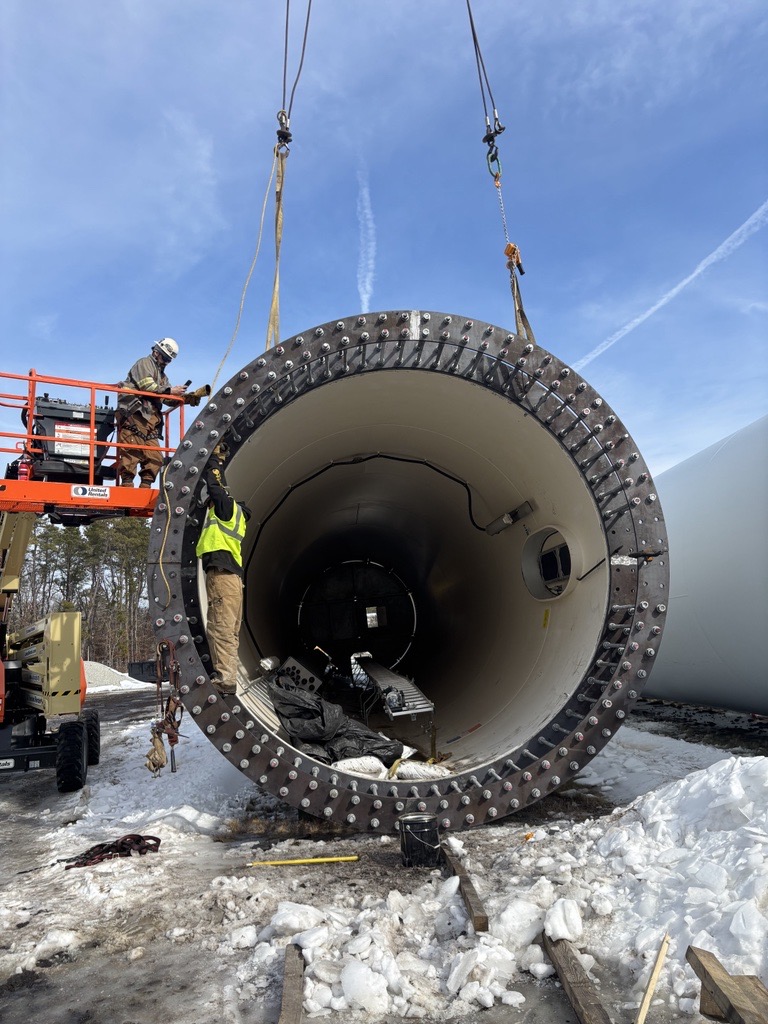
The performance of an A490 bolt is entirely dependent on proper installation. Structural joints are typically classified as either "snug-tight," "pretensioned," or "slip-critical."
- Snug-Tight: The condition that exists when all plies in a joint are in firm contact.
- Pretensioned/Slip-Critical: These require the bolt to be tightened to a specific minimum tension. This is usually achieved via the turn-of-nut method, calibrated wrench method, or through the use of TC bolts.
Because of the high-strength nature of A490 alloy steel, improper tensioning can lead to fatigue or joint slippage. We advocate for the use of calibrated tools and onsite testing to verify that every connection meets the RCSC (Research Council on Structural Connections) specifications.
Why Partner with LRKD Industries for Structural Fastening
At LRKD Industries, we position ourselves as more than a vendor; we are a dedicated partner in your project's success. We understand the pressures of the modern job site: the need for precision, the necessity of timely deliveries, and the absolute requirement for material traceability.
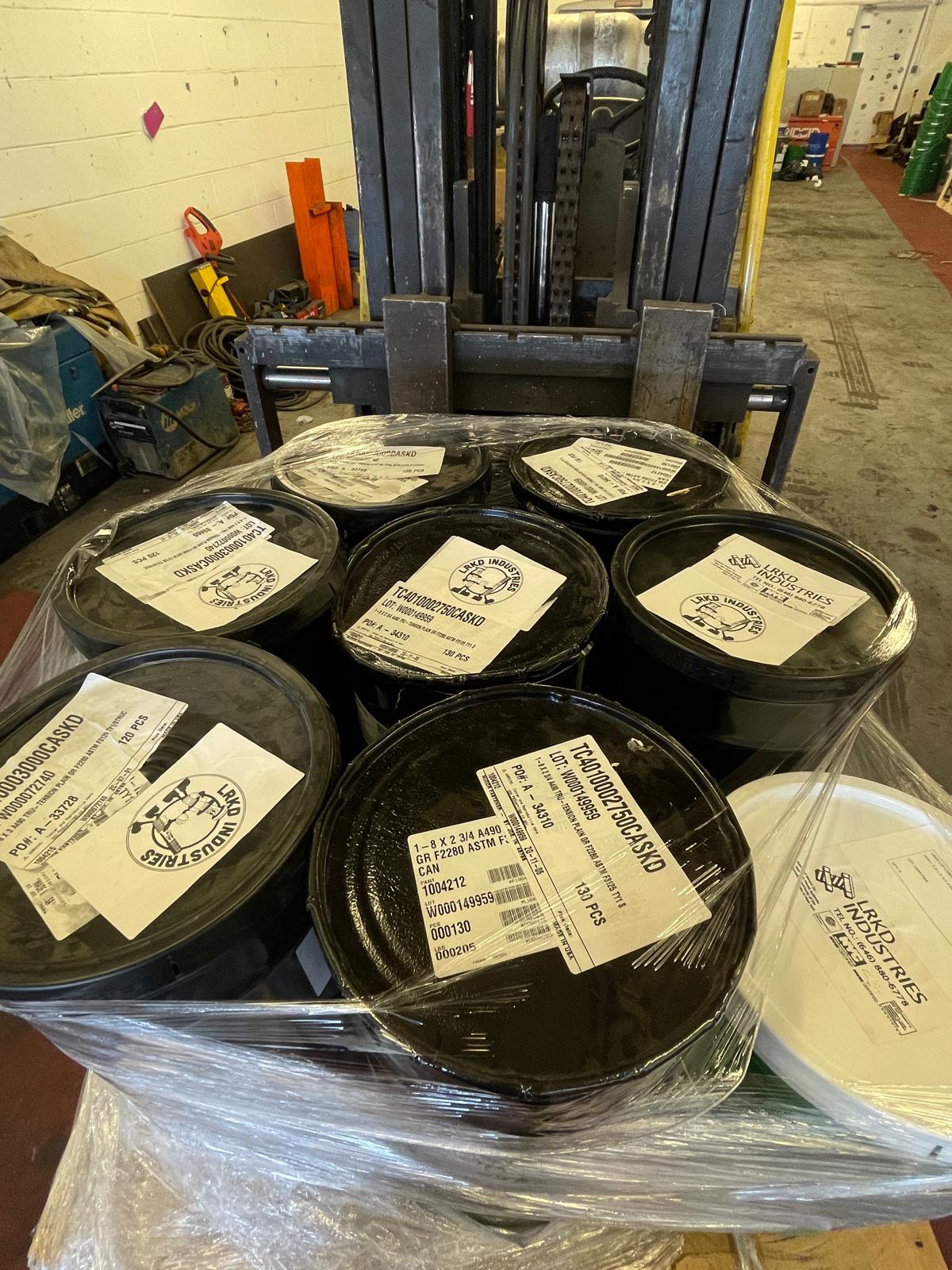
Our commitment to the industry is reflected in our capability statement, which highlights our role in supporting large-scale infrastructure, marine, and industrial projects. We maintain a robust inventory of A490 and A325 fasteners, ensuring that when your project reaches the critical assembly phase, you have the hardware you need without delay.
We recognize that every structural connection is a testament to the engineering and labor that went into it. By providing high-strength A490 bolts that meet the most stringent ASTM F3125 standards, we help ensure that those connections remain secure for decades to come.
If you are currently planning a high-strength structural project and require a reliable supply of A490 fasteners, we invite you to request a quote or contact our team for technical support. We are ready to provide the streamlined, professional service your project demands.
Author: MEDIA_LRKD