

When engineering complex steel structures such as bridges, high-rise buildings, and industrial facilities, the integrity of every structural connection remains paramount. Engineers and contractors specify a490 bolts when maximum tensile strength and load capacity are non-negotiable. These alloy steel fasteners deliver exceptional performance in heavy structural applications, but their structural efficiency relies entirely on correct installation procedures. Under the standards established by the Research Council on Structural Connections (RCSC) and adopted by the American Institute of Steel Construction (AISC), proper pretensioning is not merely a recommendation: it is a strict engineering requirement for slip-critical and pretensioned joints.
We recognize that achieving precise installation parameters on the job site demands rigorous adherence to approved methodologies. Improperly tensioned fasteners compromise the load path and structural safety of the entire assembly. In this technical guide, we examine the approved pretensioning methods for structural steel connections utilizing a490 bolts, explore pre-installation verification protocols, and outline best practices for successful field execution.
The Two-Stage Installation Foundation: Snug-Tight and Beyond
Every approved installation protocol for high-strength structural fasteners begins with a two-stage process. Skipping the initial phase or attempting to apply final tension without adequate preparation violates RCSC specifications.
The snug-tight condition forms the mandatory baseline for all structural bolted joints.
The snug-tightened condition is defined as the tightness attained by either a few impacts of an impact wrench or the full effort of an ironworker using an ordinary spud wrench to bring the connected plies into firm contact. Faying surfaces must be free of oil, dirt, and loose scale to ensure proper friction transfer.
We emphasize that tightening a490 bolts by torque alone: without calibrated job-site verification: is strictly prohibited for pretensioned or slip-critical connections. Torque coefficients vary widely based on lubrication, thread condition, and environmental factors. Therefore, field personnel must rely on verified mechanical or rotational displacement methods to guarantee that the required minimum bolt tension is fully achieved.

Approved Pretensioning Methods for A490 Fasteners
The RCSC specification outlines four approved methods to pretension high-strength structural bolts. Selecting the appropriate method depends on project specifications, accessibility, and quality control requirements.
The Turn-of-Nut Method
The turn-of-nut method relies on a specific rotational displacement beyond the snug-tight condition to elongate the bolt to its required tension.
- Step 1: Bring all fasteners in the connection to a snug-tight condition, progressing systematically from the stiffest part of the joint outward.
- Step 2: Apply match-marks across the protruding bolt thread, nut, and structural steel face to provide a clear visual reference for rotation.
- Step 3: Rotate the nut relative to the bolt by the specified fraction of a turn (ranging from one-third to one full turn, depending on bolt length and diameter) as mandated by RCSC tables.
Turn-of-nut installation is highly reliable because steel elongation correlates directly with rotation, bypassing variable friction coefficients associated with direct torque measurements.
The Calibrated Wrench Method
The calibrated wrench method utilizes a powered torque wrench: pneumatic, electric, or hydraulic: set to a predetermined torque value.
- The wrench must be calibrated daily using a job-site tension calibrator (such as a Skidmore-Wilhelm device) with sample bolts representing the specific lot, diameter, and length.
- The calibration torque must reliably produce a bolt tension that exceeds the RCSC minimum requirement by at least five percent.
- Periodic verification during production ensures that wrench output remains stable throughout the workday.
Direct Tension Indicators (DTIs)
Direct tension indicators are specialized hardened washers featuring engineered protrusions or "bumps" on their face.
- As the fastener is tightened, these protrusions compress progressively under the bolt head or nut.
- Installers use a calibrated feeler gauge to measure the remaining gap at designated intervals around the DTI perimeter.
- When the gap is reduced to the manufacturer-specified tolerance, the required minimum pretension is confirmed. DTIs offer an independent, visual quality control mechanism that simplifies field inspection.
Tension Control (TC) Bolt Assemblies (F2280)
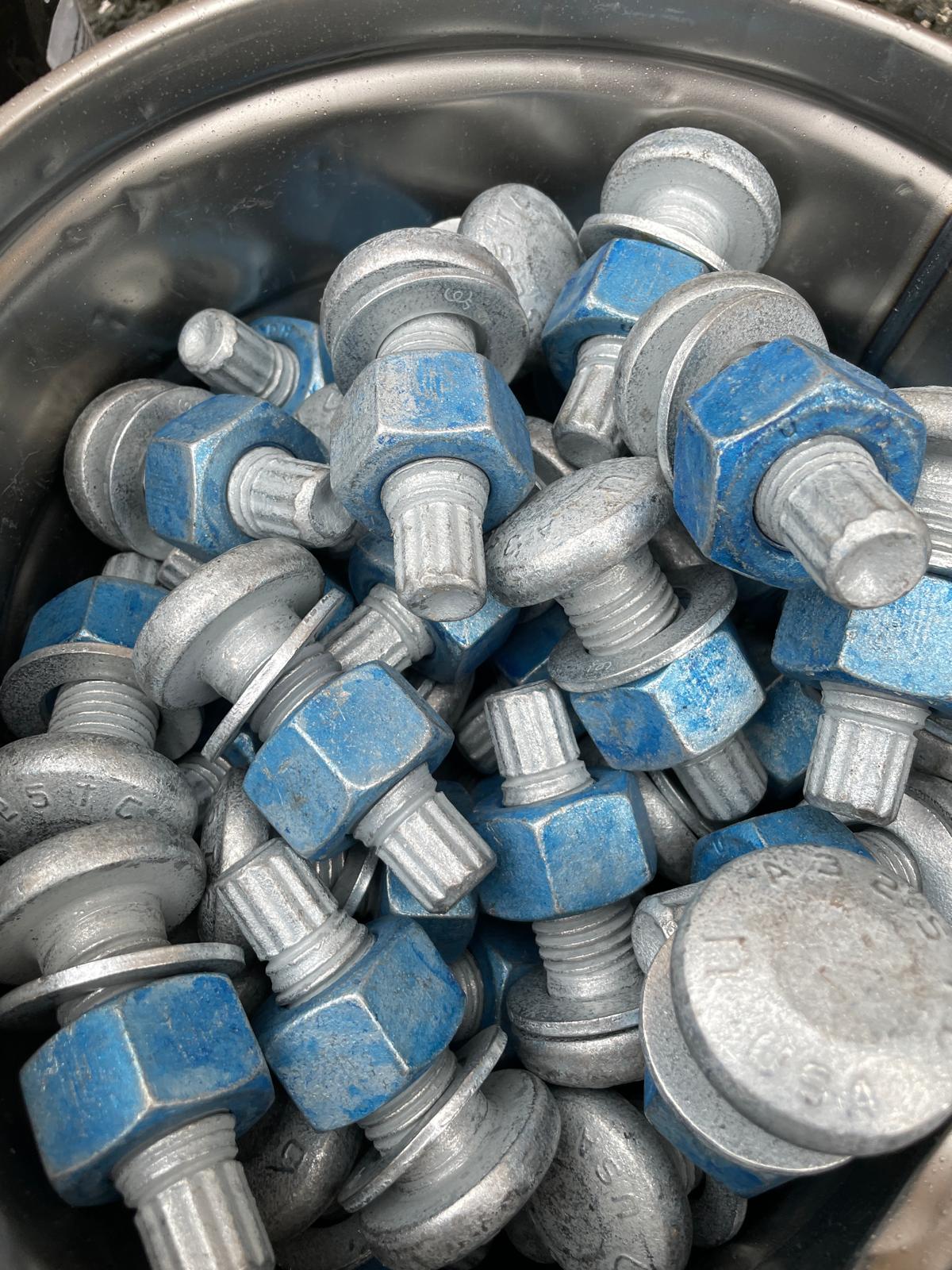
Tension control fastener assemblies (governed by ASTM specifications such as F2280 for high-strength alloy steel) feature a specialized splined tail extending past the threaded portion of the nut.
- Specialized shear wrenches grip both the nut and the splined tail simultaneously, counter-rotating during tightening.
- Once the calibrated torsional resistance is reached inside the assembly, the splined tail shears off cleanly at a designated groove.
- Inspection is primarily visual: the presence of sheared splines confirms that the fastener has reached the proper pretension level.
Pre-Installation Verification and Skidmore-Wilhelm Testing
Before any production installation of a490 bolts begins on site, the RCSC specification mandates comprehensive pre-installation verification testing. This testing must take place on site using a calibrated bolt tension measuring device: most commonly a Skidmore-Wilhelm hydraulic calibrator.
Testing must mirror actual job-site conditions for each fastener lot, diameter, and length combination.
- Representatives of each fastener lot are assembled in the device with the exact grade of washers, nuts, and lubrication planned for production.
- The selected installation method is executed to verify that it successfully develops a pretension equal to or greater than the mandatory minimum specified by AISC/RCSC (for example, achieving at least 64 kips of tension for a 1-inch diameter A490 bolt).
- If rotational methods or calibrated wrenches are used, verification ensures that the procedure does not strip threads or cause premature torsional shear failure.
This mandatory verification safeguards against lot-to-lot variations in coating, thread pitch, and lubrication performance, establishing a reliable baseline for ironworkers and inspectors alike.
Washer Requirements and Slip-Critical Design Mandates
Fastener geometry and washer deployment are critical components of proper installation. Because a490 bolts possess higher hardness levels than standard carbon steel fasteners, specific washer rules apply.
- Hardened washers are required under both the turned element (nut or bolt head) for all A490 installations to prevent galling and surface embedment into the structural steel.
- In slip-critical connections, the design relies on the frictional resistance of faying surfaces clamped together under high normal force. Therefore, full pretensioning is mandatory; bearing-type design assumptions are insufficient for joints designated as slip-critical on engineering drawings.
We recognize that precision in detailing and hardware specification eliminates costly on-site delays. Ensuring that washers, nuts, and bolts are matched correctly within a certified assembly protects structural integrity from fabrication through final erection.
Partnering with LRKD Industries for Certified Fastener Supply
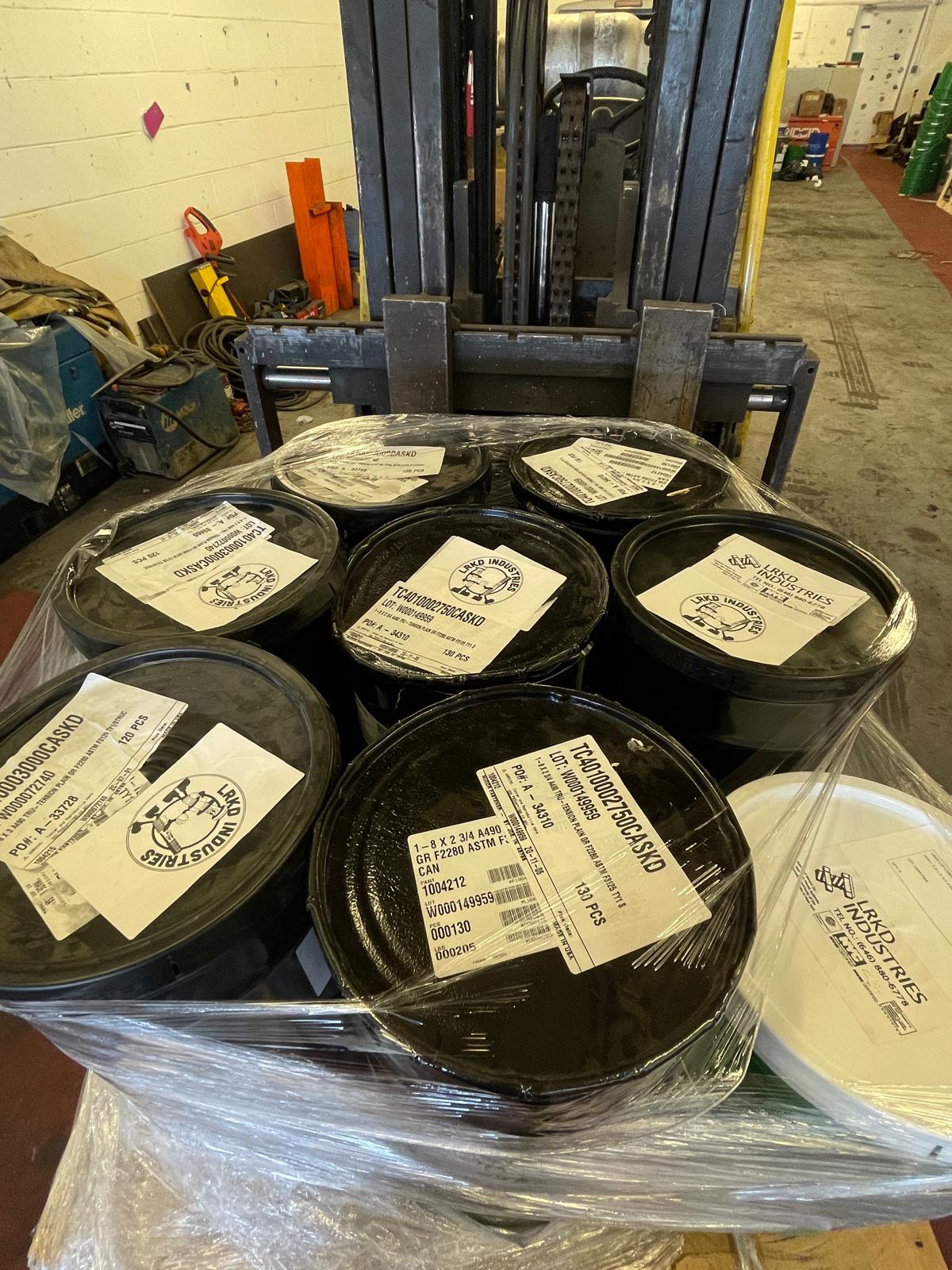
Sourcing reliable, fully certified structural fasteners is the foundation of every successful construction project. At LRKD Industries, we specialize in supplying high-quality steel fasteners and comprehensive construction solutions engineered to meet rigorous industry standards. As a proud Woman-Minority Business Enterprise (WMBE), we combine deep industry expertise with prompt customer support and meticulous quality control.
Whether your project requires certified a490 bolts, tension control assemblies, wedge anchors, or structural steel supply for commercial and industrial facilities, we deliver dependability and accuracy you can trust. Our professional in-house detailing and engineering services utilize advanced drafting to build virtual projects before fabrication, minimizing errors and streamlining your construction timeline.
Contact our team today to discuss your fastener requirements and discover how our tailored steel supply solutions empower your next structural project.
Author: MEDIA_LRKD