

When you manage demanding structural steel connections, precision, reliability, and installation efficiency dictate project success. Contractors and engineers working on commercial, industrial, and infrastructure builds face constant pressure to ensure joint integrity while maintaining aggressive construction schedules. We recognize these operational realities, which is why we provide high-grade structural fasteners engineered to exceed rigorous industry standards.
Understanding the mechanics and specifications behind modern high-strength fasteners is essential for structural longevity. Among these, a325 tension control bolts stand out as a foundational solution for modern steel construction. In this guide, we examine what these fasteners are, how their unique engineering works, and why they remain an indispensable resource for professional builders.
The Evolution and Role of Structural Bolts in Modern Construction
Structural steel framing relies entirely on the integrity of its joints. For decades, engineers have utilized heavy hex structural fasteners to transfer load and maintain rigid structural frames. Historically, traditional specifications like a325 bolts and a490 bolts served as the industry benchmark for heavy hex configurations.
To streamline engineering specifications, the American Society for Testing and Materials established ASTM F3125, incorporating former standalone standards into a single comprehensive specification. Within this framework, structural bolts are categorized by precise tensile strength and material properties:
- ASTM F3125 Grade A325: Manufactured from medium carbon or carbon-boron steel, delivering a minimum tensile strength of 120 ksi for diameters up to one inch.
- ASTM F3125 Grade A490: Fabricated from heat-treated alloy steel for applications demanding higher clamp loads, yielding a tensile strength range between 150 and 173 ksi.
While traditional heavy hex bolts perform exceptionally well, verifying proper pre-tensioning on the jobsite historically required calibrated torque wrenches and rigorous inspection protocols. That operational challenge drove the development of specialized twist-off fastener assemblies.
How Tension Control Bolts Work
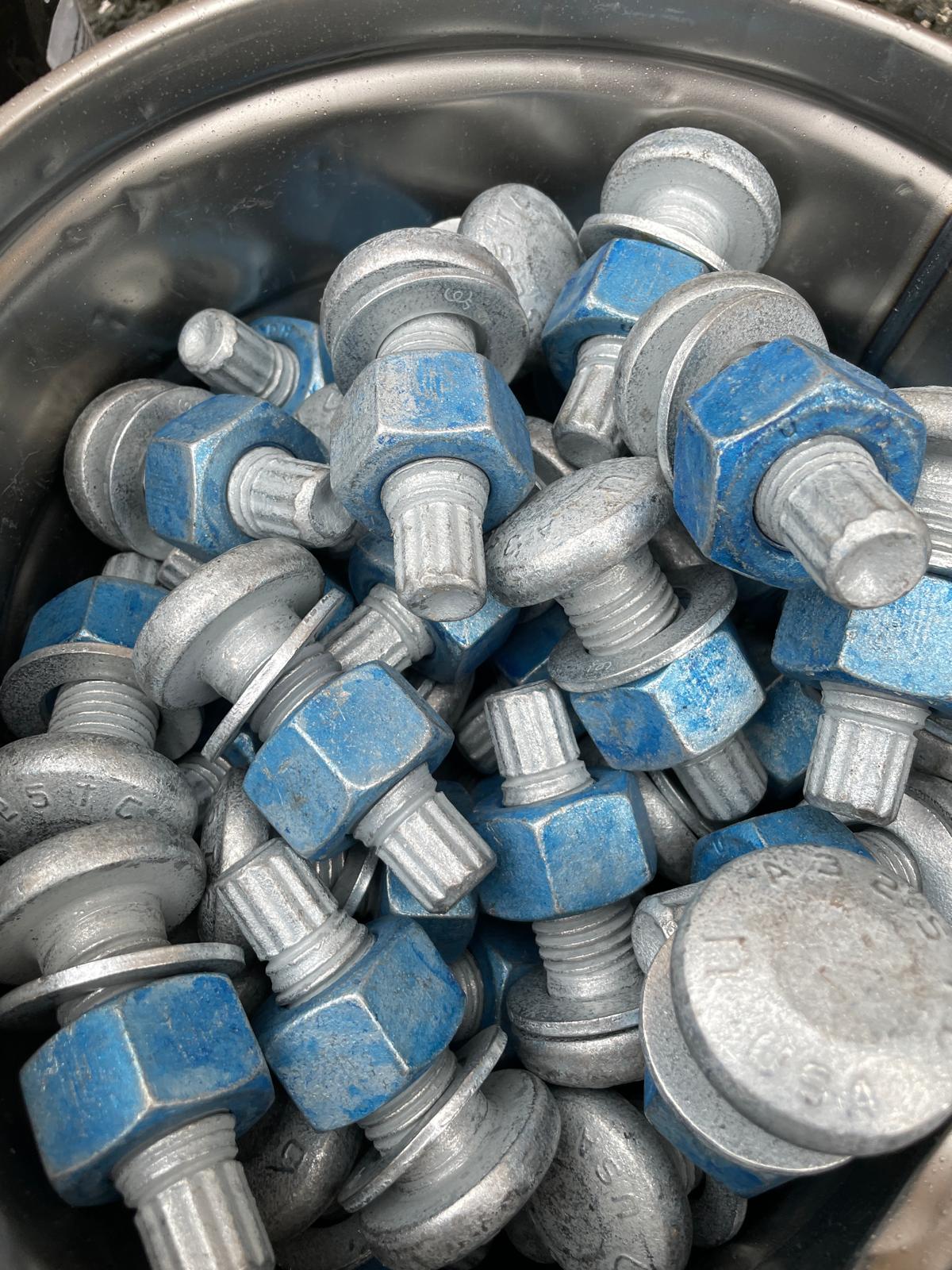
Tc bolts: formally classified under ASTM F3125 as Grade F1852 for A325 equivalents and Grade F2280 for A490 equivalents: redefine structural bolting efficiency. These assemblies consist of a matched bolt, heavy hex nut, and structural washer designed to function as a complete, pre-calibrated system.
The defining characteristic of a tension control bolt is its engineered splined end (or tail) extending past the threaded portion. Installation does not rely on measuring torque with a manual wrench. Instead, operators use a specialized electric or pneumatic shear wrench equipped with dual concentric sockets:
- The outer socket engages the heavy hex nut and rotates it clockwise.
- The inner socket simultaneously grips the splined tail, holding the bolt body stationary.
- As the nut tightens against the structural washer and joint, tension increases steadily.
- Once the precise pre-determined tension is achieved, the splined tail shears off cleanly at the designated groove.
This mechanical twist-off action provides an immediate, foolproof visual confirmation that the correct tension has been introduced into the connection. Inspectors can verify joint completion simply by glancing at the installed fastener array, eliminating guesswork and reducing inspection bottlenecks.
Advantages Over Traditional Structural Fasteners
Professional construction teams value systems that minimize human error while accelerating on-site productivity. A325 tension control bolts deliver distinct engineering and operational advantages over standard heavy hex alternatives:
- Consistent Preload: The mechanical shearing mechanism guarantees that every fastener achieves the specified minimum bolt tension independently of operator variability or calibration drift.
- One-Sided Installation: The shear wrench design allows a single ironworker to install the fastener entirely from one side of the connection, removing the need for a second worker to hold a backup wrench.
- Reduced Vibration Loosening: The controlled clamping force resists dynamic fatigue and cyclic loading in high-traffic or industrial environments.
- Streamlined Inspection: Visual verification of sheared splines allows quality control inspectors to approve connections rapidly without destructive testing or torque wrench re-verification.
We maintain a comprehensive inventory of structural fastening solutions, ensuring that your projects receive certified, traceable components ready for immediate deployment.
Typical Applications Across Critical Infrastructure
The reliability and installation speed of a325 tension control bolts make them the preferred specification across a diverse spectrum of structural engineering projects.
Bridge Construction and Highway Infrastructure
Transportation structures experience relentless dynamic loads from heavy vehicular traffic and thermal expansion. State departments of transportation frequently specify tc bolts for plate girder splices, cross-frame connections, and truss assemblies because they maintain enduring clamp force under cyclic vibration. Furthermore, hot-dip galvanized and coated variants resist atmospheric corrosion in demanding marine or coastal environments.
High-Rise Commercial Buildings
Skyscrapers and high-rise commercial structures require immense structural rigidity. Primary moment connections, column splices, and braced frame nodes utilize high-strength fasteners to withstand wind shear and seismic forces. The speed of TC bolt installation enables steel erectors to maintain rapid building cycles, keeping multi-story construction schedules on track.
Industrial Facilities and Energy Plants
Industrial complexes, manufacturing plants, and heavy equipment support structures demand robust fastening systems. Whether securing overhead crane runways, pipe racks, or structural skids, engineers rely on dependable structural connections to safeguard heavy industrial operations.

Partnering with LRKD Industries for Your Structural Supply Needs
Selecting the correct fastener is only the first step in successful project execution. Sourcing reliable materials from a trusted partner ensures supply chain continuity, material traceability, and adherence to strict engineering specifications.
As a certified Women-Minority Business Enterprise (WMBE), we combine deep-rooted industry expertise with a steadfast commitment to customer service. We provide comprehensive steel supply solutions: ranging from structural bolts and heavy hex nuts to wedge anchors and custom anchor bolts: tailored to the exacting demands of contractors and engineers in the New York metropolitan area and nationwide.
Our in-house detailing and engineering services utilize advanced digital drafting to model virtual projects prior to fabrication, minimizing on-site errors and streamlining installation. When you collaborate with our team, you gain a dedicated partner invested in the structural integrity, safety, and efficiency of your enterprise.
Mastering Fastener Selection for Long-Term Success
Mastering structural fastener selection begins with understanding the specific mechanical demands of your project environment. Whether your blueprints call for traditional heavy hex a325 bolts, high-capacity a490 bolts, or streamlined a325 tension control bolts, matching the right hardware to your structural joints guarantees safety, compliance, and lasting performance.
We recognize the complexities of modern construction, which is why we provide prompt service, uncompromising material quality, and expert technical support. Contact our team today to discuss your upcoming structural steel requirements and discover how our tailored supply solutions drive success from foundation to finish.
Author: MEDIA_LRKD